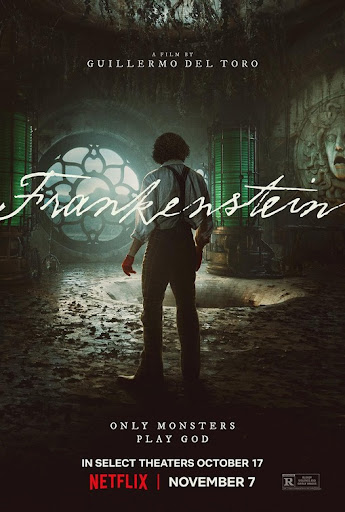

Today marks the 208th anniversary of Mary Shelley’s seminal Gothic novel, Frankenstein; or, The Modern Prometheus. For over two centuries, Frankenstein has captivated audiences, whether through the original novel or its many film adaptations. Recently, horror director Guillermo del Toro released the latest adaptation of Shelley’s work, reanimating public interest in this classic piece of gothic literature. What then is Poe’s connection to Frankenstein, and how has he influenced recent film adaptations of her work?
Mary Shelley’s Frankenstein; or, The Modern Prometheus was published in 1818 when Edgar Allan Poe was nine years old. The novel explores what it means to be ‘Man.’ The complexity of Shelley’s writing is demonstrated through her characters. Victor and his creation exist in a moral grey area—neither wholly good nor wholly evil. Victor’s obsession with creating life is spurred on both by through Enlightenment ideals of scientific progress and by his isolation, yet his hubris leads him to neglect his creation, denying it all humanity. The creature, forced into an isolated life he never chose, struggles for acceptance by Man, and humanity’s rejection of him drives his descent into monstrosity. For both Victor and his creation, the question is asked “What is a man without his humanity?”
While Poe never commented on the novel, we know it was likely an early gothic influence for the writer. Poe may have first encountered the novel while he was studying abroad in the UK as a young child. One of those who knew Poe later in life recalled “he read such books as…Mary Wollstonecraft’s Frankenstein… some of which works no doubt affected his mental constitution.”1 Scholars like Burton Pollin suggest Poe may have even taken inspiration from another of Shelley’s works, The Last Man, for his work “The Masque of the Red Death.”2 While Poe wrote directly about Shelley’ literature, he certainly admired that of her husband’s, Percy Bysshe Shelley. Poe praised Shelley’s poetry in reviews at the Southern Literary Messenger and referred to Percy Shelley, John Keats, and Samuel Taylor Coleridge as the “sole poets.”3
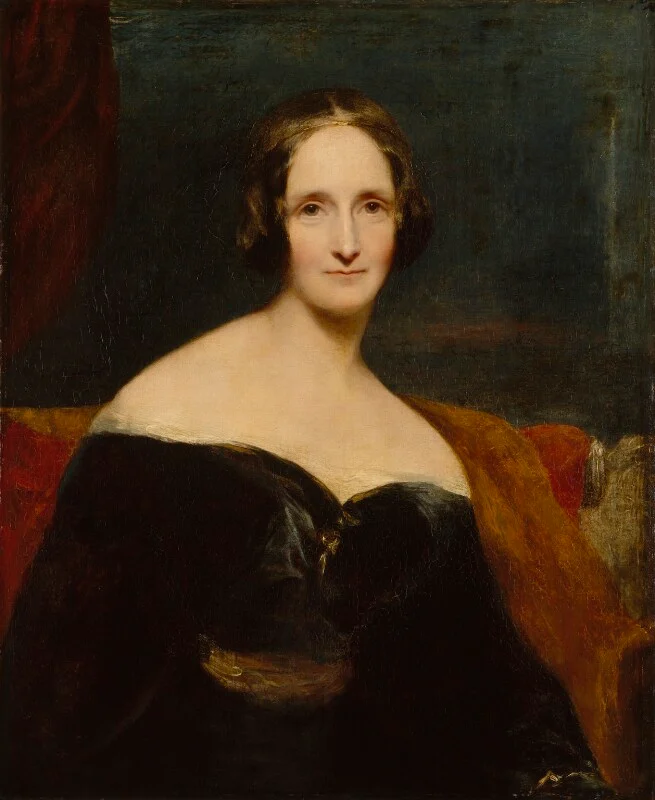
In their personal lives, both Poe and Mary Shelley had much in common. They both faced devastating losses of loved ones. As he entered adulthood, Poe endured the loss of his mother, brother, best friend’s mother, and his foster mother. Later, at the age of 38, Poe suffered the loss of his wife Virginia. Likewise, Shelley was similarly well acquainted with grief throughout her life. In the span of seven years, Shelley lost the lives of three of her children, her half-sister, and her husband Percy.
Both Poe and Shelley also began their literary careers early. Poe was 18 years old when he published his first collection of poetry, Tamerlane. Shelley was the same age when she began writing her debut novel, Frankenstein. In fact, the idea for Frankenstein was created on a summer night with Poe’s literary idol, Lord Byron. During summer of 1816, or “the summer of darkness” as it is commonly known, volcanic ash from an eruption in Indonesia caused the sky over western Europe to become clouded and cold. During this time, Shelley (at this time she was Mary Godwin), Percy Shelley, Byron, and John Polidori (author of “The Vampyre”), traveled to Byron’s Villa Diodati in Lake Geneva, Switzerland, whose frigid landscape provided much of the inspirations for the novel’s gloomy settings. One stormy night at this Villa, Byron proposed that his guests write a ghost story, and Frankenstein was born.
Both Poe and Shelley drew inspiration from the scientific advancements of their era. Both may have been inspired by one of the earliest electrical experiments conducted by Luigi Galvani in 1780. Poe may have drawn inspiration from Galvani’s work and Shelley’s novel with his own tales of reanimation. In “Some Words with a Mummy,” an ancient Egyptian mummy is reanimated by a group of 19th century doctors. When awoken, the mummy proceeds to criticize the modern world’s technological and scientific shortcomings. Similarly, in “The Man That Was Used Up,” the body of a General ABC Smith is dismembered and is reconstructed daily by his enslaved servant. In “The Facts in the Case of M. Valdemar” and “The Tale of the Ragged Mountains,” Poe explores themes similar to those Shelley’ novel including Man’s pursuit of forbidden knowledge and the consequential descent into madness.
Today, many people are introduced to Frankenstein through film adaptations, Halloween costumes, and the popular misnomer of Frankenstein’s monster. This past fall Netflix released, Guillermo del Toro’s adaption of Frankenstein, introducing a new generation to Shelley’s work. Del Toro, director of films such as Hellboy (2004), Pan’s Labyrinth (2006), and Crimson Peak (2015), has consistently reinterpreted the Gothic for the modern age. While his latest work is not a faithful adaptation of Shelley’s masterpiece, it still embodies the overarching themes of her work. Del Toro has praised Shelley’s nuanced approach to her characters, explaining that Shelley “goes deeper than many authors by refusing to impose a pattern of good and evil only as a discourse…but by actually weaving it into the plot.” This he contrasts to Poe’s work, “William Wilson,” which he states keeps its moral tones on the surface.4 In addition to his admiration for Shelley, Del Toro has long celebrated Poe, acknowledging him as a cinematic influence and contributing to the Poe statue in Boston Common.5
During this cold January, we at the Poe Museum encourage you to read one of the foundational works that not only influenced Poe’s literature but has shaped a whole literary and cinematic gothic genre for over 200 years.