Categories
The Poe Museum Blog

Lionizing

Lion-izing. A Tale.

“—————— all people went
Upon their ten toes in wild wonderment.”

Bishop Hall’s Satires

I am — that is to say, I was, a great man. But I am neither the author of Junius, nor the man in the mask — for my name is Thomas Smith, and I was born somewhere in the city of Fum-Fudge. The first action of my life was the taking hold of my nose with both hands. My mother saw this and called me a genius. My father wept for joy, and bought me a treatise on Nosology. Before I was breached I had not only mastered the treatise, but had collected into a common-place book all that is said on the subject, by Pliny, Aristotle, Alexander Ross, Minutius Felix, Hermanus Pictorius, Del Rio, Villarêt, Bartholinus, and Sir Thomas Browne.

I now began to feel my way in the science, and soon came to understand, that, provided a man had a nose sufficiently big, he might, by merely following it, arrive at a Lionship. But my attention was not confined to theories alone. Every morning I took a dram or two, and gave my proboscis a couple of pulls. When I came of age my father sent for me to his study.

‘My son’ — said he — ‘what is the chief end of your existence?’

‘Father’ — I said — ‘it is the study of Nosology.’

‘And what, Thomas’ — he continued — ‘is Nosology?’

‘Sir’ — I replied — ‘it is the Science of Noses.’

‘And can you tell me’ — he asked — ‘what is the meaning of a nose?’

‘A nose, my father’ — said I — ‘has been variously defined, by about a thousand different authors. It is now noon, or thereabouts. We shall therefore have time enough to get through with them all by midnight. To commence: — The nose, according to Bartholinus, is that protuberance, that bump, that excrescence, that ———’

‘That will do, Thomas’ — said my father. ‘I am positively thunderstruck at the extent of your information — I am, upon my soul. Come here! (and he took me by the arm.) Your education may be considered as finished, and it is high time you should scuffle for yourself — so — so — so (here he kicked me down stairs and out of the door,) so get out of my house, and God bless you!’

As I felt within me the divine afflatus, I considered this accident rather fortunate than otherwise, and determined to follow my nose. So I gave it a pull or two, and wrote a pamphlet on Nosology. All Fum-Fudge was in an uproar.

‘Wonderful genius!’ — said the Quarterly.

‘Superb physiologist!’ — said the New Monthly.

‘Fine writer!’ — said the Edinburgh.

‘Great man!’ — said Blackwood.

‘Who can he be?’ — said Mrs. Bas-Bleu.

‘What can he be?’ — said big Miss Bas-Bleu.

‘Where can he be?’ — said little Miss Bas-Bleu.

But I paid them no manner of attention, and walked into the shop of an artist.

The Duchess of Bless-my-soul was sitting for her portrait. The Marchioness of So-and-so was holding the Duchess’s poodle. The Earl of This-and-that was flirting with her salts, and His Royal Highness of Touch-me-not was standing behind her chair. I merely walked towards the artist, and held up my proboscis.

‘O beautiful!’ — sighed the Duchess of Bless-my-soul.

‘O pretty!’ — lisped the Marchioness of So-and-so.

‘Horrible!’ — groaned the Earl of This-and-that.

‘Abominable!’ — growled his Highness of Touch-me-not.

‘What will you take for it?’ — said the artist.

‘A thousand pounds’ — said I, sitting down.

‘A thousand pounds?’ — he inquired, turning the nose to the light.

‘Precisely’ — said I.

‘Beautiful!’ — said he, looking at the nose.

‘A thousand pounds’ — said I, twisting it to one side.

‘Admirable!’ — said he.

‘A thousand pounds’ — said I.

‘You shall have them’ — said he — ‘what a piece of Virtû!’ So he paid me the money, and made a sketch of my nose. I took rooms in Jermyn street, sent his Majesty the ninety-ninth edition of the Nosology with a portrait of the author, and his Royal Highness of Touch-me-not invited me to dinner.

We were all Lions and Recherchés.

There was a Grand Turk from Stamboul. He said that the angels were horses, cocks, and bulls — that somebody in the sixth heaven had seventy thousand heads and seventy thousand tongues — and that the earth was held up by a sky-blue cow with four hundred horns.

There was Sir Positive Paradox. He said that all fools were philosophers, and all philosophers were fools.

There was a writer on Ethics. He talked of Fire, Unity, and Atoms — Bi-part, and Pre-existent soul — Affinity and Discord — Primitive Intelligence and Homoomeria.

There was Theologos Theology. He talked of Eusebius and Arianus — Heresy and the Council of Nice — Consubstantialism, Homousios, and Homouioisios.

There was Fricassée from the Rocher de Cancale. He mentioned Latour, Markbrunnen and Mareschino — Muriton of red tongue, and Cauliflowers with Velouté sauce — veal à la St. Menehoult, Marinade à la St. Florentin, and orange jellies en mosaiques.

There was Signor Tintontintino from Florence. He spoke of Cimabue, Arpino, Carpaccio, and Argostino — the gloom of Caravaggio — the amenity of Albano — the golden glories of Titian — the frows of Rubens, and the waggeries of Jan Steen.

There was the great Geologist Feltzpar. He talked of Hornblende Mica-slate, Quartz, Schist, Schorl, and Pudding-stone.

There was the President of the Fum-Fudge University. He said that the moon was called Bendis in Thrace, Bubastis in Egypt, Dian in Rome, and Artemis in Greece.

There was Delphinus Polyglot. He told us what had become of the eighty-three lost tragedies of Æschylus — of the fifty-four orations of Isæus — of the three hundred and ninety-one speeches of Lysias — of the hundred and eighty treatises of Theophrastus — of the eighth book of the Conic Sections of Apollonius — of Pindar’s Hymns and Dithyrambics, and the five and forty Tragedies of Homer Junior.

There was a modern Platonist. He quoted Porphyry, Iamblichus, Plotinus, Proclus, Hierocles, Mamimus Tyrius, and Syrianus.

There was a human-perfectibility man. He quoted Turgot, Price, Priestley, Condorcet, De Staël, and the “Ambitious Student in rather ill health.”

There was myself. I talked of Pictorius, Del Rio, Alexander Ross, Minutius Felix, Bartholinus, Sir Thos. Browne, and the Science of Noses.

‘Marvellous clever man!’ — said his Highness.

‘Superb!’ — said the guests: and the next morning her Grace of Bless-my-soul paid me a visit.

‘Will you go to Almacks, pretty creature?’ she said.

‘Certainly’ — said I. ‘Nose and all?’ — she asked.

‘Positively’ — I replied.

‘Here then is a card’ — she said — ‘shall I say you will be there?’

‘Dear Duchess! with all my heart.’

‘Pshaw! no — but with all your nose?’

‘Every bit of it, my life,’ — said I. So I gave it a pull or two, and found myself at Almacks. The rooms were crowded to suffocation.

‘He is coming!’ — said somebody on the stair case.

‘He is coming!’ — said somebody farther up.

‘He is coming!’ — said somebody farther still.

‘He is come’ — said the Duchess — ‘he is come, the little love!’ And she caught me by both hands, and looked me in the nose.

‘Ah joli!’ — said Mademoiselle Pas Seul.

‘Dios guarda!’ — said Don Stiletto.

‘Diavolo!’ — said Count Capricornuto.’

‘Tousand Teufel!’ — said Baron Bludenuff.

‘Tweedle-dee —— tweedle-dee —— tweedle-dum!’ said the orchestra.

‘Ah joli! — Dios guarda! — Diavolo! — and Tousand Teufel!’ repeated Mademoiselle Pas Seul, Don Stiletto, Count Capricornuto, and Baron Bludenuff. It was too bad — it was not to be borne. I grew angry.

‘Sir!’ — said I to the Baron — ‘you are a baboon.’

‘Sir!’ — replied he, after a pause, ——— ‘Donner and Blitzen!’

This was sufficient. The next morning I shot off his nose at six o’clock, and then called upon my friends.

‘Bête!’ — said the first.

‘Fool!’ — said the second.

‘Ninny!’ — said the third.

‘Dolt!’ — said the fourth.

‘Noodle!’ — said the fifth.

‘Ass!’ — said the sixth.

‘Be off!’ — said the seventh.

At all this I felt mortified, and called upon my father.

‘Father’ — I said — ‘what is the chief end of my existence!’

‘My son’ — he replied — ‘it is still the study of Nosology. But in hitting the Baron’s nose you have overshot your mark. You have a fine nose it is true, but then Bludenuff has none. You are d——d, and he has become the Lion of the day. In Fum-Fudge great is a Lion with a proboscis, but greater by far is a Lion with no proboscis at all.’


Edgar Allan Poe

Originally Published 1835

Categories
The Poe Museum Blog

The Light-House

The Light-House

Jan 1 — 1796. This day — my first on the light-house — I make this entry in my Diary, as agreed on with De Grät. As regularly as I can keep the journal, I will — but there is no telling what may happen to a man all alone as I am — I may get sick, or worse ….. So far well! The cutter had a narrow escape — but why dwell on that, since I am here, all safe? My spirits are beginning to revive already, at the mere thought of being — for once in my life at least — thoroughly alone; for, of course, Neptune, large as he is, is not to be taken into consideration as “society”. Would to Heaven I had ever found in “society” one half as much faith as in this poor dog: — in such case I and “society” might never have parted — even for the year … What most surprises me, is the difficulty De Grät had in getting me the appointment — and I a noble of the realm! It could not be that the Consistory had any doubt of my ability to manage the light. One man had attended it before now — and got on quite as well as the three that are usually put in. The duty is a mere nothing; and the printed instructions are as plain as possible. It never would have done to let Orndoff accompany me. I never should have made any way with my book as long as he was within reach of me, with his intolerable gossip — not to mention that everlasting mëerschaum. Besides, I wish to be alone …… It is strange that I never observed, until this moment, how dreary a sound that word has — “alone”! I could half fancy there was some peculiarity in the echo of these cylindrical walls — but oh, no! — this is all nonsense. I do believe I am going to get nervous about my insulation. That will never do. I have not forgotten De Grät’s prophecy. Now for a scramble to the lantern and a good look around to “see what I can see” ……………. To see what I can see indeed! — not very much. The swell is subsiding a little, I think — but the cutter will have a rough passage home, nevertheless. She will hardly get within sight of the Norland before noon to-morrow — and yet it can hardly be more than 190 or 200 miles.

Jan.2. I have passed this day in a species of ecstasy that I find it impossible to describe. My passion for solitude could scarcely have been more thoroughly gratified. I do not say satisfied; for I believe I should never be satiated with such delight as I have experienced to-day ……… The wind lulled about day-break, and by the afternoon the sea had gone down materially ….. Nothing to be seen, with the telescope even, but ocean and sky, with an occasional gull.

Jan. 3. A dead calm all day. Towards evening, the sea looked very much like glass. A few sea-weeds came in sight; but besides them absolutely nothing all day — not even the slightest speck of cloud. ……. Occupied myself in exploring the light-house …. It is a very lofty one — as I find to my cost when I have to ascend its interminable stairs — not quite 160 feet, I should say, from the low-water mark to the top of the lantern. From the bottom inside the shaft, however, the distance to the summit is 180 feet at least: — thus the floor is 20 feet below the surface of the sea, even at low-tide …… It seems to me that the hollow interior at the bottom should have been filled in with solid masonry. Undoubtedly the whole would have been thus rendered more safe: — but what am I thinking about? A structure such as this is safe enough under any circumstances. I should feel myself secure in it during the fiercest hurricane that ever raged — and yet I have heard seamen say occasionally, with a wind at South-West, the sea has been known to run higher here than any where with the single exception of the Western opening of the Straits of Magellan. No mere sea, though, could accomplish anything with this solid iron-riveted wall — which, at 50 feet from high-water mark, is four feet thick, if one inch …….. The basis on which the structure rests seems to me to be chalk ……

Jan 4.

[Manuscript ends here.]


Edgar Allan Poe

Thought to be written in 1849

Categories
The Poe Museum Blog

The Oval Portrait

The Oval Portrait

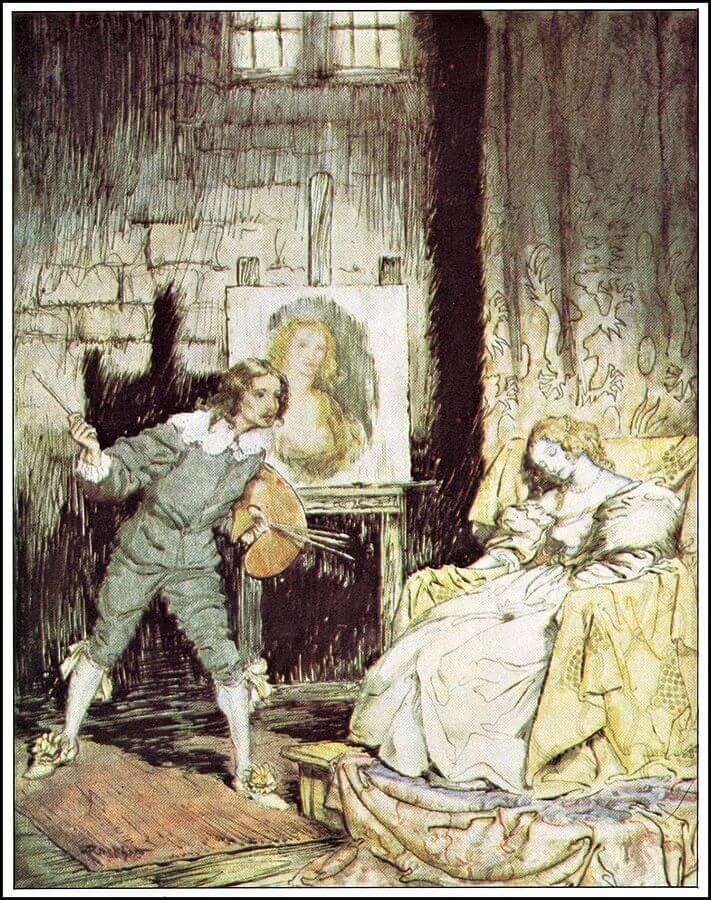
The chateau into which my valet had ventured to make forcible entrance, rather than permit me, in my desperately wounded condition, to pass a night in the open air, was one of those piles of commingled gloom and grandeur which have so long frowned among the Apennines, not less in fact than in the fancy of Mrs. Radcliffe. To all appearance it had been temporarily and very lately abandoned. We established ourselves in one of the smallest and least sumptuously furnished apartments. It lay in a remote turret of the building. Its decorations were rich, yet tattered and antique. Its walls were hung with tapestry and bedecked with manifold and multiform armorial trophies, together with an unusually great number of very spirited modern paintings in frames of rich golden arabesque. In these paintings, which depended from the walls not only in their main surfaces, but in very many nooks which the bizarre architecture of the chateau rendered necessary — in these paintings my incipient delirium, perhaps, had caused me to take deep interest; so that I bade Pedro to close the heavy shutters of the room — since it was already night — to light the tongues of a tall candelabrum which stood by the head of my bed — and to throw open far and wide the fringed curtains of black velvet which enveloped the bed itself. I wished all this done that I might resign myself, if not to sleep, at least alternately to the contemplation of these pictures, and the perusal of a small volume which had been found upon the pillow, and which purported to criticise and describe them.

Long — long I read — and devoutly, devotedly I gazed. Rapidly and gloriously the hours flew by, and the deep midnight came. The position of the candelabrum displeased me, and outreaching my hand with difficulty, rather than disturb my slumbering valet, I placed it so as to throw its rays more fully upon the book.

But the action produced an effect altogether unanticipated. The rays of the numerous candles (for there were many) now fell within a niche of the room which had hitherto been thrown into deep shade by one of the bed-posts. I thus saw in vivid light a picture all unnoticed before. It was the portrait of a young girl just ripening into womanhood. I glanced at the painting hurriedly, and then closed my eyes. Why I did this was not at first apparent even to my own perception. But while my lids remained thus shut, I ran over in my mind my reason for so shutting them. It was an impulsive movement to gain time for thought — to make sure that my vision had not deceived me — to calm and subdue my fancy for a more sober and more certain gaze. In a very few moments I again looked fixedly at the painting.

That I now saw aright I could not and would not doubt; for the first flashing of the candles upon that canvass had seemed to dissipate the dreamy stupor which was stealing over my senses, and to startle me at once into waking life.

The portrait, I have already said, was that of a young girl. It was a mere head and shoulders, done in what is technically termed a vignette manner; much in the style of the favorite heads of Sully. The arms, the bosom and even the ends of the radiant hair, melted imperceptibly into the vague yet deep shadow which formed the back ground of the whole. The frame was oval, richly gilded and filagreed in Moresque. As a thing of art nothing could be more admirable than the painting itself. But it could have been neither the execution of the work, nor the immortal beauty of the countenance, which had so suddenly and so vehemently moved me. Least of all, could it have been that my fancy, shaken from its half slumber, had mistaken the head for that of a living person. I saw at once that the peculiarities of the design, of the vignetting, and of the frame, must have instantly dispelled such idea — must have prevented even its momentary entertainment. Thinking earnestly upon these points, I remained, for an hour perhaps, half sitting, half reclining, with my vision riveted upon the portrait. At length, satisfied with the true secret of its effect, I fell back within the bed. I had found the spell of the picture in an absolute life-likeliness of expression, which, at first startling, finally confounded, subdued and appalled me. With deep and reverent awe I replaced the candelabrum in its former position. The cause of my deep agitation being thus shut from view, I sought eagerly the volume which discussed the paintings and their histories. Turning to the number which designated the oval portrait, I there read the vague and quaint words which follow:

“She was a maiden of rarest beauty, and not more lovely than full of glee. And evil was the hour when she saw, and loved, and wedded the painter. He, passionate, studious, austere, and having already a bride in his Art; she a maiden of rarest beauty, and not more lovely than full of glee: all light and smiles, and frolicksome as the young fawn: loving and cherishing all things: hating only the Art which was her rival: dreading only the pallet and brushes and other untoward instruments which deprived her of the countenance of her lover. It was thus a terrible thing for this lady to hear the painter speak of his desire to portray even his young bride. But she was humble and obedient, and sat meekly for many weeks in the dark high turret-chamber where the light dripped upon the pale canvass only from overhead. But he, the painter, took glory in his work, which went on from hour to hour, and from day to day. And he was a passionate, and wild, and moody man, who became lost in reveries; so that he would not see that the light which fell so ghastlily in that lone turret withered the health and the spirits of his bride, who pined visibly to all but him. Yet she smiled on and still on, uncomplainingly, because she saw that the painter, (who had high renown,) took a fervid and burning pleasure in his task, and wrought day and night to depict her who so loved him, yet who grew daily more dispirited and weak. And in sooth some who beheld the portrait spoke of its resemblance in low words, as of a mighty marvel, and a proof not less of the power of the painter than of his deep love for her whom he depicted so surpassingly well. But at length, as the labor drew nearer to its conclusion, there were admitted none into the turret; for the painter had grown wild with the ardor of his work, and turned his eyes from the canvass rarely, even to regard the countenance of his wife. And he would not see that the tints which he spread upon the canvass were drawn from the cheeks of her who sat beside him. And when many weeks had passed, and but little remained to do, save one brush upon the mouth and one tint upon the eye, the spirit of the lady again flickered up as the flame within the socket of the lamp. And then the brush was given, and then the tint was placed; and, for one moment, the painter stood entranced before the work which he had wrought; but in the next, while he yet gazed, he grew tremulous and very pallid, and aghast, and crying with a loud voice, ‘This is indeed Life itself!’ turned suddenly to regard his beloved: — She was dead!”


Edgar Allan Poe

Published in 1845 (Originally published as “Life in Death” in 1842).

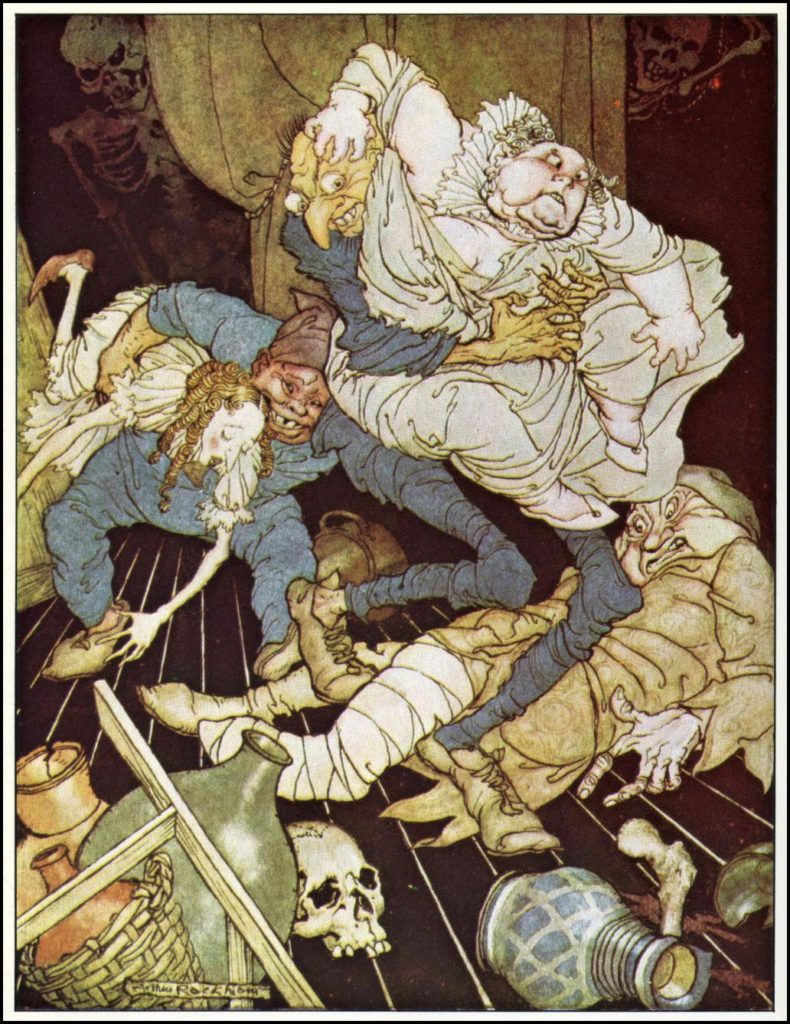
Image by Arthur Rackham

Categories
The Poe Museum Blog

The Domain Of Arnheim

The Domain Of Arnheim

The garden like a lady fair was cut,
That lay as if she slumbered in delight,
And to the open skies her eyes did shut.
The azure fields of Heaven were ‘sembled right
In a large round set with the flowers of light.
The flowers de luce and the round sparks of dew
That hung upon their azure leaves did shew
Like twinkling stars that sparkle in the evening blue.

— Giles Fletcher.

From his cradle to his grave a gale of prosperity bore my friend Ellison along. Nor do I use the word prosperity in its mere worldly sense. I mean it as synonymous with happiness. The person of whom I speak seemed born for the purpose of foreshadowing the doctrines of Turgôt, Price, Priestley and Condorcêt — of exemplifying by individual instance what has been deemed the chimera of the perfectionists. In the brief existence of Ellison I fancy that I have seen refuted the dogma, that in man’s very nature lies some hidden principle, the antagonist of bliss. An anxious examination of his career has given me to understand that, in general, from the violation of a few simple laws of humanity arises the wretchedness of mankind — that as a species we have in our possession the as yet unwrought elements of content — and that, even now, in the present darkness and madness of all thought on the great question of the social condition, it is not impossible that man, the individual, under certain unusual and highly fortuitous conditions, may be happy.

With opinions such as these my young friend, too, was fully imbued; and thus it is worthy of observation that the uninterrupted enjoyment which distinguished his life was, in great measure, the result of preconcert. It is, indeed, evident that with less of the instinctive philosophy which, now and then, stands so well in the stead of experience, Mr. Ellison would have found himself precipitated, by the very extraordinary successes of his life, into the common vortex of unhappiness which yawns for those of pre-eminent endowments. But it is by no means my object to pen an essay on happiness. The ideas of my friend may be summed up in a few words. He admitted but four elementary principles, or, more strictly, conditions, of bliss. That which he considered chief was (strange to say!) the simple and purely physical one of free exercise in the open air. “The health,” he said, “attainable by other means is scarcely worth the name.” He instanced the ecstasies of the fox-hunter, and pointed to the tillers of the earth, the only people who, as a class, can be fairly considered happier than others. His second condition was the love of woman. His third, and most difficult of realization, was the contempt of ambition. His fourth was an object of unceasing pursuit; and he held that, other things being equal, the extent of attainable happiness was in proportion to the spirituality of this object.

Ellison was remarkable in the continuous profusion of good gifts lavished upon him by fortune. In personal grace and beauty he exceeded all men. His intellect was of that order to which the acquisition of knowledge is less a labor than an intuition and a necessity. His family was one of the most illustrious of the empire. His bride was the loveliest and most devoted of women. His possessions had been always ample; but, on the attainment of his majority, it was discovered that one of those extraordinary freaks of fate had been played in his behalf which startle the whole social world amid which they occur, and seldom fail radically to alter the moral constitution of those who are their objects.

It appears that, about a hundred years before Mr. Ellison’s coming of age, there had died, in a remote province, one Mr. Seabright Ellison. This gentleman had amassed a princely fortune, and, having no immediate connections, conceived the whim of suffering his wealth to accumulate for a century after his decease. Minutely and sagaciously directing the various modes of investment, he bequeathed the aggregate amount to the nearest of blood, bearing the name of Ellison, who should be alive at the end of the hundred years. Many attempts had been made to set aside this singular bequest; their ex post facto character rendered them abortive; but the attention of a jealous government was aroused, and a legislative act finally obtained, forbidding all similar accumulations. This act, however, did not prevent young Ellison from entering into possession, on his twenty-first birth-day, as the heir of his ancestor Seabright, of a fortune of four hundred and fifty millions of dollars.*

When it had become known that such was the enormous wealth inherited, there were, of course, many speculations as to the mode of its disposal. The magnitude and the immediate availability of the sum bewildered all who thought on the topic. The possessor of any appreciable amount of money might have been imagined to perform any one of a thousand things. With riches merely surpassing those of any citizen, it would have been easy to suppose him engaging to supreme excess in the fashionable extravagances of his time — or busying himself with political intrigue — or aiming at ministerial power — or purchasing increase of nobility — or collecting large museums of virtu — or playing the munificent patron of letters, of science, of art — or endowing, and bestowing his name upon extensive institutions of charity. But for the inconceivable wealth in the actual possession of the heir, these objects and all ordinary objects were felt to afford too limited a field. Recourse was had to figures, and these but sufficed to confound. It was seen that, even at three per cent., the annual income of the inheritance amounted to no less than thirteen millions and five hundred thousand dollars; which was one million and one hundred and twenty-five thousand per month; or thirty-six thousand nine hundred and eighty-six per day; or one thousand five hundred and forty-one per hour; or six and twenty dollars for every minute that flew. Thus the usual track of supposition was thoroughly broken up. Men knew not what to imagine. There were some who even conceived that Mr. Ellison would divest himself of at least one half of his fortune, as of utterly superfluous opulence — enriching whole troops of his relatives by division of his superabundance. To the nearest of these he did, in fact, abandon the very unusual wealth which was his own before the inheritance.

I was not surprised, however, to perceive that he had long made up his mind on a point which had occasioned so much discussion to his friends. Nor was I greatly astonished at the nature of his decision. In regard to individual charities he had satisfied his conscience. In the possibility of any improvement, properly so called, being effected by man himself in the general condition of man, he had (I am sorry to confess it) little faith. Upon the whole, whether happily or unhappily, he was thrown back, in very great measure, upon self.

In the widest and noblest sense he was a poet. He comprehended, moreover, the true character, the august aims, the supreme majesty and dignity of the poetic sentiment. The fullest, if not the sole proper satisfaction of this sentiment he instinctively felt to lie in the creation of novel forms of beauty. Some peculiarities, either in his early education, or in the nature of his intellect, had tinged with what is termed materialism all his ethical speculations; and it was this bias, perhaps, which led him to believe that the most advantageous at least, if not the sole legitimate field for the poetic exercise, lies in the creation of novel moods of purely physical loveliness. Thus it happened he became neither musician nor poet — if we use this latter term in its every-day acceptation. Or it might have been that he neglected to become either, merely in pursuance of his idea that in contempt of ambition is to be found one of the essential principles of happiness on earth. Is it not, indeed, possible that, while a high order of genius is necessarily ambitious, the highest is above that which is termed ambition? And may it not thus happen that many far greater than Milton have contentedly remained “mute and inglorious?” I believe that the world has never seen — and that, unless through some series of accidents goading the noblest order of mind into distasteful exertion, the world will never see — that full extent of triumphant execution, in the richer domains of art, of which the human nature is absolutely capable.

Ellison became neither musician nor poet; although no man lived more profoundly enamored of music and poetry. Under other circumstances than those which invested him, it is not impossible that he would have become a painter. Sculpture, although in its nature rigorously poetical, was too limited in its extent and consequences, to have occupied, at any time, much of his attention. And I have now mentioned all the provinces in which the common understanding of the poetic sentiment has declared it capable of expatiating. But Ellison maintained that the richest, the truest and most natural, if not altogether the most extensive province, had been unaccountably neglected. No definition had spoken of the landscape-gardener as of the poet; yet it seemed to my friend that the creation of the landscape-garden offered to the proper Muse the most magnificent of opportunities. Here, indeed, was the fairest field for the display of imagination in the endless combining of forms of novel beauty; the elements to enter into combination being, by a vast superiority, the most glorious which the earth could afford. In the multiform and multicolor of the flowers and the trees, he recognised the most direct and energetic efforts of Nature at physical loveliness. And in the direction or concentration of this effort — or, more properly, in its adaptation to the eyes which were to behold it on earth — he perceived that he should be employing the best means — laboring to the greatest advantage — in the fulfilment, not only of his own destiny as poet, but of the august purposes for which the Deity had implanted the poetic sentiment in man.

“Its adaptation to the eyes which were to behold it on earth.” In his explanation of this phraseology, Mr. Ellison did much toward solving what has always seemed to me an enigma: — I mean the fact (which none but the ignorant dispute) that no such combination of scenery exists in nature as the painter of genius may produce. No such paradises are to be found in reality as have glowed on the canvass of Claude. In the most enchanting of natural landscapes, there will always be found a defect or an excess — many excesses and defects. While the component parts may defy, individually, the highest skill of the artist, the arrangement of these parts will always be susceptible of improvement. In short, no position can be attained on the wide surface of the natural earth, from which an artistical eye, looking steadily, will not find matter of offence in what is termed the “composition” of the landscape. And yet how unintelligible is this! In all other matters we are justly instructed to regard nature as supreme. With her details we shrink from competition. Who shall presume to imitate the colors of the tulip, or to improve the proportions of the lily of the valley? The criticism which says, of sculpture or portraiture, that here nature is to be exalted or idealized rather than imitated, is in error. No pictorial or sculptural combinations of points of human loveliness do more than approach the living and breathing beauty. In landscape alone is the principle of the critic true; and, having felt its truth here, it is but the headlong spirit of generalization which has led him to pronounce it true throughout all the domains of art. Having, I say, felt its truth here; for the feeling is no affectation or chimera. The mathematics afford no more absolute demonstrations than the sentiments of his art yields the artist. He not only believes, but positively knows, that such and such apparently arbitrary arrangements of matter constitute and alone constitute the true beauty. His reasons, however, have not yet been matured into expression. It remains for a more profound analysis than the world has yet seen, fully to investigate and express them. Nevertheless he is confirmed in his instinctive opinions by the voice of all his brethren. Let a “composition” be defective; let an emendation be wrought in its mere arrangement of form; let this emendation be submitted to every artist in the world; by each will its necessity be admitted. And even far more than this: — in remedy of the defective composition, each insulated member of the fraternity would have suggested the identical emendation.

I repeat that in landscape arrangements alone is the physical nature susceptible of exaltation, and that, therefore, her susceptibility of improvement at this one point, was a mystery I had been unable to solve. My own thoughts on the subject had rested in the idea that the primitive intention of nature would have so arranged the earth’s surface as to have fulfilled at all points man’s sense of perfection in the beautiful, the sublime, or the picturesque; but that this primitive intention had been frustrated by the known geological disturbances — disturbances of form and color-grouping, in the correction or allaying of which lies the soul of art. The force of this idea was much weakened, however, by the necessity which it involved of considering the disturbances abnormal and unadapted to any purpose. It was Ellison who suggested that they were prognostic of death. He thus explained: — Admit the earthly immortality of man to have been the first intention. We have then the primitive arrangement of the earth’s surface adapted to his blissful estate, as not existent but designed. The disturbances were the preparations for his subsequently conceived deathful condition.

“Now,” said my friend, “what we regard as exaltation of the landscape may be really such, as respects only the mortal or human point of view. Each alteration of the natural scenery may possibly effect a blemish in the picture, if we can suppose this picture viewed at large — in mass — from some point distant from the earth’s surface, although not beyond the limits of its atmosphere. It is easily understood that what might improve a closely scrutinized detail, may at the same time injure a general or more distantly observed effect. There may be a class of beings, human once, but now invisible to humanity, to whom, from afar, our disorder may seem order — our unpicturesqueness picturesque; in a word, the earth-angels, for whose scrutiny more especially than our own, and for whose death-refined appreciation of the beautiful, may have been set in array by God the wide landscape-gardens of the hemispheres.”

In the course of discussion, my friend quoted some passages from a writer on landscape-gardening, who has been supposed to have well treated his theme:

“There are properly but two styles of landscape-gardening, the natural and the artificial. One seeks to recall the original beauty of the country, by adapting its means to the surrounding scenery, cultivating trees in harmony with the hills or plain of the neighboring land; detecting and bringing into practice those nice relations of size, proportion and color which, hid from the common observer, are revealed everywhere to the experienced student of nature. The result of the natural style of gardening is seen rather in the absence of all defects and incongruities — in the prevalence of a healthy harmony and order — than in the creation of any special wonders or miracles. The artificial style has as many varieties as there are different tastes to gratify. It has a certain general relation to the various styles of building. There are the stately avenues and retirements of Versailles; Italian terraces; and a various mixed old English style, which bears some relation to the domestic Gothic or English Elizabethan architecture. Whatever may be said against the abuses of the artificial landscape-gardening, a mixture of pure art in a garden scene adds to it a great beauty. This is partly pleasing to the eye, by the show of order and design, and partly moral. A terrace, with an old moss-covered balustrade, calls up at once to the eye the fair forms that have passed there in other days. The slightest exhibition of art is an evidence of care and human interest.”

“From what I have already observed,” said Ellison, “you will understand that I reject the idea, here expressed, of recalling the original beauty of the country. The original beauty is never so great as that which may be introduced. Of course, everything depends on the selection of a spot with capabilities. What is said about detecting and bringing into practice nice relations of size, proportion, and color, is one of those mere vaguenesses of speech which serve to veil inaccuracy of thought. The phrase quoted may mean anything, or nothing, and guides in no degree. That the true result of the natural style of gardening is seen rather in the absence of all defects and incongruities than in the creation of any special wonders or miracles, is a proposition better suited to the grovelling apprehension of the herd than to the fervid dreams of the man of genius. The negative merit suggested appertains to that hobbling criticism which, in letters, would elevate Addison into apotheosis. In truth, while that virtue which consists in the mere avoidance of vice appeals directly to the understanding, and can thus be circumscribed in rule, the loftier virtue, which flames in creation, can be apprehended in its results alone. Rule applies but to the merits of denial — to the excellencies which refrain. Beyond these, the critical art can but suggest. We may be instructed to build a “Cato,” but we are in vain told how to conceive a Parthenon or an “Inferno.” The thing done, however; the wonder accomplished; and the capacity for apprehension becomes universal. The sophists of the negative school who, through inability to create, have scoffed at creation, are now found the loudest in applause. What, in its chrysalis condition of principle, affronted their demure reason, never fails, in its maturity of accomplishment, to extort admiration from their instinct of beauty.

“The author’s observations on the artificial style,” continued Ellison, “are less objectionable. A mixture of pure art in a garden scene adds to it a great beauty. This is just; as also is the reference to the sense of human interest. The principle expressed is incontrovertible — but there may be something beyond it. There may be an object in keeping with the principle — an object unattainable by the means ordinarily possessed by individuals, yet which, if attained, would lend a charm to the landscape-garden far surpassing that which a sense of merely human interest could bestow. A poet, having very unusual pecuniary resources, might, while retaining the necessary idea of art, or culture, or, as our author expresses it, of interest, so imbue his designs at once with extent and novelty of beauty, as to convey the sentiment of spiritual interference. It will be seen that, in bringing about such result, he secures all the advantages of interest or design, while relieving his work of the harshness or technicality of the worldly art. In the most rugged of wildernesses — in the most savage of the scenes of pure nature — there is apparent the art of a creator; yet this art is apparent to reflection only; in no respect has it the obvious force of a feeling. Now let us suppose this sense of the Almighty design to be one step depressed — to be brought into something like harmony or consistency with the sense of human art — to form an intermedium between the two: — let us imagine, for example, a landscape whose combined vastness and definitiveness — whose united beauty, magnificence, and strangeness, shall convey the idea of care, or culture, or superintendence, on the part of beings superior, yet akin to humanity — then the sentiment of interest is preserved, while the art intervolved is made to assume the air of an intermediate or secondary nature — a nature which is not God, nor an emanation from God, but which still is nature in the sense of the handiwork of the angels that hover between man and God.”

It was in devoting his enormous wealth to the embodiment of a vision such as this — in the free exercise in the open air ensured by the personal superintendence of his plans — in the unceasing object which these plans afforded — in the high spirituality of the object — in the contempt of ambition which it enabled him truly to feel — in the perennial springs with which it gratified, without possibility of satiating, that one master passion of his soul, the thirst for beauty; above all, it was in the sympathy of a woman, not unwomanly, whose loveliness and love enveloped his existence in the purple atmosphere of Paradise, that Ellison thought to find, and found, exemption from the ordinary cares of humanity, with a far greater amount of positive happiness than ever glowed in the rapt day-dreams of De Stäel.

I despair of conveying to the reader any distinct conception of the marvels which my friend did actually accomplish. I wish to describe, but am disheartened by the difficulty of description, and hesitate between detail and generality. Perhaps the better course will be to unite the two in their extremes.

Mr. Ellison’s first step regarded, of course, the choice of a locality; and scarcely had he commenced thinking on this point, when the luxuriant nature of the Pacific Islands arrested his attention. In fact, he had made up his mind for a voyage to the South Seas, when a night’s reflection induced him to abandon the idea. “Were I misanthropic,” he said, “such a locale would suit me. The thoroughness of its insulation and seclusion, and the difficulty of ingress and egress, would in such case be the charm of charms; but as yet I am not Timon. I wish the composure but not the depression of solitude. There must remain with me a certain control over the extent and duration of my repose. There will be frequent hours in which I shall need, too, the sympathy of the poetic in what I have done. Let me seek, then, a spot not far from a populous city — whose vicinity, also, will best enable me to execute my plans.”

In search of a suitable place so situated, Ellison travelled for several years, and I was permitted to accompany him. A thousand spots with which I was enraptured he rejected without hesitation, for reasons which satisfied me, in the end, that he was right. We came at length to an elevated table-land of wonderful fertility and beauty, affording a panoramic prospect very little less in extent than that of Ætna, and, in Ellison’s opinion as well as my own, surpassing the far-famed view from that mountain in all the true elements of the picturesque.

“I am aware,” said the traveller, as he drew a sigh of deep delight after gazing on this scene, entranced, for nearly an hour, “I know that here, in my circumstances, nine-tenths of the most fastidious of men would rest content. This panorama is indeed glorious, and I should rejoice in it but for the excess of its glory. The taste of all the architects I have ever known leads them, for the sake of ‘prospect,’ to put up buildings on hill-tops. The error is obvious. Grandeur in any of its moods, but especially in that of extent, startles, excites — and then fatigues, depresses. For the occasional scene nothing can be better — for the constant view nothing worse. And, in the constant view, the most objectionable phase of grandeur is that of extent; the worst phase of extent, that of distance. It is at war with the sentiment and with the sense of seclusion — the sentiment and sense which we seek to humor in ‘retiring to the country.’ In looking from the summit of a mountain we cannot help feeling abroad in the world. The heart-sick avoid distant prospects as a pestilence.”

It was not until toward the close of the fourth year of our search that we found a locality with which Ellison professed himself satisfied. It is, of course, needless to say where was this locality. The late death of my friend, in causing his domain to be thrown open to certain classes of visitors, has given to Arnheim a species of secret and subdued if not solemn celebrity, similar in kind, although infinitely superior in degree, to that which so long distinguished Fonthill.

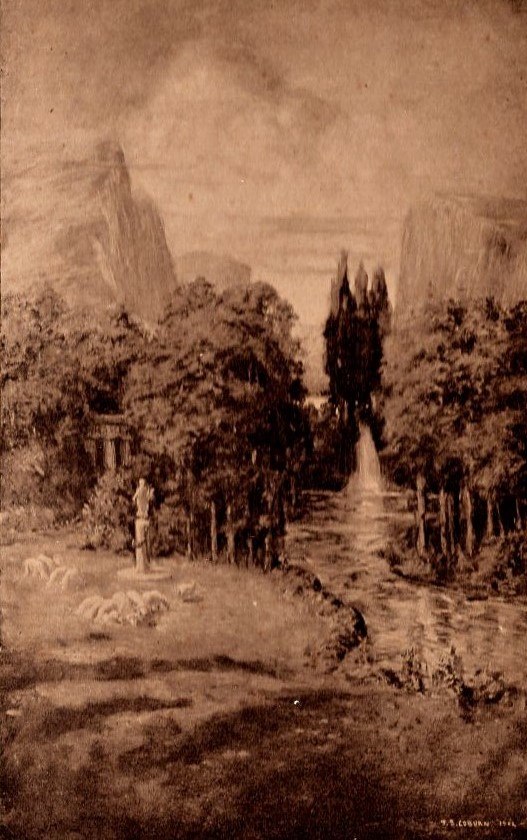
The usual approach to Arnheim was by the river. The visitor left the city in the early morning. During the forenoon he passed between shores of a tranquil and domestic beauty, on which grazed innumerable sheep, their white fleeces spotting the vivid green of rolling meadows. By degrees the idea of cultivation subsided into that of merely pastoral care. This slowly became merged in a sense of retirement — this again in a consciousness of solitude. As the evening approached, the channel grew more narrow; the banks more and more precipitous; and these latter were clothed in richer, more profuse, and more sombre foliage. The water increased in transparency. The stream took a thousand turns, so that at no moment could its gleaming surface be seen for a greater distance than a furlong. At every instant the vessel seemed imprisoned within an enchanted circle, having insuperable and impenetrable walls of foliage, a roof of ultra-marine satin, and no floor — the keel balancing itself with admirable nicety on that of a phantom bark which, by some accident having been turned upside down, floated in constant company with the substantial one, for the purpose of sustaining it. The channel now became a gorge — although the term is somewhat inapplicable, and I employ it merely because the language has no word which better represents the most striking — not the most distinctive — feature of the scene. The character of gorge was maintained only in the height and parallelism of the shores; it was lost altogether in their other traits. The walls of the ravine (through which the clear water still tranquilly flowed) arose to an elevation of a hundred and occasionally of a hundred and fifty feet, and inclined so much toward each other as, in a great measure, to shut out the light of day; while the long plume-like moss which depended densely from the intertwining shrubberies overhead, gave the whole chasm an air of funereal gloom. The windings became more frequent and intricate, and seemed often as if returning in upon themselves, so that the voyager had long lost all idea of direction. He was, moreover, enwrapt in an exquisite sense of the strange. The thought of nature still remained, but her character seemed to have undergone modification: there was a weird symmetry, a thrilling uniformity, a wizard propriety in these her works. Not a dead branch — not a withered leaf — not a stray pebble — not a patch of the brown earth was anywhere visible. The crystal water welled up against the clean granite, or the unblemished moss, with a sharpness of outline that delighted while it bewildered the eye.

Having threaded the mazes of this channel for some hours, the gloom deepening every moment, a sharp and unexpected turn of the vessel brought it suddenly, as if dropped from heaven, into a circular basin of very considerable extent when compared with the width of the gorge. It was about two hundred yards in diameter, and girt in at all points but one — that immediately fronting the vessel as it entered — by hills equal in general height to the walls of the chasm, although of a thoroughly different character. Their sides sloped from the water’s edge at an angle of some forty-five degrees, and they were clothed from base to summit — not a perceptible point escaping — in a drapery of the most gorgeous flower-blossoms; scarcely a green leaf being visible among the sea of odorous and fluctuating color. This basin was of great depth, but so transparent was the water that the bottom, which seemed to consist of a thick mass of small round alabaster pebbles, was distinctly visible by glimpses — that is to say, whenever the eye could permit itself not to see, far down in the inverted heaven, the duplicate blooming of the hills. On these latter there were no trees, nor even shrubs of any size. The impressions wrought on the observer were those of richness, warmth, color, quietude, uniformity, softness, delicacy, daintiness, voluptuousness, and a miraculous extremeness of culture that suggested dreams of a new race of fairies, laborious, tasteful, magnificent, and fastidious; but as the eye traced upward the myriad-tinted slope, from its sharp junction with the water to its vague termination amid the folds of overhanging cloud, it became, indeed, difficult not to fancy a panoramic cataract of rubies, sapphires, opals and golden onyxes, rolling silently out of the sky.

The visitor, shooting suddenly into this bay from out the gloom of the ravine, is delighted but astounded by the full orb of the declining sun, which he had supposed to be already far below the horizon, but which now confronts him, and forms the sole termination of an otherwise limitless vista seen through another chasm-like rift in the hills.

But here the voyager quits the vessel which has borne him so far, and descends into a light canoe of ivory, stained with arabesque devices in vivid scarlet, both within and without. The poop and beak of this boat arise high above the water, with sharp points, so that the general form is that of an irregular crescent. It lies on the surface of the bay with the proud grace of a swan. On its ermined floor reposes a single feathery paddle of satin-wood; but no oarsmen or attendant is to be seen. The guest is bidden to be of good cheer — that the fates will take care of him. The larger vessel disappears, and he is left alone in the canoe, which lies apparently motionless in the middle of the lake. While he considers what course to pursue, however, he becomes aware of a gentle movement in the fairy bark. It slowly swings itself around until its prow points toward the sun. It advances with a gentle but gradually accelerated velocity, while the slight ripples it creates seem to break about the ivory side in divinest melody — seem to offer the only possible explanation of the soothing yet melancholy music for whose unseen origin the bewildered voyager looks around him in vain.

The canoe steadily proceeds, and the rocky gate of the vista is approached, so that its depths can be more distinctly seen. To the right arise a chain of lofty hills rudely and luxuriantly wooded. It is observed, however, that the trait of exquisite cleanness where the bank dips into the water, still prevails. There is not one token of the usual river débris. To the left the character of the scene is softer and more obviously artificial. Here the bank slopes upward from the stream in a very gentle ascent, forming a broad sward of grass of a texture resembling nothing so much as velvet, and of a brilliancy of green which would bear comparison with the tint of the purest emerald. This plateau varies in width from ten to three hundred yards; reaching from the river brink to a wall, fifty feet high, which extends, in an infinity of curves, but following the general direction of the river, until lost in the distance to the westward. This wall is of one continuous rock, and has been formed by cutting perpendicularly the once rugged precipice of the stream’s southern bank; but no trace of the labor has been suffered to remain. The chiselled stone has the hue of ages and is profusely overhung and overspread with the ivy, the coral honeysuckle, the eglantine, and the clematis. The uniformity of the top and bottom lines of the wall is fully relieved by occasional trees of gigantic height, growing singly or in small groups, both along the plateau and in the domain behind the wall, but in close proximity to it; so that frequent limbs (of the black walnut especially) reach over and dip their pendent extremities into the water. Farther back within the domain, the vision is impeded by an impenetrable screen of foliage.

These things are observed during the canoe’s gradual approach to what I have called the gate of the vista. On drawing nearer to this, however, its chasm-like appearance vanishes; a new outlet from the bay is discovered to the left — in which direction the wall is also seen to sweep, still following the general course of the stream. Down this new opening the eye cannot penetrate very far; for the stream, accompanied by the wall, still bends to the left, until both are swallowed up by the leaves.

The boat, nevertheless, glides magically into the winding channel; and here the shore opposite the wall is found to resemble that opposite the wall in the straight vista. Lofty hills, rising occasionally into mountains, and covered with vegetation in wild luxuriance, still shut in the scene.

Floating gently onward, but with a velocity slightly augmented, the voyager, after many short turns, finds his progress apparently barred by a gigantic gate or rather door of burnished gold, elaborately carved and fretted, and reflecting the direct rays of the now fast-sinking sun with an effulgence that seems to wreath the whole surrounding forest in flames. This gate is inserted in the lofty wall; which here appears to cross the river at right angles. In a few moments, however, it is seen that the main body of the water still sweeps in a gentle and extensive curve to the left, the wall following it as before, while a stream of considerable volume, diverging from the principal one, makes its way, with a slight ripple, under the door, and is thus hidden from sight. The canoe falls into the lesser channel and approaches the gate. Its ponderous wings are slowly and musically expanded. The boat glides between them, and commences a rapid descent into a vast amphitheatre entirely begirt with purple mountains, whose bases are laved by a gleaming river throughout the full extent of their circuit. Meantime the whole Paradise of Arnheim bursts upon the view. There is a gush of entrancing melody; there is an oppressive sense of strange sweet odor; — there is a dream-like intermingling to the eye of tall slender Eastern trees — bosky shrubberies — flocks of golden and crimson birds — lily-fringed lakes — meadows of violets, tulips, poppies, hyacinths and tuberoses — long intertangled lines of silver streamlets — and, upspringing confusedly from amid all, a mass of semi-Gothic, semi-Saracenic architecture, sustaining itself by miracle in mid-air; glittering in the red sunlight with a hundred oriels, minarets, and pinnacles; and seeming the phantom handiwork, conjointly, of the Sylphs, of the Fairies, of the Genii, and of the Gnomes.

*An incident, similar in outline to the one here imagined, occurred, not very long ago, in England. The name of the fortunate heir was Thelluson. I first saw an account of this matter in the “Tour” of Prince Puckler Muskau, who makes the sum inherited ninety millions of pounds, and justly observes that “in the contemplation of so vast a sum, and of the services to which it might be applied, there is something even of the sublime.” To suit the views of this article I have followed the Prince’s statement, although a grossly exaggerated one. The germ, and, in fact, the commencement of the present paper was published many years ago — previous to the issue of the first number of Sue’s admirable “Juif Errant,” which may possibly have been suggested to him by Muskau’s account.


Edgar Allan Poe

Originally published as “The Landscape Garden” in 1842

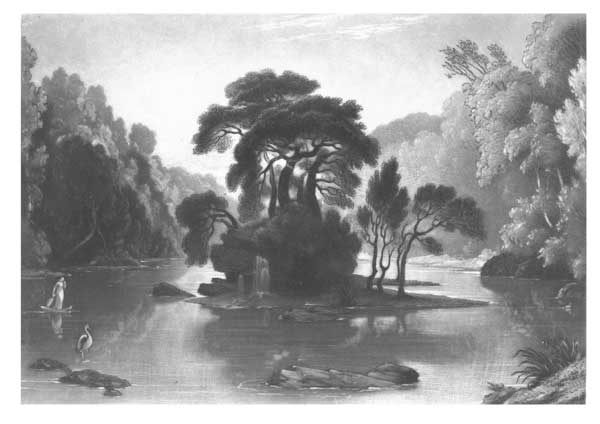
Image by F. Simpson Coburn

Categories
The Poe Museum Blog

Landor’s Cottage

Landor’s Cottage

A Pendant to ‘The Domain Of Arnheim.’

During a pedestrian tour last summer, through one or two of the river counties of New York, I found myself, as the day declined, somewhat embarrassed about the road I was pursuing. The land undulated very remarkably; and my path, for the last hour, had wound about and about so confusedly, in its effort to keep in the valleys, that I no longer knew in what direction lay the sweet village of B——, where I had determined to stop for the night. The sun had scarcely shone — strictly speaking — during the day, which nevertheless had been unpleasantly warm. A smoky mist, resembling that of the Indian summer, enveloped all things, and of course, added to my uncertainty. Not that I cared much about the matter. If I did not hit upon the village before sunset, or even before dark, it was more than possible that a little Dutch farmhouse, or something of that kind, would soon make its appearance — although, in fact, the neighborhood (perhaps on account of being more picturesque than fertile) was very sparsely inhabited. At all events, with my knapsack for a pillow, and my hound as a sentry, a bivouac in the open air was just the thing which would have amused me. I sauntered on, therefore, quite at ease — Ponto taking charge of my gun — until at length, just as I had begun to consider whether the numerous little glades that led hither and thither were intended to be paths at all, I was conducted by one of the most promising of them into an unquestionable carriage track. There could be no mistaking it. The traces of light wheels were evident; and although the tall shrubberies and overgrown undergrowth met overhead, there was no obstruction whatever below, even to the passage of a Virginian mountain wagon — the most aspiring vehicle, I take it, of its kind. The road, however, except in being open through the wood — if wood be not too weighty a name for such an assemblage of light trees — and except in the particulars of evident wheel-tracks — bore no resemblance to any road I had before seen. The tracks of which I speak were but faintly perceptible — having been impressed upon the firm, yet pleasantly moist surface of — what looked more like green Genoese velvet than anything else. It was grass, clearly — but grass such as we seldom see out of England — so short, so thick, so even, and so vivid in color. Not a single impediment lay in the wheel-route — not even a chip or dead twig. The stones that once obstructed the way had been carefully placed — not thrown — along the sides of the lane, so as to define its boundaries at bottom with a kind of half-precise, half-negligent, and wholly picturesque definition. Clumps of wild flowers grew everywhere, luxuriantly, in the interspaces.

What to make of all this, of course I knew not. Here was art undoubtedly — that did not surprise me — all roads, in the ordinary sense, are works of art; nor can I say that there was much to wonder at in the mere excess of art manifested; all that seemed to have been done, might have been done here — with such natural ‘capabilities’ (as they have it in the books on Landscape Gardening) — with very little labor and expense. No; it was not the amount but the character of the art which caused me to take a seat on one of the blossomy stones and gaze up and down this fairy-like avenue for half an hour or more in bewildered admiration. One thing became more and more evident the longer I gazed: an artist, and one with a most scrupulous eye for form, had superintended all these arrangements. The greatest care had been taken to preserve a due medium between the neat and graceful on the one hand, and the pittoresque, in the true sense of the Italian term, on the other. There were few straight, and no long uninterrupted lines. The same effect of curvature or of color, appeared twice, usually, but not oftener, at any one point of view. Everywhere was variety in uniformity. It was a piece of ‘composition,’ in which the most fastidiously critical taste could scarcely have suggested an emendation.

I had turned to the right as I entered this road, and now, arising, I continued in the same direction. The path was so serpentine, that at no moment could I trace its course for more than two or three paces in advance. Its character did not undergo any material change.

Presently the murmur of water fell gently upon my ear — and in a few moments afterwards, as I turned with the road somewhat more abruptly than hitherto, I became aware that a building of some kind lay at the foot of a gentle declivity just before me. I could see nothing distinctly on account of the mist which occupied all the little valley below. A gentle breeze, however, now arose, as the sun was about descending; and while I remained standing on the brow of the slope, the fog gradually became dissipated into wreaths, and so floated from over the scene.

As it came fully into view — thus gradually as I describe it — piece by piece, here a tree, there a glimpse of water, and here again the summit of a chimney, I could scarcely help fancying that the whole was one of the ingenious illusions sometimes exhibited under the name of ‘vanishing pictures.’

By the time, however, that the fog had thoroughly disappeared, the sun had made its way down behind the gentle hills, and thence, as if with a slight chassez to the south, had come again fully into sight; glaring with a purplish lustre through a chasm that entered the valley from the west. Suddenly, therefore — and as if by the hand of magic — this whole valley and every thing in it became brilliantly visible.

The first coup d’œil, as the sun slid into the position described, impressed me very much as I have been impressed when a boy, by the concluding scene of some well-arranged theatrical spectacle or melodrama. Not even the monstrosity of color was wanting; for the sunlight came out through the chasm, tinted all orange and purple; while the vivid green of the grass in the valley was reflected more or less upon all objects from the curtain of vapor that still hung overhead, as if loth to take its total departure from a scene so enchantingly beautiful.

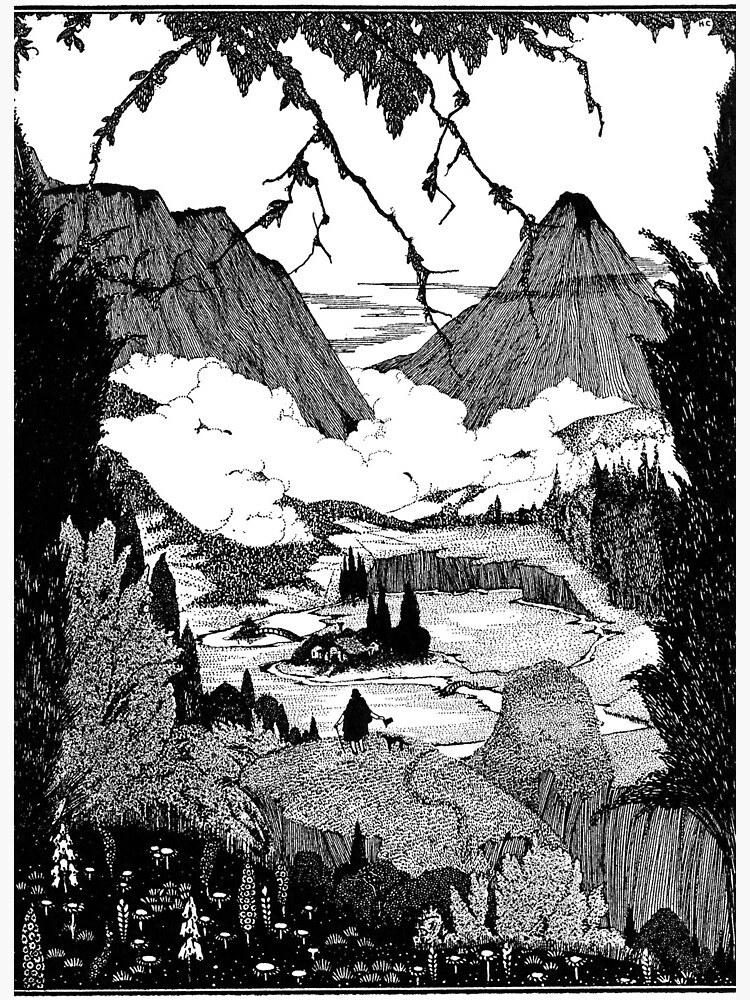
The little vale into which I thus peered down from under the fog-canopy, could not have been more than four hundred yards long; while in breadth it varied from fifty to one hundred and fifty, or perhaps two hundred. It was most narrow at its northern extremity, opening out as it tended southwardly, but with no very precise regularity. The widest portion was within eighty yards of the southern extreme. The slopes which encompassed the vale could not fairly be called hills, unless at their northern face. Here a precipitous ledge of granite arose to a height of some ninety feet; and, as I have mentioned, the valley at this point was not more than fifty feet wide; but as the visiter proceeded southwardly from the cliff, he found on his right hand and on his left, declivities at once less high, less precipitous, and less rocky. All, in a word, sloped and softened to the south; and yet the whole vale was engirdled by eminences, more or less high, except at two points. One of these I have already spoken of. It lay considerably to the north of west, and was where the setting sun made its way, as I have before described, into the amphitheatre, through a cleanly cut natural cleft in the granite embankment: this fissure might have been ten yards wide at its widest point, so far as the eye could trace it. It seemed to lead up, up, like a natural causeway, into the recesses of unexplored mountains and forests. The other opening was directly at the southern end of the vale. Here, generally, the slopes were nothing more than gentle inclinations, extending from east to west about one hundred and fifty yards. In the middle of this extent was a depression, level with the ordinary floor of the valley. As regards vegetation, as well as in respect to every thing else, the scene softened and sloped to the south. To the north — on the craggy precipice — a few paces from the verge — up sprang the magnificent trunks of numerous hickories, black walnuts, and chestnuts, interspersed with occasional oak; and the strong lateral branches thrown out by the walnuts especially, spread far over the edge of the cliff. Proceeding southwardly, the explorer saw, at first, the same class of trees, but less and less lofty and Salvatorish in character; then he saw the gentler elm, succeeded by the sassafras and locust — these again by the softer linden, red-bud, catalpa, and maple — these yet again by still more graceful and more modest varieties. The whole face of the southern declivity was covered with wild shrubbery alone — an occasional silver willow or white poplar excepted. In the bottom of the valley itself — (for it must be borne in mind that the vegetation hitherto mentioned grew only on the cliffs or hill-sides) — were to be seen three insulated trees. One was an elm of fine size and exquisite form: it stood guard over the southern gate of the vale. Another was a hickory, much larger than the elm, and altogether a much finer tree, although both were exceedingly beautiful: it seemed to have taken charge of the north-western entrance, springing from a group of rocks in the very jaws of the ravine, and throwing its graceful body, at an angle of nearly forty-five degrees, far out into the sunshine of the amphitheatre. About thirty yards east of this tree stood, however, the pride of the valley, and beyond all question the most magnificent tree I have ever seen, unless, perhaps, among the cypresses of the Itchiatuckanee. It was a triple-stemmed tulip-tree — the Liriodendron Tulipiferum — one of the natural order of magnolias. Its three trunks separated from the parent at about three feet from the soil, and diverging very slightly and gradually, were not more than four feet apart at the point where the largest stem shot out into foliage: this was at an elevation of about eighty feet. The whole height of the principal division was one hundred and twenty feet. Nothing can surpass in beauty the form, or the glossy, vivid green of the leaves of the tulip-tree. In the present instance they were fully eight inches wide; but their glory was altogether eclipsed by the gorgeous splendor of the profuse blossoms. Conceive, closely congregated, a million of the largest and most resplendent tulips! Only thus can the reader get any idea of the picture I would convey. And then the stately grace of the clean, delicately-granulated columnar stems, the largest four feet in diameter, at twenty from the ground. The innumerable blossoms, mingling with those of other trees scarcely less beautiful, although infinitely less majestic, filled the valley with more than Arabian perfumes.

The general floor of the amphitheatre was grass of the same character as that I had found in the road: if anything, more deliciously soft, thick, velvety, and miraculously green. It was hard to conceive how all this beauty had been attained.

I have spoken of two openings into the vale. From the one to the north-west issued a rivulet, which came, gently murmuring and slightly foaming, down the ravine, until it dashed against the group of rocks out of which sprang the insulated hickory. Here, after encircling the tree, it passed on a little to the north of east, leaving the tulip tree some twenty feet to the south, and making no decided alteration in its course until it came near the midway between the eastern and western boundaries of the valley. At this point, after a series of sweeps, it turned off at right angles and pursued a generally southern direction — meandering as it went — until it became lost in a small lake of irregular figure (although roughly oval), that lay gleaming near the lower extremity of the vale. This lakelet was, perhaps, a hundred yards in diameter at its widest part. No crystal could be clearer than its waters. Its bottom, which could be distinctly seen, consisted altogether of pebbles brilliantly white. Its banks, of the emerald grass already described, rounded, rather than sloped, off into the clear heaven below; and so clear was this heaven, so perfectly, at times, did it reflect all objects above it, that where the true bank ended and where the mimic one commenced, it was a point of no little difficulty to determine. The trout, and some other varieties of fish, with which this pond seemed to be almost inconveniently crowded, had all the appearance of veritable flying-fish. It was almost impossible to believe that they were not absolutely suspended in the air. A light birch canoe that lay placidly on the water, was reflected in its minutest fibres with a fidelity unsurpassed by the most exquisitely polished mirror. A small island, fairly laughing with flowers in full bloom, and affording little more space than just enough for a picturesque little building, seemingly a fowl-house — arose from the lake not far from its northern shore — to which it was connected by means of an inconceivably light-looking and yet very primitive bridge. It was formed of a single, broad and thick plank of the tulip wood. This was forty feet long, and spanned the interval between shore and shore with a slight but very perceptible arch, preventing all oscillation. From the southern extreme of the lake issued a continuation of the rivulet, which, after meandering for, perhaps, thirty yards, finally passed through the ‘depression’ (already described) in the middle of the southern declivity, and tumbling down a sheer precipice of a hundred feet, made its devious and unnoticed way to the Hudson.

The lake was deep — at some points thirty feet — but the rivulet seldom exceeded three, while its greatest width was about eight. Its bottom and banks were as those of the pond — if a defect could have been attributed to them, in point of picturesqueness, it was that of excessive neatness.

The expanse of the green turf was relieved, here and there, by an occasional showy shrub, such as the hydrangea, or the common snow-ball, or the aromatic seringa; or, more frequently, by a clump of geraniums blossoming gorgeously in great varieties. These latter grew in pots which were carefully buried in the soil, so as to give the plants the appearance of being indigenous. Besides all this, the lawn’s velvet was exquisitely spotted with sheep — a considerable flock of which roamed about the vale, in company with three tamed deer, and a vast number of brilliantly-plumed ducks. A very large mastiff seemed to be in vigilant attendance upon these animals, each and all.

Along the eastern and western cliffs — where, towards the upper portion of the amphitheatre, the boundaries were more or less precipitous — grew ivy in great profusion — so that only here and there could even a glimpse of the naked rock be obtained. The northern precipice, in like manner, was almost entirely clothed by grape-vines of rare luxuriance; some springing from the soil at the base of the cliff, and others from ledges on its face.

The slight elevation which formed the lower boundary of this little domain, was crowned by a neat stone wall, of sufficient height to prevent the escape of the deer. Nothing of the fence kind was observable elsewhere; for nowhere else was an artificial enclosure needed: — any stray sheep, for example, which should attempt to make its way out of the vale by means of the ravine, would find its progress arrested, after a few yards’ advance, by the precipitous ledge of rock over which tumbled the cascade that had arrested my attention as I first drew near the domain. In short, the only ingress or egress was through a gate occupying a rocky pass in the road, a few paces below the point at which I stopped to reconnoitre the scene.

I have described the brook as meandering very irregularly through the whole of its course. Its two general directions, as I have said, were first from west to east, and then from north to south. At the turn, the stream, sweeping backwards, made an almost circular loop, so as to form a peninsula which was very nearly an island, and which included about the sixteenth of an acre. On this peninsula stood a dwelling-house — and when I say that this house, like the infernal terrace seen by Vathek, ‘était d’une architecture inconnue dans les annales de la terre,’ I mean, merely, that its tout ensemble struck me with the keenest sense of combined novelty and propriety — in a word, of poetry — (for, than in the words just employed, I could scarcely give, of poetry in the abstract, a more rigorous definition) — and I do not mean that merely outré was perceptible in any respect.

In fact, nothing could well be more simple — more utterly unpretending than this cottage. Its marvellous effect lay altogether in its artistic arrangement as a picture. I could have fancied, while I looked at it, that some eminent landscape-painter had built it with his brush.

The point of view from which I first saw the valley, was not altogether, although it was nearly, the best point from which to survey the house. I will therefore describe it as I afterwards saw it — from a position on the stone wall at the southern extreme of the amphitheatre.

The main building was about twenty-four feet long and sixteen broad — certainly not more. Its total height, from the ground to the apex of the roof, could not have exceeded eighteen feet. To the west end of this structure was attached one about a third smaller in all its proportions: — the line of its front standing back about two yards from that of the larger house; and the line of its roof, of course, being considerably depressed below that of the roof adjoining. At right angles to these buildings, and from the rear of the main one — not exactly in the middle — extended a third compartment, very small — being, in general, one-third less than the western wing. The roofs of the two larger were very steep — sweeping down from the ridge-beam with a long concave curve, and extending at least four feet beyond the walls in front, so as to form the roofs of two piazzas. These latter roofs, of course, needed no support; but as they had the air of needing it, slight and perfectly plain pillars were inserted at the corners alone. The roof of the northern wing was merely an extension of a portion of the main roof. Between the chief building and western wing arose a very tall and rather slender square chimney of hard Dutch bricks, alternately black and red: — a slight cornice of projecting bricks at the top. Over the gables, the roofs also projected very much: — in the main building about four feet to the east and two to the west. The principal door was not exactly in the main division, being a little to the east — while the two windows were to the west. These latter did not extend to the floor, but were much longer and narrower than usual — they had single shutters like doors — the panes were of lozenge form, but quite large. The door itself had its upper half of glass, also in lozenge panes — a movable shutter secured it at night. The door to the west wing was in its gable, and quite simple — a single window looked out to the south. There was no external door to the north wing, and it, also, had only one window to the east.

The blank wall of the eastern gable was relieved by stairs (with a balustrade) running diagonally across it — the ascent being from the south. Under cover of the widely projecting eave these steps gave access to a door leading to the garret, or rather loft — for it was lighted only by a single window to the north, and seemed to have been intended as a store-room.

The piazzas of the main building and western wing had no floors, as is usual; but at the doors and at each window, large, flat, irregular slabs of granite lay embedded in the delicious turf, affording comfortable footing in all weather. Excellent paths of the same material — not nicely adapted, but with the velvety sod filling frequent intervals between the stones, led hither and thither from the house, to a crystal spring about five paces off, to the road, or to one or two out-houses that lay to the north, beyond the brook, and were thoroughly concealed by a few locusts and catalpas.

Not more than six steps from the main door of the cottage stood the dead trunk of a fantastic pear-tree, so clothed from head to foot in the gorgeous bignonia blossoms that one required no little scrutiny to determine what manner of sweet thing it could be. From various arms of this tree hung cages of different kinds. In one, a large wicker cylinder with a ring at top, revelled a mocking bird; in another, an oriole; in a third, the impudent bobolink — while three or four more delicate prisons were loudly vocal with canaries.

The pillars of the piazza were enwreathed in jasmine and sweet honeysuckle; while from the angle formed by the main structure and its west wing, in front, sprang a grape-vine of unexampled luxuriance. Scorning all restraint, it had clambered first to the lower roof — then to the higher; and along the ridge of this latter it continued to writhe on, throwing out tendrils to the right and left, until at length it fairly attained the east gable, and fell trailing over the stairs.

The whole house, with its wings, was constructed of the old-fashioned Dutch shingles — broad, and with unrounded corners. It is a peculiarity of this material to give houses built of it the appearance of being wider at bottom than at top — after the manner of Egyptian architecture; and in the present instance, this exceedingly picturesque effect was aided by numerous pots of gorgeous flowers that almost encompassed the base of the buildings.

The shingles were painted a dull gray; and the happiness with which this neutral tint melted into the vivid green of the tulip-tree leaves that partially overshadowed the cottage, can readily be conceived by an artist.

From the position near the stone wall, as described, the buildings were seen at great advantage — for the south-eastern angle was thrown forward — so that the eye took in at once the whole of the two fronts, with the picturesque eastern gable, and at the same time obtained just a sufficient glimpse of the northern wing, with parts of a pretty roof to the spring-house, and nearly half of a light bridge that spanned the brook in the near vicinity of the main buildings.

I did not remain very long on the brow of the hill, although long enough to make a thorough survey of the scene at my feet. It was clear that I had wandered from the road to the village, and I had thus good traveller’s excuse to open the gate before me, and inquire my way, at all events; so, without more ado, I proceeded.

The road, after passing the gate, seemed to lie upon a natural ledge, sloping gradually down along the face of the north-eastern cliffs. It led me on to the foot of the northern precipice, and thence over the bridge, round by the eastern gable to the front door. In this progress, I took notice that no sight of the out-houses could be obtained.

As I turned the corner of the gable, the mastiff bounded towards me in stern silence, but with the eye and the whole air of a tiger. I held him out my hand, however, in token of amity — and I never yet knew the dog who was proof against such an appeal to his courtesy. He not only shut his mouth and wagged his tail, but absolutely offered me his paw — afterwards extending his civilities to Ponto.

As no bell was discernible, I rapped with my stick against the door, which stood half open. Instantly a figure advanced to the threshold — that of a young woman about twenty-eight years of age — slender, or rather slight, and somewhat above the medium height. As she approached, with a certain modest decision of step altogether indescribable, I said to myself, ‘Surely here I have found the perfection of natural, in contradistinction from artificial grace.’ The second impression which she made on me, but by far the more vivid of the two, was that of enthusiasm. So intense an expression of romance, perhaps I should call it, or of unworldliness, as that which gleamed from her deep-set eyes, had never so sunk into my heart of hearts before. I know not how it is, but this peculiar expression of the eye, wreathing itself occasionally into the lips, is the most powerful, if not absolutely the sole spell, which rivets my interest in woman. ‘Romance,’ provided my readers fully comprehended what I would here imply by the word — ‘romance’ and ‘womanliness’ seem to me convertible terms: and, after all, what man truly loves in woman, is, simply, her womanhood. The eyes of Annie (I heard some one from the interior call her ‘Annie, darling!’) were ‘spiritual gray;’ her hair, a light chestnut: this is all I had time to observe of her.

At her most courteous of invitations, I entered — passing first into a tolerably wide vestibule. Having come mainly to observe, I took notice that to my right as I stepped in, was a window, such as those in front of the house; to the left, a door leading into the principal room; while, opposite me, an open door enabled me to see a small apartment, just the size of the vestibule, arranged as a study, and having a large bow window looking out to the north.

Passing into the parlor, I found myself with Mr. Landor — for this, I afterwards found, was his name. He was civil, even cordial in his manner; but just then, I was more intent on observing the arrangements of the dwelling which had so much interested me, than the personal appearance of the tenant.

The north wing, I now saw, was a bed-chamber: its door opened into the parlor. West of this door was a single window, looking towards the brook. At the west end of the parlor, were a fire-place, and a door leading into the west wing — probably a kitchen.

Nothing could be more rigorously simple than the furniture of the parlor. On the floor was an ingrain carpet, of excellent texture — a white ground, spotted with small circular green figures. At the windows were curtains of snowy white jaconet muslin: they were tolerably full, and hung decisively, perhaps rather formally, in sharp, parallel plaits to the floor — just to the floor. The walls were papered with a French paper of great delicacy — a silver ground, with a faint green cord running zig-zag throughout. Its expanse was relieved merely by three of Julien’s exquisite lithographs à trois crayons, fastened to the wall without frames. One of these drawings was a scene of Oriental luxury, or rather voluptuousness; another was a ‘carnival piece,’ spirited beyond compare; the third was a Greek female head — a face so divinely beautiful, and yet of an expression so provokingly indeterminate, never before arrested my attention.

The more substantial furniture consisted of a round table, a few chairs (including a large rocking-chair,) and a sofa, or rather ‘settee;’ its material was plain maple painted a creamy white, slightly interstriped with green — the seat of cane. The chairs and table were ‘to match;’ but the forms of all had evidently been designed by the same brain which planned ‘the grounds:’ it is impossible to conceive anything more graceful.

On the table were a few books, a large, square, crystal bottle of some novel perfume; a plain ground-glass astral (not solar) lamp, with an Italian shade; and a large vase of resplendently-blooming flowers. Flowers indeed of gorgeous colors and delicate odor, formed the sole mere decoration of the apartment. The fire-place was nearly filled with a vase of brilliant geranium. On a triangular shelf in each angle of the room stood also a similar vase, varied only as to its lovely contents. One or two smaller bouquets adorned the mantel; and late violets clustered about the open windows.

It is not the purpose of this paper to do more than give, in detail, a picture of Mr. Landor’s residence — as I found it. How he made it what it was — and why, with some particulars of Mr. Landor himself — may, possibly form the subject of another article.


Edgar Allan Poe

Published 1849

Image by Harry Clarke

Categories
The Poe Museum Blog

King Pest

King Pest The First – A Tale Containing An Allegory

The Gods do bear and well allow in kings
The things which they abhor in rascal routes.

–Buckhurst’s Tragedy of Ferrex and Porrex.

About twelve o’clock, one sultry night, in the month of August, and during the chivalrous reign of the third Edward, two seamen belonging to the crew of the “Free and Easy,” a trading schooner plying between Sluys and the Thames, and then at anchor in that river, were much astonished to find themselves seated in the tap-room of an ale-house in the parish of St. Andrews, London — which ale-house bore for sign the portraiture of a “Jolly Tar.”

The room, it is needless to say, although ill-contrived, smoke-blackened, low-pitched, and in every other respect agreeing with the general character of such places at the period — was, nevertheless, in the opinion of the grotesque groups scattered here and there within it, sufficiently well adapted for its purpose.

Of these groups our two seamen formed, I think, the most interesting, if not the most conspicuous.

The one who appeared to be the elder, and whom his companion addressed by the characteristic appellation of “Legs,” was also much the most ill-favored, and, at the same time, much the taller of the two. He might have measured six feet nine inches, and an habitual stoop in the shoulders seemed to have been the necessary consequence of an altitude so enormous.

Superfluities in height were, however, more than accounted for by deficiencies in other respects. He was exceedingly, wofully, awfully thin; and might, as his associates asserted, have answered, when sober, for a pennant at the mast-head, or, when stiff with liquor, have served for a jib-boom. But these jests, and others of a similar nature, had evidently produced, at no time, any effect upon the leaden muscles of the tar. With high cheek-bones, a large hawk-nose, retreating chin, fallen under-jaw, and huge protruding white eyes, the expression of his countenance, although tinged with a species of dogged indifference to matters and things in general, was not the less utterly solemn and serious beyond all attempts at imitation or description.

The younger seaman was in all outward appearance, the antipodes of his companion. His stature could not have exceeded four feet. A pair of stumpy bow-legs supported his squat, unwieldy figure, while his unusually short and thick arms, with no ordinary fists at their extremities, swung off, dangling from his sides like the fins of a sea-turtle. Small eyes, of no particular color, twinkled far back in his head. His nose remained buried in the mass of flesh which enveloped his round, full, and purple face; and his thick upper-lip rested upon the still thicker one beneath with an air of complacent self-satisfaction, much heightened by the owner’s habit of licking them at intervals. He evidently regarded his tall ship-mate with a feeling half-wondrous, half-quizzical; and stared up occasionally in his face as the red setting sun stares up at the crags of Ben Nevis.

Various and eventful, however, had been the peregrinations of the worthy couple in and about the different tap-houses of the neighborhood during the earlier hours of the night. Funds even the most ample, are not always everlasting: and it was with empty pockets our friends had ventured upon the present hostelrie.

At the precise period, then, when this history properly commences, Legs, and his fellow Hugh Tarpaulin, sat, each with both elbows resting upon the large oaken table in the middle of the floor, and with a hand upon either cheek. They were eyeing, from behind a huge flagon of unpaid-for “humming-stuff,” the portentous words “No Chalk,” which to their indignation and astonishment were scored over the door-way by means of that very identical mineral whose presence they purported to deny. Not that the gift of decyphering written characters — a gift among the commonalty of that day considered little less cabalistical than the art of inditing — could, in strict justice, have been laid to the charge of either disciple of the sea; but there was, to say the truth, a certain twist in the formation of the letters — an indescribable lee-lurch about the whole — which foreboded, in the opinion of both seamen, a long run of dirty weather; and determined them at once, in the pithy words of Legs himself, to “pump ship, clew up all sail, and scud before the wind.”

Having accordingly drank up what remained of the ale, and looped up the points of their short doublets, they finally made a bolt for the street. Although Tarpaulin rolled twice into the fire-place, mistaking it for the door, yet their escape was at length happily effected — and half after twelve o’clock found our heroes ripe for mischief, and running for life down a dark alley in the direction of St. Andrew’s Stair, hotly pursued by the landlord and landlady of the “Jolly Tar.”


At the epoch of this eventful tale, and periodically, for many years before and after, all England, but more especially the metropolis, resounded with the fearful cry of “Pest! — Pest! — Pest!” The city was in a great measure depopulated — and in those horrible regions, in the vicinity of the Thames, where amid the dark, narrow, and filthy lanes and alleys, the Demon of Disease was supposed to have had his nativity, awe, terror, and superstition were alone to be found stalking abroad.

By authority of the king such districts were placed under ban, and all persons forbidden, under pain of death, to intrude upon their dismal solitude. Yet neither the mandate of the monarch, nor the huge barriers erected at the entrances of the streets, nor the prospect of that loathsome death which, with almost absolute certainty, overwhelmed the wretch whom no peril could deter from the adventure, prevented the unfurnished and untenanted dwellings from being stripped, by the hand of nightly rapine, of every article such as iron, brass, or lead-work, which could in any manner be turned to a profitable account.

Above all, it was usually found, upon the annual winter opening of the barriers, that locks, bolts, and secret cellars, had proved but slender protection to those rich stores of wines and liquors which, in consideration of the risk and trouble of removal, many of the numerous dealers having shops in the neighborhood had consented to trust, during the period of exile, to so insufficient a security.

But there were very few of the terror-stricken people who attributed these doings to the agency of human hands. Pest-Spirits, Plague-Goblins, and Fever-Demons were the popular imps of mischief; and tales so blood-chilling were hourly told, that the whole mass of forbidden buildings was, at length, enveloped in terror as in a shroud, and the plunderer himself was often scared away by the horrors his own depredations had created; leaving the entire vast circuit of prohibited district to gloom, silence, pestilence, and death.


It was by one of these terrific barriers already mentioned, and which indicated the region beyond to be under the Pest-Ban, that, in scrambling down an alley, Legs and the worthy Hugh Tarpaulin found their progress suddenly impeded. To return was out of the question, and no time was to be lost, as their pursuers were close upon their heels. With thorough-bred seamen to clamber up the roughly fashioned plank-work was a trifle; and, maddened with the twofold excitement of exercise and liquor, they leaped unhesitatingly down within the enclosure, and holding on their drunken course with shouts and yellings, were soon bewildered in its noisome and intricate recesses.

Had they not, indeed, been intoxicated beyond all sense of human feelings, their reeling footsteps must have been palsied by the horrors of their situation. The air was damp, cold and misty. The paving-stones loosened from their beds, lay in wild disorder amid the tall, rank grass, which sprang up hideously around the feet and ankles. Rubbish of fallen houses choked up the streets. The most fetid and poisonous smells every where prevailed — and by the occasional aid of that ghastly and uncertain light which, even at midnight, never fails to emanate from a vapory and pestilential atmosphere, might be discerned lying in the by-paths and alleys, or rotting in the windowless habitations, the carcass of many a nocturnal plunderer arrested by the hand of the plague in the very perpetration of his robbery.

But it lay not in the power of images, or sensations, or impediments like these, to stay the course of men who, naturally brave, and at that time especially, brimful of courage and of “humming-stuff,” would have reeled, as straight as their condition might have permitted, undauntedly into the very jaws of the Arch-angel Death. Onward — still onward stalked the gigantic Legs, making the desolate solemnity echo and re-echo with yells like the terrific war-whoop of the Indian: and onward — still onward rolled the dumpy Tarpaulin, hanging on to the doublet of his more active companion, and far surpassing the latter’s most strenuous exertions in the way of vocal music, by bull-roarings in basso, from the profundity of his Stentorian lungs.

They had now evidently reached the strong hold of the pestilence. Their way at every step or plunge grew more noisome and more horrible — the paths more narrow and more intricate. Huge stones and beams falling momently from the decaying roofs above them, gave evidence, by their sullen and heavy descent, of the vast height of the surrounding buildings, while actual exertion became necessary to force a passage through frequent heaps of putrid human corpses.

Suddenly, as the seamen stumbled against the entrance of a gigantic and ghastly-looking building, a yell more than usually shrill from the throat of the excited Legs, was replied to from within in a rapid succession of wild, laughter-like, and fiendish shrieks.

Nothing daunted at sounds which, of such a nature, at such a time, and in such a place, might have curdled the very blood in hearts less irrecoverably on fire, the drunken couple burst open the pannels of the door, and staggered into the midst of things with a volley of curses. It is not to be supposed however, that the scene which here presented itself to the eyes of the gallant Legs and worthy Tarpaulin, produced at first sight any other effect upon their illuminated faculties than an overwhelming sensation of stupid astonishment.

The room within which they found themselves, proved to be the shop of an undertaker — but an open trap-door in a corner of the floor near the entrance, looked down upon a long range of wine-cellars, whose depths the occasional sounds of bursting bottles proclaimed to be well stored with their appropriate contents. In the middle of the room stood a table — in the centre of which again arose a huge tub of what appeared to be punch. Bottles of various wines and cordials, together with grotesque jugs, pitchers, and flagons of every shape and quality, were scattered profusely upon the board. Around it, upon coffin-tressels, was seated a company of six — this company I will endeavor to delineate one by one.

Fronting the entrance, and elevated a little above his companions, sat a personage who appeared to be the president of the table. His stature was gaunt and tall, and Legs was confounded to behold in him a figure more emaciated than himself. His face was yellower than the yellowest saffron — but no feature of his visage, excepting one alone, was sufficiently marked to merit a particular description. This one consisted in a forehead so unusually and hideously lofty, as to have the appearance of a bonnet or crown of flesh superseded upon the natural head. His mouth was puckered and dimpled into a singular expression of ghastly affability, and his eyes, as indeed the eyes of all at table, were glazed over with the fumes of intoxication.

This gentleman was clothed from head to foot in a richly embroidered black silk-velvet pall wrapped negligently around his form after the fashion of a Spanish cloak. His head was stuck all full of tall, sable hearse-plumes, which he nodded to and fro with a jaunty and knowing air, and, in his right hand, he held a huge human thigh-bone, with which he appeared to have been just knocking down some member of the company for a song.

Opposite him, and with her back to the door, was a lady of no whit the less extraordinary character. Although quite as tall as the person who has just been described, she had no right to complain of his unnatural emaciation. She was evidently in the last stage of a dropsy; and her figure resembled nearly in outline the shapeless proportions of the huge puncheon of October beer which stood, with the head driven in, close by her side, in a corner of the chamber. Her face was exceedingly round, red, and full — and the same peculiarity, or rather want of peculiarity, attached itself to her countenance, which I before mentioned in the case of the president — that is to say, only one feature of her face was sufficiently distinguished to need a separate characterization: indeed, the acute Tarpaulin immediately observed that the same remark might have applied to each individual person of the party; every one of whom seemed to possess a monopoly of some particular portion of physiognomy. With the lady in question this portion proved to be the mouth. Commencing at the right ear, it swept with a terrific chasm to the left — the short pendants which she wore in either auricle continually bobbing into the aperture. She made, however, every exertion to keep her jaws closed and looked dignified, in a dress consisting of a newly starched and ironed shroud coming up close under her chin, with a crimped ruffle of cambric muslin.

At her right hand sat a diminutive young lady whom she appeared to patronize. This delicate little creature, in the trembling of her wasted fingers, in the livid hue of her lips, and in the slight hectic spot which tinged her otherwise leaden complexion, gave evident indications of a galloping consumption.

An air of extreme haut ton, however, pervaded her whole appearance — she wore, in a graceful and degagé manner, a large and beautiful winding-sheet of the finest India lawn — her hair hung in ringlets over her neck — a soft smile played about her mouth — but her nose, extremely long, thin, sinuous, flexible, and pimpled, hung down far below her under lip, and, in spite of the delicate manner in which she now and then moved it to one side or the other with her tongue, gave an expression rather doubtful to her countenance.

Over against her, and upon the left of the dropsical lady, was seated a little puffy, wheezing, and gouty old man, whose cheeks hung down upon the shoulders of their owner, like two huge bladders of Oporto wine. With his arms folded, and with one bandaged leg cocked up against the table, he seemed to think himself entitled to some consideration.

He evidently prided himself much upon every inch of his personal appearance, but took more especial delight in calling attention to his gaudy-colored surcoat. This, to say the truth, must have cost no little money, and was made to fit him exceedingly well — being fashioned from one of the curiously embroidered silken covers appertaining to those glorious escutcheons which, in England and elsewhere, are customarily hung up in some conspicuous place upon the dwellings of departed aristocracy.

Next to him, and at the right hand of the president, was a gentleman in long white hose and cotton drawers. His frame shook in a ludicrous manner, with a fit of what Tarpaulin called “the horrors.” His jaws, which had been newly shaved, were tightly tied up by a bandage of muslin; and his arms being fastened in a similar way at the wrists, prevented him from helping himself too freely to the liquors upon the table; a precaution rendered necessary, in the opinion of Legs, by the peculiarly sottish and wine-bibbing cast of his visage. A pair of prodigious ears, nevertheless, which it was no doubt found impossible to confine, towered away into the atmosphere of the apartment, and were occasionally pricked up, or depressed, as the sounds of bursting bottles increased, or died away, in the cellars underneath.

Fronting him, sixthly and lastly, was situated a singularly stiff-looking personage, who, being afflicted with paralysis, must, to speak seriously, have felt very ill at ease in his unaccommodating habiliments. He was habited, somewhat uniquely, in a new and handsome mahogany coffin.

The top or head-piece of the coffin pressed upon the skull of the wearer, and extended over it in the fashion of a hood, giving to the entire face an air of indescribable interest. Arm-holes had been cut in the sides, for the sake not more of elegance than of convenience — but the dress, nevertheless, prevented its proprietor from sitting as erect as his associates; and as he lay reclining against his tressel, at an angle of forty-five degrees, a pair of huge goggle eyes rolled up their awful whites towards the ceiling in absolute amazement at their own enormity.

Before each of the party lay a portion of a skull which was used as a drinking cup. Overhead was suspended an enormous human skeleton, by means of a rope tied round one of the legs and fastened to a ring in the ceiling. The other limb, confined by no such fetter, stuck off from the body at right angles, causing the whole loose and rattling frame to dangle and twirl about in a singular manner, at the caprice of every occasional puff of wind which found its way into the apartment. In the cranium of this hideous thing lay a quantity of ignited and glowing charcoal, which threw a fitful but vivid light over the entire scene; while coffins, and other wares appertaining to the shop of an undertaker, were piled high up around the room, and against the windows, preventing any straggling ray from escaping into the street.

It has been before hinted that at sight of this extraordinary assembly, and of their still more extraordinary paraphernalia, our two seamen did not conduct themselves with that proper degree of decorum which might have been expected. Legs, having leant himself back against the wall, near which he happened to be standing, dropped his lower jaw still lower than usual, and spread open his eyes to their fullest extent: while Hugh Tarpaulin, stooping down so as to bring his nose upon a level with the table, and spreading out a palm upon either knee, burst into a long, loud, and obstreperous roar of very ill-timed and immoderate laughter.

Without, however, taking offence at behavior so excessively rude, the tall president smiled very graciously upon the intruders — nodded to them in a dignified manner with his head of sable plumes — and, arising, took each by an arm, and led him to a seat which some others of the company had placed in the meantime for his accommodation. Legs to all this offered not the slightest resistance, but sat down as he was directed — while the gallant Hugh removing his coffin-tressel from its station near the head of the table, to the vicinity of the little consumptive lady in the winding-sheet, plumped down by her side in high glee, and, pouring out a skull of red wine, drank it off to their better acquaintance. But at this presumption the stiff gentleman in the coffin seemed exceedingly nettled, and serious consequences might have ensued, had not the president, rapping upon the table with his truncheon, diverted the attention of all present to the following speech:

“It becomes our duty upon the present happy occasion” ———

“Avast there!” — interrupted Legs, looking very serious — “avast there a bit, I say, and tell us who the devil ye all are, and what business ye have here rigged off like the foul fiends, and swilling the snug ‘blue ruin’ stowed away for the winter by my honest shipmate Will Wimble the undertaker!”

At this unpardonable piece of ill-breeding, all the original company half started to their feet, and uttered the same rapid succession of wild fiendish shrieks which had before caught the attention of the seamen. The president, however, was the first to recover his composure, and at length, turning to Legs with great dignity, recommenced:

“Most willingly will we gratify any reasonable curiosity on the part of guests so illustrious, unbidden though they be. Know then that in these dominions I am monarch, and here rule with undivided empire under the title of ‘King Pest the First.’

“This apartment which you no doubt profanely suppose to be the shop of Will Wimble the undertaker — a man whom we know not, and whose plebeian appellation has never before this night thwarted our royal ears — this apartment, I say, is the Dais-Chamber of our Palace, devoted to the councils of our kingdom, and to other sacred and lofty purposes.

“The noble lady who sits opposite is Queen Pest, and our Serene Consort. The other exalted personages whom you behold are all of our family, and wear the insignia of the blood royal under the respective titles of ‘His Grace the Arch Duke Pest-Iferous’ — ‘His Grace the Duke Pest-Ilential’ — ‘His Grace the Duke Tem-Pest’ — and ‘Her Serene Highness the Arch Duchess Ana-Pest.’

“As regards” — continued he — “your demand of the business upon which we sit here in council, we might be pardoned for replying that it concerns and concerns alone our own private and regal interest, and is in no manner important to any other than ourself. But in consideration of those rights to which as guests and strangers you may feel yourselves entitled, we will furthermore explain that we are here this night, prepared by deep research and accurate investigation, to examine, analyze, and thoroughly determine the indefinable spirit — the incomprehensible qualities and nare of those inestimable treasures of the palate, the wines, ales, and liqueurs of this goodly Metropolis: by so doing to advance not more our own designs than the true welfare of that unearthly sovereign whose reign is over us all — whose dominions are unlimited — and whose name is ‘Death.’ ”

“Whose name is Davy Jones!” — ejaculated Tarpaulin, helping the lady by his side to a skull of liqueur, and pouring out a second for himself.

“Profane varlet!” — said the president, now turning his attention to the worthy Hugh — “profane and execrable wretch! — we have said, that in consideration of those rights which, even in thy filthy person, we feel no inclination to violate, we have condescended to make reply to your rude and unseasonable inquiries. We, nevertheless, for your unhallowed intrusion upon our councils, believe it our duty to mulct you and your companion in each a gallon of Black Strap — having drank which to the prosperity of our kingdom — at a single draught — and upon your bended knees — you shall be forthwith free either to proceed upon your way, or remain and be admitted to the privileges of our table according to your respective and individual pleasures.”

“It would be a matter of utter impossibility” — replied Legs, whom the assumptions and dignity of King Pest the First had evidently inspired with some feelings of respect, and who arose and steadied himself by the table as he spoke — “it would, please your majesty, be a matter of utter impossibility to stow away in my hold even one-fourth of that same liquor which your majesty has just mentioned. To say nothing of the stuffs placed on board in the forenoon by way of ballast, and not to mention the various ales and liqueurs shipped this evening at different sea-ports, I am, at present, full up to the throat of ‘humming-stuff’ taken in and duly paid for at the sign of the ‘Jolly Tar.’ You will, therefore, please your majesty, be so good as take the will for the deed — for by no manner of means either can I or will I swallow another drop — least of all a drop of that villainous bilge-water that answers to the hail of ‘Black Strap.’ ”

“Belay that!” — interrupted Tarpaulin, astonished not more at the length of his companion’s speech than at the nature of his refusal — “Belay that you lubber! — and I say, Legs, none of your palaver! My hull is still light, although I confess you yourself seem to be a little top-heavy; and as for the matter of your share of the cargo, why rather than raise a squall I would find stowage-room for it myself, but” ——

“This proceeding” — interposed the president — “is by no means in accordance with the terms of the mulct or sentence which is in its nature Median, and not to be altered or recalled. The conditions we have imposed must be fulfilled to the letter, and that without a moment’s hesitation — in failure of which fulfilment we decree that you do here be tied neck and heels together, and duly drowned as rebels in yon hogshead of October beer!”

“A sentence! — a sentence! — a righteous and just sentence! — a glorious decree! — a most worthy and upright, and holy condemnation!” — shouted the Pest family altogether. The king elevated his forehead into innumerable wrinkles — the gouty little old man puffed like a pair of bellows — the lady of the winding sheet waved her nose to and fro — the gentleman in the cotton drawers pricked up his ears — she of the shroud gasped like a dying fish — and he of the coffin looked stiff and rolled up his eyes.

“Ugh! — ugh! — ugh!” — chuckled Tarpaulin without heeding the general excitation — “ugh! — ugh! — ugh! —— ugh! — ugh! — ugh! — ugh! — ugh! — ugh! — ugh! I was saying,” — said he, “I was saying when Mr. King Pest poked in his marling-spike, that as for the matter of two or three gallons more or less Black Strap, it was a trifle to a tight sea-boat like myself not overstowed — but when it comes to drinking the health of the Devil — whom God assoilzie — and going down upon my marrow bones to his ill-favored majesty there, whom I know, as well as I know myself to be a sinner, to be nobody in the whole world but Tim Hurlygurly, the organ-grinder — why! its quite another guess sort of a thing, and utterly and altogether past my comprehension.”

He was not allowed to finish this speech in tranquillity. At the name of Tim Hurlygurly the whole Junto leaped from their seats.

“Treason!” — shouted his Serenity King Pest the First.

“Treason!” — said the little man with the gout.

“Treason!” — screamed the Arch Duchess Ana-Pest.

“Treason!” — muttered the gentleman with his jaws tied up.

“Treason!” — growled he of the coffin.

“Treason!” treason!” — shrieked her majesty of the mouth; and, seizing by the hinder part of his breeches the unfortunate Tarpaulin, who had just commenced pouring out for himself a skull of liqueur, she lifted him high up into the air, and dropped him without ceremony into the huge open puncheon of his beloved ale. Bobbing up and down, for a few seconds, like an apple in a bowl of toddy, he, at length, finally disappeared amid the whirlpool of foam which, in the already effervescent liquor, his struggles easily succeeded in creating.

Not tamely however did the tall seaman behold the discomfiture of his companion. Jostling King Pest through the open trap, the valiant Legs slammed the door down upon him with an oath, and strode towards the centre of the room. Here tearing down the huge skeleton which swung over the table, he laid it about him with so much energy and good will, that, as the last glimpses of light died away within the apartment, he succeeded in knocking out the brains of the little gentleman with the gout. Rushing then with all his force against the fatal hogshead full of October ale and Hugh Tarpaulin, he rolled it over and over in an instant. Out burst a deluge of liquor so fierce — so impetuous — so overwhelming — that the room was flooded from wall to wall — the loaded table was overturned — the tressels were thrown upon their backs — the tub of punch into the fire-place — and the ladies into hysterics. Jugs, pitchers, and carboys mingled promiscuously in the melée, and wicker flagons encountered desperately with bottles of junk. Piles of death-furniture floundered about. Skulls floated en masse — hearse-plumes nodded to escutcheons — the man with the horrors was drowned upon the spot — the little stiff gentleman sailed off in his coffin — and the victorious Legs, seizing by the waist the fat lady in the shroud, scudded out into the street followed under easy sail, by the redoubtable Hugh Tarpaulin, who, having sneezed three or four times, panted and puffed after him with the Arch Duchess Ana-Pest.


Edgar Allan Poe

Originally Published 1835

Image by Arthur Rackham

Categories
The Poe Museum Blog

The Island Of The Fay

The Island Of The Fay

Science, true daughter of old Time thou art,
Who alterest all things with thy peering eyes!
Why prey’st thou thus upon the poet’s heart,
Vulture, whose wings are dull realities?!
How should he love thee, or how deem thee wise,
Who wouldst not leave him, in his wandering,
To seek for treasure in the jewelled skies,
Albeit be he soared with an undaunted wing?
Hast thou not dragged Diana from her car?
And driven the Hamadryad from the wood?
Hast thou not spoilt a story in each star?
Hast thou not torn the Naiad from her flood?
The elfin from the grass? — the dainty fay,
The witch, the sprite, the goblin — where are they? 

–Anon.

“La musique,” says Marmontel, with the same odd confusion of thought and language which leads him to give his very equivocal narratives the title of “Contes Moraux” — “la musique est le seul des talens qui jouissent de lui même; tous les autres veulent des temoins.” He here confounds the pleasure derivable from sweet sounds with the capacity for creating them. No more than any other talent, is that for music susceptible of complete enjoyment, where there is no second party to appreciate its exercise. And it is only in common with other talents that it produces effects which may be fully enjoyed in solitude. The idea which the raconteur has either failed to entertain clearly, or has sacrificed in its expression to his national love of point, is, doubtless, the very tenable one that the higher order of music is the most thoroughly estimated when we are the most exclusively alone. The proposition, in this form, will be admitted at once by those who love the lyre for its own sake, and for its spiritual uses. But there is one pleasure still within the reach of fallen mortality — and perhaps only one — which owes even more than does music to the accessory sentiment of seclusion. I mean the happiness experienced in the contemplation of natural scenery. In truth, the man who would behold aright the glory of God upon earth must in solitude behold that glory. To me, at least, the presence — not of human life only — but of life in any other form than that of the green things which grow upon the soil and are voiceless — is a stain upon the landscape — is at war with the genius of the scene. I love, indeed, to regard the dark valleys, and the grey rocks, and the waters that silently smile, and the forests that sigh in uneasy slumbers, and the proud watchful mountains that look down upon all — I love to regard these as themselves but the colossal members of one vast animate and sentient whole — a whole whose form (that of the sphere) is the most perfect and the most inclusive of all; whose path is among associate planets; whose meek handmaiden is the moon; whose mediate sovereign is the sun; whose life is eternity; whose intelligence is that of a God; whose enjoyment is knowledge; whose destinies are lost in immensity; whose cognizance of ourselves is akin with our own cognizance of the animalculæ in crystal, or of those which infest the brain — a being which we, in consequence, regard as purely inanimate and material, much in the same manner as these animalculæ must thus regard us.

Our telescopes, and our mathematical investigations assure us on every hand — notwithstanding the cant of the more ignorant of the priesthood — that space, and therefore that bulk, is an important consideration in the eyes of the Almighty. The cycles in which the stars move are those best adapted for the evolution, without collision, of the greatest possible number of bodies. The forms of these bodies are accurately such as, within a given surface, to include the greatest possible amount of matter; — while the surfaces themselves are so disposed as to accommodate a denser population than could be accommodated on the same surfaces otherwise arranged. Nor is it any argument against bulk being an object with God, that space itself is infinite; for there may be an infinity of matter to fill it. And since we see clearly that the endowment of matter with vitality is a principle — indeed as far as our judgments extend, the leading principle — in the operations of Deity — it is scarcely logical to imagine that it is confined to the regions of the minute, where we daily trace it, and that it does not extend to those of the august. As we find cycle within cycle without end — yet all revolving around one far-distant centre which is the Godhead, may we not analogically suppose, in the same manner, life within life, the less within the greater, and all within the Spirit Divine? In short, we are madly erring, through self-esteem, in believing man, in either his temporal or future destinies, to be of more moment in the universe than that vast “clod of the valley” which he tills and contemns, and to which he denies a soul for no more profound reason than that he does not behold its operation.

These fancies, and such as these, have always given to my meditations among the mountains, and the forests, by the rivers and the ocean, a tinge of what the every-day world would not fail to term fantastic. My wanderings amid such scenes have been many, and far-searching, and often solitary; and the interest with which I have strayed through many a dim deep valley, or gazed into the reflected Heaven of many a bright lake, has been an interest greatly deepened by the thought that I have strayed and gazed alone. What flippant Frenchman was it who said, in allusion to the well-known work of Zimmerman, that “la solitude est une belle chose; mais il faut quelqu ’un pour vous dire que la solitude est une belle chose?” The epigram cannot be gainsayed; but the necessity is a thing that does not exist.

It was during one of my lonely journeyings, amid a far-distant region of mountain locked within mountain, and sad rivers and melancholy tarns writhing or sleeping within all — that I chanced upon the rivulet and island which are the subject of our engraving. [[See Image Above]] I came upon them suddenly in the leafy June, and threw myself upon the turf, beneath the branches of an unknown odorous shrub, that I might doze as I contemplated the scene. I  felt that thus only should I look upon it, such was the character of phantasm which it wore.

On all sides — save to the west, where the sun was about sinking — arose the verdant walls of the forest. The little river, which turned sharply in its course, and was thus immediately lost to sight, seemed to have no exit from its prison, but to be absorbed by the deep green foliage of the trees to the east — while in the opposite quarter (so it appeared to me as I lay at length and glanced upward) there poured down noiselessly and continuously into the valley, a rich, golden and crimson waterfall from the sun-set fountains of the sky.

About midway in the short vista which my dreamy vision took in, one small circular island, fantastically verdured, reposed upon the bosom of the stream.

So blended bank and shadow there,

That each seemed pendulous in air —

so mirror-like was the glassy water, that it was scarcely possible to say at what point upon the slope of the emerald turf its crystal dominion began.

My position enabled me to include in a single view both the eastern and western extremities of the islet; and I observed a singularly-marked difference in their aspects. The latter was all one radiant harem of garden beauties. It glowed and blushed beneath the eye of the slant sun-light, and fairly laughed with flowers. The grass was short, springy, sweet-scented, and Asphodel-interspersed. The trees were lithe, mirthful, erect — bright, slender and graceful — of eastern figure and foliage, with bark smooth, glossy, and particolored. There seemed a deep sense of life and of joy about all; and although no airs blew from out the Heavens, yet every thing had motion through the gentle sweepings to and fro of innumerable butterflies, that might have been mistaken for tulips with wings.

The other, or eastern end of the isle was whelmed in the blackest shade. A sombre, yet beautiful and peaceful gloom here pervaded all things. The trees were dark in color and mournful in form and attitude — wreathing themselves into sad, solemn, and spectral shapes, that conveyed ideas of mortal sorrow and untimely death. The grass wore the deep tint of the cypress, and the heads of its blades hung droopingly, and, hither and thither among it, were many small unsightly hillocks, low, and narrow, and not very long, that had the aspect of graves, but were not, although over and all about them the rue and the rosemary clambered. The shade of the trees fell heavily upon the water, and seemed to bury itself therein, impregnating the depths of the element with darkness. I fancied that each shadow, as the sun descended lower and lower, separated itself sullenly from the trunk that gave it birth, and thus became absorbed by the stream; while other shadows issued momently from the trees, taking the place of their predecessors entombed.

This idea, having once seized upon my fancy, greatly excited it, and I lost myself forthwith in reverie. “If ever island were enchanted,” — said I to myself, — “this is it. This is the haunt of the few gentle Fays who remain from the wreck of the race. Are these green tombs theirs? — or do they yield up at all their sweet lives as mankind yield up their own? In dying, do they not rather waste away mournfully; rendering unto God their existence little by little, as these trees render up shadow after shadow, exhausting their substances unto dissolution? What the wasting tree is to the water that imbibes its shade, growing thus blacker by what it preys upon, may not the life of the Fay be to the Death which engulfs it? — but what fairy-like form is this which glides so solemnly along the water?”

As I thus mused, with half-shut eyes, while the sun rapidly sank to rest, and eddying currents careered round and round the island, bearing upon their bosom large, dazzling white flakes of the bark of the sycamore — flakes which, in their multiform positions upon the water, a quick imagination might have converted into anything it pleased — while I thus mused, it appeared to me that the form of one of those very Fays about whom I had been pondering, made its way slowly into the darkness from out the light at the western end of the island. She stood erect in a singularly fragile canoe, and urged it with the mere phantom of an oar. While within the influence of the lingering sunbeams, her attitude seemed indicative of joy — but sorrow deformed it as she passed within the shade. Slowly she glided along, and at length rounded the islet and re-entered the region of light. “The revolution which has just been made by the Fay,” — continued I musingly — “is the cycle of the brief year of her life. She has floated through her winter and through her summer. She is a year nearer to Death; for I did not fail to see that as she came into the shade, her shadow fell from her, and was swallowed up in the dark water, making its blackness more black.”

And again the boat appeared, and the Fay; — but about the attitude of the latter there was more of care and uncertainty, and less of elastic joy. She floated again from out the light, and into the gloom (which deepened momently) and again her shadow fell from her into the ebony water, and became absorbed into its blackness. And again and again she made the circuit of the island, (while the sun rushed down to his slumbers;) and at each issuing forth into the light, there was more sorrow about her person, while it grew feebler, and far fainter, and more indistinct; and at each passage into the gloom, there fell from her a darker shade, which became whelmed in a shadow more black. But at length, when the sun had utterly departed, the Fay, now the mere ghost of her former self, went disconsolately with her boat into the region of the ebony flood — and that she issued thence at all I cannot say, — for darkness fell over all things, and I beheld her magical figure no more.


Edgar Allan Poe

Published May 1841

Engraving by John Sartain

Although the poem is cited as “Anon” the actual poet is Poe. It is a revised version of his poem “Sonnet — To Science”

Categories
The Poe Museum Blog

A Dream

Hear “A Dream” Read Aloud.

A Dream


In visions of the dark night
I have dream’d of joy departed —
But a waking dream of life and light
Hath left me broken hearted:

And what is not a dream by day
To him whose eyes are cast
On things around him with a ray
Turn’d back upon the past?

That holy dream — that holy dream,
While all the world were chiding,
Hath cheer’d me as a lovely beam
A lonely spirit guiding: 

What tho’ that light, thro’ storm and night
So trembled from afar —
What could there be more purely bright
In Truth’s day-star? —


Edgar Allan Poe

Published 1829 (Earlier version published as “Untitled” in 1827)

Image by W. Heath Robinson

Categories
The Poe Museum Blog

Poe Museum Receives Dozens of Artifacts in Honor of 100 Year Anniversary

The Poe Museum has received a transformative gift of nearly sixty treasured Edgar Allan Poe artifacts in honor of the museum’s 100 year anniversary. This collection of items, including personal belongings, letters and rare first editions was donated by leading literary collector Susan Jaffe Tane and will be unveiled to the public on April 28, 2022 at a special UnHappy Hour at the Poe Museum. Maeve Jones, Executive Director at the Poe Museum as of January 3, 2022, says: “The Poe Museum is honored to provide a permanent home for this transformative addition to its collection. Ms. Tane’s generous gift furthers our mission to illuminate Poe for everyone, evermore.”

Highlights of the collection include Edgar Allan Poe’s pocket watch, the engagement ring Poe gave to his last fiancée shortly before his death, and a fragment of Poe’s original coffin.

Susan Jaffe Tane says of her gift to the Poe Museum: “As a dedicated Poe collector I have understood my responsibility to preserve the best of our literary heritage. In honor and celebration of the museum’s Centennial I am proud to contribute some highlights of my collection including Poe’s pocket watch, his engagement ring to Sarah Elmira Royster and a fragment of his coffin. I am particularly pleased and comforted that these items have found a proper and ‘FOREVER’ home.”

Edgar Allan Poe’s Pocket Watch

According to the Poe Museum’s curator Chris Semtner, “Poe’s watch is especially important because this is the watch he owned while he was writing his popular horror story ‘The Tell-Tale Heart,’ which repeatedly references a watch. This might just be the very watch Poe was envisioning when he described the old man’s heartbeat as ‘a low, dull, quick sound, such as a watch makes when enveloped in cotton.’

Engagement Ring Given to Shelton

Poe’s engagement ring is evidence of the tragic love story between Poe and Elmira Royster Shelton. Engaged as teenagers, only to have their engagement broken by her father, Poe and Shelton became engaged a second time in the last months of his life. Poe gave Shelton this ring, engraved with the name “Edgar”. He died just ten days before their wedding would have taken place. Shelton survived him by over three decades and claimed, toward the end of her life, that Poe had told her that she had been the inspiration for his final poem, “Annabel Lee.”

Poe’s Coffin Fragment

The coffin fragment came from the original coffin in which Poe was buried, days after his death in 1849. In 1875, Poe’s body was moved across the cemetery. When lifted from the ground, the coffin broke (and out fell Poe). Semtner notes, “Poe wrote so many stories about being buried alive that it seems only fitting that we have a piece of the very coffin in which he was buried.”

According to Maeve Jones, Executive Director, “The Poe Museum looks forward to unveiling these incredible artifacts over the course of its centennial anniversary in 2022.”

Categories
The Poe Museum Blog

The Imp of the Perverse

The Imp Of The Perverse

In the consideration of the faculties and impulses — of the prima mobilia of the human soul, the phrenologists have failed to make room for a propensity which, although obviously existing as a radical, primitive, irreducible sentiment, has been equally overlooked by all the moralists who have preceded them. In the pure arrogance of the reason we have all overlooked it. We have suffered its existence to escape our senses solely through want of belief — of faith — whether it be faith in Revelation or faith in the inner teachings of the spirit. Its idea has not occurred to us, simply because of its seeming supererogation. We saw no need for the propensity in question. We could not perceive its necessity. We could not understand — that is to say, we could not have understood, had the notion of this primum mobile ever obtruded itself — in what manner it might be made to further the objects of humanity, either temporal or eternal. It cannot be denied that all metaphysicianism has been concocted à priori. The intellectual or logical man, rather than the understanding or observant man, set himself to imagine designs — to dictate purposes to God. Having thus fathomed to his satisfaction the intentions of Jehovah, out of these intentions he reared his innumerable systems of Mind. In the matter of Phrenology, for example, we first determined, naturally enough, that it was the design of Deity that man should eat. We then assigned to man an organ of Alimentiveness, and this organ is the scourge by which Deity compels man to his food. Again, having settled it to be God’s will that man should continue his species, we discovered an organ of Amativeness forthwith. And so with Combativeness, with Ideality, with Causality, with Constructiveness; so, in short, with every organ, whether representing a propensity, a moral sentiment, or a faculty of the pure intellect. And in these arrangements of the principia of human action, the Spurzheimites, whether right or wrong, in part, or upon the whole, have but followed, in principle, the footsteps of their predecessors; deducing and establishing every thing from the preconceived destiny of man, and upon the ground of the objects of his Creator.

It would have been safer — if classify we must — to classify upon the basis of what man usually or occasionally did, and was always occasionally doing, rather than upon the basis of what we took it for granted the Deity intended him to do. If we cannot comprehend God in his visible works, how then in his inconceivable thoughts that call the works into being? If we cannot understand him in his objective creatures, how then in his substantive moods and phases of creation?

Induction à posteriori would have brought Phrenology to admit, as an innate and primitive principle of human action, a paradoxical something which, for want of a better term, we may call Perverseness. In the sense I intend, it is, in fact, a mobile without motive — a motive not motivirt. Through its promptings we act without comprehensible object. Or if this shall be understood as a contradiction in terms, we may so far modify the proposition as to say that through its promptings we act for the reason that we should not. In theory, no reason can be more unreasonable, but in reality there is none so strong. With certain minds, under certain circumstances, it becomes absolutely irresistible. I am not more sure that I breathe, than that the conviction of the wrong or impolicy of an action is often the one unconquerable force which impels us, and alone impels us, to its prosecution. Nor will this overwhelming tendency to do wrong for the wrong’s sake, admit of analysis, or resolution into ulterior elements. It is a radical, a primitive impulse — elementary. It will be said, I am aware, that when we persist in acts because we feel we should not persist in them, our conduct is but a modification of that which ordinarily springs from the Combativeness of Phrenology. But a glance will show the fallacy of this idea. The phrenological Combativeness has for its essence the necessity of self-defence. It is our safeguard against injury. Its principle regards our well-being; and thus the desire to be well must be excited simultaneously with any principle which shall be merely a modification of Combativeness. But in the case of that something which I term Perverseness, the desire to be well is not only not aroused, but a strongly antagonistical sentiment prevails.

An appeal to one’s own heart is, after all, the best reply to the sophistry just noticed. No one who trustingly consults his own soul will be disposed to deny the entire radicalness of the propensity in question. It is not more incomprehensible than distinct. There lives no man who, at some period, has not been tormented, for example, by an earnest desire to tantalize a listener by circumlocution. The speaker, in such case, is aware that he displeases; he has every intention to please; he is usually curt, precise, and clear; the most laconic and luminous language is struggling for utterance upon his tongue; it is only with difficulty that he restrains himself from giving it flow; he dreads and deprecates the anger of him whom he addresses; yet a shadow seems to flit across the brain, and suddenly the thought strikes that, by certain involutions and parentheses, anger may be engendered. That single thought is enough. The impulse increases to a wish — the wish to a desire — the desire to an uncontrollable longing — and the longing, in defiance of all consequences, is indulged.

Again: — We have a task before us which must be speedily performed. We know that it will be ruinous to make delay. The most important crisis of our life calls, trumpet-tongued, for immediate energy and action. We glow — we are consumed with eagerness to commence the work, and our whole souls are on fire with the anticipation of the glorious result. It must — it shall be undertaken to-day — and yet we put it off until to-morrow. And why? There is no answer except that we feel perverse — employing the word with no comprehension of the principle. To-morrow arrives, and with it a more impatient anxiety to do our duty; but with this very increase of anxiety arrives, also, a nameless — a positively fearful, because unfathomable, craving for delay. This craving gathers strength as the moments fly. The last hour for action is at hand. We tremble with the violence of the conflict within us — of the definite with the indefinite — of the Substance with the Shadow; but, if the contest have proceeded thus far, it is the Shadow which prevails. We struggle in vain. The clock strikes and is the knell of our welfare, but at the same time is the chanticleer-note to the Thing that has so long overawed us. It flies. It disappears. We are free. The old energy returns. We will labor now — alas, it is too late!

And yet again: — We stand upon the brink of a precipice. We peer into the abyss. We grow sick and dizzy. Our first impulse is to shrink from the danger, and yet, unaccountably, we remain. By slow degrees our sickness, and dizziness, and horror, become merged in a cloud of unnameable feeling. By gradations still more imperceptible this cloud assumes shape, as did the vapor from the bottle out of which arose the Genius in the Arabian Nights. But out of this our cloud on the precipice’s edge, there grows into palpability a shape far more terrible than any Genius or any Demon of a tale. And yet it is but a Thought, although one which chills the very marrow of our bones with the fierceness of the delight of its horror. It is merely the idea of what would be our sensations during the sweeping precipitancy of a fall from such a height. And this fall — this rushing annihilation — for the very reason that it involves that one most ghastly and loathsome of all the most ghastly and loathsome images of death and suffering which have ever presented themselves to our imagination — for this very cause do we now the most impetuously desire it. And because our reason strenuously deters us from the brink, therefore do we the more unhesitatingly approach it. There is no passion in Nature of so demoniac an impatience as the passion of him who, shuddering upon the edge of a precipice, thus meditates a plunge. To indulge, even for a moment, in any attempt at thought, is to be inevitably lost; for reflection but urges us to forbear, and therefore it is, I say, that we cannot. If there be no friendly arm to check us, or if we fail in a sudden effort to throw ourselves backward from the danger, and so out of its sight, we plunge and are destroyed.

Examine these and similar actions as we will, we shall find them resulting solely from the spirit of the Perverse. We perpetrate them merely because we feel that we should not. Beyond or behind this there is no principle that men, in their fleshly nature, can understand; and were it not occasionally known to operate in furtherance of good, we might deem the anomalous feeling a direct instigation of the Arch-fiend.

I have premised thus much that I may be able, in some degree, to give an intelligible answer to your queries — that I may explain to you why I am here — that I may assign something like a reason for my wearing these fetters and for tenanting the cell of the condemned. Had I not been thus prolix, you might either have misunderstood me altogether, or, with the rabble, you might have fancied me mad.

It is impossible that any deed could have been wrought with more thorough deliberation. For weeks — for months — I pondered upon the means of the murder. I rejected a thousand schemes because their accomplishment involved a chance of detection. At length, in reading some French memoirs, I found an account of a nearly fatal illness that occurred to Madame Pilau, through the agency of a candle accidentally poisoned. The idea struck my fancy at once. I knew my victim’s habit of reading in bed. I knew, too, that his apartment was narrow and ill-ventilated. But I need not vex you with impertinent details. I need not describe the easy artifices by which I substituted, in his candle-stand, a wax-light of my own making for the one which I there found. The next morning he was dead in his bed, and the verdict was “Death by the visitation of God.”

Having inherited his estate, all went merrily with me for years. The idea of detection never obtruded itself. Of the remains of the fatal taper I had myself carefully disposed, nor had I left the shadow of a clue by which it would be possible to convict or even to suspect me of the crime.

It is inconceivable how rich a sentiment of satisfaction arose in my bosom as I reflected upon my absolute security. For a very long period of time I reveled in this sentiment. It afforded me, I believe, more real delight than all the mere worldly advantages accruing from my sin.

There arrived at length an epoch, after which this pleasurable feeling took to itself a new tone, and grew, by scarcely perceptible gradations, into a haunting and harassing thought — a thought that harassed because it haunted.

I could scarcely get rid of it for an instant. It is quite a common thing to be thus annoyed by the ringing in our ears, or memories, of the burden of an ordinary song, or some unimpressive snatches from an opera. Nor will we be the less tormented though the song in itself be good, or the opera-air meritorious. In this manner, at last, I would perpetually find myself pondering upon my impunity and security, and very frequently would catch myself repeating, in a low, under-tone, the phrases “I am safe — I am safe.”

One day, while sauntering listlessly about the streets, I arrested myself in the act of murmuring, half aloud, these customary syllables. In a fit of petulance at my indiscretion I remodeled them thus: — “I am safe — I am safe — yes, if I do not prove fool enough to make open confession.”

No sooner had I uttered these words, than I felt an icy chill creep to my heart. I had had (long ago, during childhood) some experience in those fits of Perversity whose nature I have been at so much trouble in explaining, and I remembered that in no instance had I successfully resisted their attacks. And now my own casual self-suggestion — that I might possibly prove fool enough to make open confession — confronted me, as if the very ghost of him I had murdered, and beckoned me on to death.

At first I made a strong effort to shake off this nightmare of the soul. I whistled — I laughed aloud — I walked vigorously — faster and still faster. At length I saw — or fancied that I saw — a vast and formless shadow that seemed to dog my footsteps, approaching me from behind, with a cat-like and stealthy pace. It was then that I ran. I felt a wild desire to shriek aloud. Every succeeding wave of thought overwhelmed me with new terror — for alas! I understood too well that to think, in my condition, was to be undone. I still quickened my steps. I bounded like a madman through the crowded thoroughfares. But now the populace took alarm and pursued. Then — then I felt the consummation of my Fate. Could I have torn out my tongue I would have done it. But a rough voice from some member of the crowd now resounded in my ears, and a rougher grasp seized me by the arm. I turned — I gasped for breath. For a moment I experienced all the pangs of suffocation — I became blind, and deaf, and giddy — and at this instant it was no mortal hand, I knew, that struck me violently with a broad and massive palm upon the back. At that blow the long-imprisoned secret burst forth from my soul.

They say that I spoke with distinct enunciation, but with emphasis and passionate hurry, as if in dread of interruption before concluding the brief but pregnant sentences that consigned me to the hangman and to Hell.


Edgar Allan Poe

Published in July 1845

Image by Arthur Rackham

Categories
The Poe Museum Blog

Hop-Frog

Hop-Frog

I never knew any one so keenly alive to a joke as the king was. He seemed to live only for joking. To tell a good story of the joke kind, and to tell it well, was the surest road to his favor. Thus it happened that his seven ministers were all noted for their accomplishments as jokers. They all took after the king, too, in being large, corpulent, oily men, as well as inimitable jokers. Whether people grow fat by joking, or whether there is something in fat itself which predisposes to a joke, I have never been quite able to determine; but certain it is that a lean joker is a rara avis in terris.

About the refinements, or, as he called them, the “ghosts” of wit, the king troubled himself very little. He had an especial admiration for breadth in a jest, and would often put up with length, for the sake of it. Over-niceties wearied him. He would have preferred Rabelais’s “Gargantua,” to the “Zadig” of Voltaire: and, upon the whole, practical jokes suited his taste far better than verbal ones.

At the date of my narrative, professing jesters had not altogether gone out of fashion at court. Several of the great continental “powers” still retained their “fools,” who wore motley, with caps and bells, and who were expected to be always ready with sharp witticisms, at a moment’s notice, in consideration of the crumbs that fell from the royal table.

Our king, as a matter of course, retained his “fool.” The fact is, he required something in the way of folly — if only to counterbalance the heavy wisdom of the seven wise men who were his ministers — not to mention himself.

His fool, or professional jester, was not only a fool, however. His value was trebled in the eyes of the king, by the fact of his being also a dwarf and a cripple. Dwarfs were as common at court, in those days, as fools; and many monarchs would have found it difficult to get through their days (days are rather longer at court than elsewhere) without both a jester to laugh with, and a dwarf to laugh at. But, as I have already observed, your jesters, in ninety-nine cases out of a hundred, are fat, round and unwieldy — so that it was no small source of self-gratulation with our king that, in Hop-Frog (this was the fool’s name,) he possessed a triplicate treasure in one person.

I believe the name “Hop-Frog” was not that given to the dwarf by his sponsors at baptism, but it was conferred upon him, by general consent of the several ministers, on account of his inability to walk as other men do. In fact, Hop-Frog could only get along by a sort of interjectional gait — something between a leap and a wriggle — a movement that afforded illimitable amusement, and of course consolation, to the king, for (notwithstanding the protuberance of his stomach and a constitutional swelling of the head) the king, by his whole court, was accounted a capital figure.

But although Hop-Frog, through the distortion of his legs, could move only with great pain and difficulty along a road or floor, the prodigious muscular power which nature seemed to have bestowed upon his arms, by way of compensation for deficiency in the lower limbs, enabled him to perform many feats of wonderful dexterity, where trees or ropes were in question, or anything else to climb. At such exercises he certainly much more resembled a squirrel, or a small monkey, than a frog.

I am not able to say, with precision, from what country Hop-Frog originally came. It was from some barbarous region, however, that no person ever heard of — a vast distance from the court of our king. Hop-Frog, and a young girl very little less dwarfish than himself (although of exquisite proportions, and a marvellous dancer,) had been forcibly carried off from their respective homes in adjoining provinces, and sent as presents to the king, by one of his ever-victorious generals.

Under these circumstances, it is not to be wondered at that a close intimacy arose between the two little captives. Indeed, they soon became sworn friends. Hop-Frog, who, although he made a great deal of sport, was by no means popular, had it not in his power to render Trippetta many services; but she, on account of her grace and exquisite beauty (although a dwarf,) was universally admired and petted: so she possessed much influence; and never failed to use it, whenever she could, for the benefit of Hop-Frog.

On some grand state occasion — I forget what — the king determined to have a masquerade, and whenever a masquerade or anything of that kind, occurred at our court, then the talents both of Hop-Frog and Trippetta were sure to be called in play. Hop-Frog, in especial, was so inventive in the way of getting up pageants, suggesting novel characters, and arranging costume, for masked balls, that nothing could be done, it seems, without his assistance.

The night appointed for the fête had arrived. A gorgeous hall had been fitted up, under Trippetta’s eye, with every kind of device which could possibly give éclât to a masquerade. The whole court was in a fever of expectation. As for costumes and characters, it might well be supposed that everybody had come to a decision on such points. Many had made up their minds (as to what rôles they should assume) a week, or even a month, in advance; and, in fact, there was not a particle of indecision anywhere — except in the case of the king and his seven minsters. Why they hesitated I never could tell, unless they did it by way of a joke. More probably, they found it difficult, on account of being so fat, to make up their minds. At all events, time flew; and, as a last resource, they sent for Trippetta and Hop-Frog.

When the two little friends obeyed the summons of the king, they found him sitting at his wine with the seven members of his cabinet council; but the monarch appeared to be in a very ill humor. He knew that Hop-Frog was not fond of wine; for it excited the poor cripple almost to madness; and madness is no comfortable feeling. But the king loved his practical jokes, and took pleasure in forcing Hop-Frog to drink and (as the king called it) “to be merry.”

“Come here, Hop-Frog,” said he, as the jester and his friend entered the room: “swallow this bumper to the health of your absent friends [here Hop-Frog sighed,] and then let us have the benefit of your invention. We want characters — characters, man — something novel — out of the way. We are wearied with this everlasting sameness. Come, drink! the wine will brighten your wits.”

Hop-Frog endeavored, as usual, to get up a jest in reply to these advances from the king; but the effort was too much. It happened to be the poor dwarf’s birthday, and the command to drink to his “absent friends” forced the tears to his eyes. Many large, bitter drops fell into the goblet as he took it, humbly, from the hand of the tyrant.

“Ah! ha! ha! ha!” roared the latter, as the dwarf reluctantly drained the beaker. “See what a glass of good wine can do! Why, your eyes are shining already!”

Poor fellow! his large eyes gleamed, rather than shone; for the effect of wine on his excitable brain was not more powerful than instantaneous. He placed the goblet nervously on the table, and looked round upon the company with a half-insane stare. They all seemed highly amused at the success of the king’s “joke.”

“And now to business,” said the prime minister, a very fat man.

“Yes,” said the King; “Come, Hop-Frog, lend us your assistance. Characters, my fine fellow; we stand in need of characters — all of us — ha! ha! ha!” and as this was seriously meant for a joke, his laugh was chorused by the seven.

“ Hop-Frog also laughed, although feebly and somewhat vacantly.”

“Come, come,” said the king, impatiently, “have you nothing to suggest?”

“I am endeavoring to think of something novel,” replied the dwarf, abstractedly, for he was quite bewildered by the wine.

“Endeavoring!” cried the tyrant, fiercely; “what do you mean by that? Ah, I perceive. You are sulky, and want more wine. Here, drink this!” and he poured out another goblet full and offered it to the cripple, who merely gazed at it, gasping for breath.

“Drink, I say!” shouted the monster, “or by the fiends —”

The dwarf hesitated. The king grew purple with rage. The courtiers smirked. Trippetta, pale as a corpse, advanced to the monarch’s seat, and, falling on her knees before him, implored him to spare her friend.

The tyrant regarded her, for some moments, in evident wonder at her audacity. He seemed quite at a loss what to do or say — how most becomingly to express his indignation. At last, without uttering a syllable, he pushed her violently from him, and threw the contents of the brimming goblet in her face.

The poor girl got up as best she could, and, not daring even to sigh, resumed her position at the foot of the table.

There was a dead silence for about half a minute, during which the falling of a leaf, or of a feather, might have been heard. It was interrupted by a low, but harsh and protracted grating sound which seemed to come at once from every corner of the room.

“What — what — what are you making that noise for?” demanded the king, turning furiously to the dwarf.

The latter seemed to have recovered, in great measure, from his intoxication, and looking fixedly but quietly into the tyrant’s face, merely ejaculated:

“I — I? How could it have been me?”

“The sound appeared to come from without,” observed one of the courtiers. “I fancy it was the parrot at the window, whetting his bill upon his cage-wires.”

“True,” replied the monarch, as if much relieved by the suggestion; “but, on the honor of a knight, I could have sworn that it was the gritting of this vagabond’s teeth.”

Hereupon the dwarf laughed (the king was too confirmed a joker to object to any one’s laughing), and displayed a set of large, powerful, and very repulsive teeth. Moreover, he avowed his perfect willingness to swallow as much wine as desired. The monarch was pacified; and having drained another bumper with no very perceptible ill effect, Hop-Frog entered at once, and with spirit, into the plans for the masquerade.

“I cannot tell what was the association of idea,” observed he, very tranquilly, and as if he had never tasted wine in his life, “but just after your majesty had struck the girl and thrown the wine in her face — just after your majesty had done this, and while the parrot was making that odd noise outside the window, there came into my mind a capital diversion — one of my own country frolics — often enacted among us, at our masquerades: but here it will be new altogether. Unfortunately, however, it requires a company of eight persons, and —”

“Here we are! “ cried the king, laughing at his acute discovery of the coincidence; “eight to a fraction — I and my seven ministers. Come! what is the diversion?”

“We call it,” replied the cripple, “the Eight Chained Ourang-Outangs, and it really is excellent sport if well enacted.”

“We will enact it,” remarked the king, drawing himself up, and lowering his eyelids.

“The beauty of the game,” continued Hop-Frog, “lies in the fright it occasions among the women.”

“Capital!” roared in chorus the monarch and his ministry.

“I will equip you as ourang-outangs,” proceeded the dwarf; “leave all that to me. The resemblance shall be so striking, that the company of masqueraders will take you for real beasts — and of course, they will be as much terrified as astonished.”

“O, this is exquisite!” exclaimed the king. “Hop-Frog! I will make a man of you.”

“The chains are for the purpose of increasing the confusion by their jangling. You are supposed to have escaped, en masse, from your keepers. Your majesty cannot conceive the effect produced, at a masquerade, by eight chained ourang-outangs, imagined to be real ones by most of the company; and rushing in with savage cries, among the crowd of delicately and gorgeously habited men and women. The contrast is inimitable.”

“It must be,” said the king: and the council arose hurriedly (as it was growing late), to put in execution the scheme of Hop-Frog.

His mode of equipping the party as ourang-outangs was very simple, but effective enough for his purposes. The animals in question had, at the epoch of my story, very rarely been seen in any part of the civilized world; and as the imitations made by the dwarf were sufficiently beast-like and more than sufficiently hideous, their truthfulness to nature was thus thought to be secured.

The king and his ministers were first encased in tight-fitting stockinet shirts and drawers. They were then saturated with tar. At this stage of the process, some one of the party suggested feathers; but the suggestion was at once overruled by the dwarf, who soon convinced the eight, by ocular demonstration, that the hair of such a brute as the ourang-outang was much more efficiently represented by flax. A thick coating of the latter was accordingly plastered upon the coating of tar. A long chain was now procured. First, it was passed about the waist of the king, and tied; then about another of the party, and also tied; then about all successively, in the same manner. When this chaining arrangement was complete, and the party stood as far apart from each other as possible, they formed a circle; and to make all things appear natural, Hop-Frog passed the residue of the chain, in two diameters, at right angles, across the circle, after the fashion adopted, at the present day, by those who capture Chimpanzees, or other large apes, in Borneo.

The grand saloon in which the masquerade was to take place, was a circular room, very lofty, and receiving the light of the sun only through a single window at top. At night (the season for which the apartment was especially designed,) it was illuminated principally by a large chandelier, depending by a chain from the centre of the sky-light, and lowered, or elevated, by means of a counter-balance as usual; but (in order not to look unsightly) this latter passed outside the cupola and over the roof.

The arrangements of the room had been left to Trippetta’s superintendence; but, in some particulars, it seems, she had been guided by the calmer judgment of her friend the dwarf. At his suggestion it was that, on this occasion, the chandelier was removed. Its waxen drippings (which, in weather so warm, it was quite impossible to prevent,) would have been seriously detrimental to the rich dresses of the guests, who, on account of the crowded state of the saloon, could not all be expected to keep from out its centre — that is to say, from under the chandelier. Additional sconces were set in various parts of the hall, out of the way; and a flambeau, emitting sweet odor, was placed in the right hand of each of the Caryatides that stood against the wall — some fifty or sixty altogether.

The eight ourang-outangs, taking Hop-Frog’s advice, waited patiently until midnight (when the room was thoroughly filled with masqueraders) before making their appearance. No sooner had the clock ceased striking, however, than they rushed, or rather rolled in, all together — for the impediment of their chains caused most of the party to fall, and all to stumble as they entered.

The excitement among the masqueraders was prodigious, and filled the heart of the king with glee. As had been anticipated, there were not a few of the guests who supposed the ferocious-looking creatures to be beasts of some kind in reality, if not precisely ourang-outangs. Many of the women swooned with affright; and had not the king taken the precaution to exclude all weapons from the saloon, his party might soon have expiated their frolic in their blood. As it was, a general rush was made for the doors; but the king had ordered them to be locked immediately upon his entrance; and, at the dwarf’s suggestion, the keys had been deposited with him.

While the tumult was at its height, and each masquerader attentive only to his own safety — (for, in fact, there was much real danger from the pressure of the excited crowd,) — the chain by which the chandelier ordinarily hung, and which had been drawn up on its removal, might have been seen very gradually to descend, until its hooked extremity came within three feet of the floor.

Soon after this, the king and his seven friends, having reeled about the hall in all directions, found themselves, at length, in its centre, and, of course, in immediate contact with the chain. While they were thus situated, the dwarf, who had followed closely at their heels, inciting them to keep up the commotion, took hold of their own chain at the intersection of the two portions which crossed the circle diametrically and at right angles. Here, with the rapidity of thought, he inserted the hook from which the chandelier had been wont to depend; and, in an instant, by some unseen agency, the chandelier-chain was drawn so far upward as to take the hook out of reach, and, as an inevitable consequence, to drag the ourang-outangs together in close connection, and face to face.

The masqueraders, by this time, had recovered, in some measure, from their alarm; and, beginning to regard the whole matter as a well-contrived pleasantry, set up a loud shout of laughter at the predicament of the apes.

“Leave them to me! “ now screamed Hop-Frog, his shrill voice making itself easily heard through all the din. “Leave them to me. I fancy I know them. If I can only get a good look at them, I can soon tell who they are.”

Here, scrambling over the heads of the crowd, he managed to get to the wall; when, seizing a flambeau from one of the Caryatides, he returned, as he went, to the centre of the room — leaped, with the agility of a monkey, upon the kings head — and thence clambered a few feet up the chain — holding down the torch to examine the group of ourang-outangs, and still screaming, “I shall soon find out who they are!”

And now, while the whole assembly (the apes included) were convulsed with laughter, the jester suddenly uttered a shrill whistle; when the chain flew violently up for about thirty feet — dragging with it the dismayed and struggling ourang-outangs, and leaving them suspended in mid-air between the sky-light and the floor. Hop-Frog, clinging to the chain as it rose, still maintained his relative position in respect to the eight maskers, and still (as if nothing were the matter) continued to thrust his torch down towards them, as though endeavoring to discover who they were.

So thoroughly astonished were the whole company at this ascent, that a dead silence, of about a minute’s duration, ensued. It was broken by just such a low, harsh, grating sound, as had before attracted the attention of the king and his councillors, when the former threw the wine in the face of Trippetta. But, on the present occasion, there could be no question as to whence the sound issued. It came from the fang-like teeth of the dwarf, who ground them and gnashed them as he foamed at the mouth, and glared, with an expression of maniacal rage, into the upturned countenances of the king and his seven companions.

“Ah, ha!” said at length the infuriated jester. “Ah, ha! I begin to see who these people are, now!” Here, pretending to scrutinize the king more closely, he held the flambeau to the flaxen coat which enveloped him, and which instantly burst into a sheet of vivid flame. In less than half a minute the whole eight ourang-outangs were blazing fiercely, amid the shrieks of the multitude who gazed at them from below, horror-stricken, and without the power to render them the slightest assistance.

At length the flames, suddenly increasing in virulence, forced the jester to climb higher up the chain, to be out of their reach; and, as he made this movement, the crowd again sank, for a brief instant, into silence. The dwarf seized his opportunity, and once more spoke:

“I now see distinctly,” he said, “what manner of people these maskers are. They are a great king and his seven privy-councillors — a king who does not scruple to strike a defenceless girl, and his seven councillors who abet him in the outrage. As for myself, I am simply Hop-Frog, the jester — and this is my last jest.”

Owing to the high combustibility of both the flax and the tar to which it adhered, the dwarf had scarcely made an end of his brief speech before the work of vengeance was complete. The eight corpses swung in their chains, a fetid, blackened, hideous, and indistinguishable mass. The cripple hurled his torch at them, clambered leisurely to the ceiling, and disappeared through the sky-light.

It is supposed that Trippetta, stationed on the roof of the saloon, had been the accomplice of her friend in his fiery revenge, and that, together, they effected their escape to their own country: for neither was seen again.


Edgar Allan Poe

Originally Published in 1849

Image by Arthur Rackham

Categories
The Poe Museum Blog

The Unparalleled Adventure Of One Hans Pfaall

The Unparalleled Adventure OF One Hans Pfaall

With a heart of furious fancies, Whereof I am commander, With a burning spear and a horse of air, To the wilderness I wander.

Tom O’Bedlam’s Song.

By late accounts from Rotterdam, that city seems to be in a high state of philosophical excitement. Indeed, phenomena have there occurred of a nature so completely unexpected — so entirely novel — so utterly at variance with preconceived opinions — as to leave no doubt on my mind that long ere this all Europe is in an uproar, all physics in a ferment, all reason and astronomy together by the ears.

It appears that on the ——— day of ———, (I am not positive about the date,) a vast crowd of people, for purposes not specifically mentioned, were assembled in the great square of the Exchange in the well-conditioned city of Rotterdam. The day was warm — unusually so for the season — there was hardly a breath of air stirring; and the multitude were in no bad humor at being now and then besprinkled with friendly showers of momentary duration, that fell from large white masses of cloud profusely distributed about the blue vault of the firmament. Nevertheless, about noon, a slight but remarkable agitation became apparent in the assembly; the clattering of ten thousand tongues succeeded; and, in an instant afterwards, ten thousand faces were upturned towards the heavens, ten thousand pipes descended simultaneously from the corners of ten thousand mouths, and a shout, which could be compared to nothing but the roaring of Niagara, resounded long, loudly and furiously, through all the city and through all the environs of Rotterdam.

The origin of this hubbub soon became sufficiently evident. From behind the huge bulk of one of those sharply defined masses of cloud already mentioned, was seen slowly to emerge into an open area of blue space, a queer, heterogeneous, but apparently solid substance, so oddly shaped, so whimsically put together, as not to be in any manner comprehended, and never to be sufficiently admired, by the host of sturdy burghers who stood open-mouthed below. What could it be? In the name of all the devils in Rotterdam, what could it possibly portend? No one knew; no one could imagine; no one — not even the burgomaster Mynheer Superbus Von Underduk — had the slightest clew by which to unravel the mystery; so, as nothing more reasonable could be done, every one to a man replaced his pipe carefully in the corner of his mouth, and maintaining an eye steadily upon the phenomenon, puffed, paused, waddled about, and grunted significantly — then waddled back, grunted, paused, and finally — puffed again.

In the meantime, however, lower and still lower towards the goodly city, came the object of so much curiosity, and the cause of so much smoke. In a very few minutes it arrived near enough to be accurately discerned. It appeared to be — yes! it was undoubtedly a species of balloon; but surely no such balloon had ever been seen in Rotterdam before. For who, let me ask, ever heard of a balloon manufactured entirely of dirty newspapers? No man in Holland certainly; yet here, under the very noses of the people, or rather at some distance above their noses, was the identical thing in question, and composed, I have it on the best authority, of the precise material which no one had ever before known to be used for a similar purpose. — It was an egregious insult to the good sense of the burghers of Rotterdam. As to the shape of the phenomenon, it was even still more reprehensible, being little or nothing better than a huge fool’s-cap turned upside down. And this similitude was regarded as by no means lessened, when upon nearer inspection, the crowd saw a large tassel depending from its apex, and, around the upper rim or base of the cone, a circle of little instruments, resembling sheep-bells, which kept up a continual tinkling to the tune of Betty Martin. But still worse. — Suspended by blue ribbons to the end of this fantastic machine, there hung, by way of car, an enormous drab beaver hat, with a brim superlatively broad, and a hemispherical crown with a black band and a silver buckle. It is, however, somewhat remarkable that many citizens of Rotterdam swore to having seen the same hat repeatedly before; and indeed the whole assembly seemed to regard it with eyes of familiarity; while the vrow Grettel Pfaall, upon sight of it, uttered an exclamation of joyful surprise, and declared it to be the identical hat of her good man himself. Now this was a circumstance the more to be observed, as Pfaall, with three companions, had actually disappeared from Rotterdam about five years before, in a very sudden and unaccountable manner, and up to the date of this narrative all attempts at obtaining intelligence concerning them had failed. To be sure, some bones which were thought to be human, mixed up with a quantity of odd-looking rubbish, had been lately discovered in a retired situation to the east of the city; and some people went so far as to imagine that in this spot a foul murder had been committed, and that the sufferers were in all probability Hans Pfaall and his associates. — But to return.

The balloon (for such no doubt it was) had now descended to within a hundred feet of the earth, allowing the crowd below a sufficiently distinct view of the person of its occupant. This was in truth a very singular somebody. He could not have been more than two feet in height; but this altitude, little as it was, would have been sufficient to destroy his equilibrium, and tilt him over the edge of his tiny car, but for the intervention of a circular rim reaching as high as the breast, and rigged on to the cords of the balloon. The body of the little man was more than proportionally broad, giving to his entire figure a rotundity highly absurd. His feet, of course, could not be seen at all. His hands were enormously large. His hair was gray, and collected into a queue behind. His nose was prodigiously long, crooked and inflammatory; his eyes full, brilliant, and acute; his chin and cheeks, although wrinkled with age, were broad, puffy, and double; but of ears of any kind there was not a semblance to be discovered upon any portion of his head. This odd little gentleman was dressed in a loose surtout of sky-blue satin, with tight breeches to match, fastened with silver buckles at the knees. His vest was of some bright yellow material; a white taffety cap was set jauntily on one side of his head; and, to complete his equipment, a blood-red silk handkerchief enveloped his throat, and fell down, in a dainty manner, upon his bosom, in a fantastic bow-knot of super-eminent dimensions.

Having descended, as I said before, to about one hundred feet from the surface of the earth, the little old gentleman was suddenly seized with a fit of trepidation, and appeared disinclined to make any nearer approach to terra firma. Throwing out, therefore, a quantity of sand from a canvass bag, which he lifted with great difficulty, he became stationary in an instant. He then proceeded in a hurried and agitated manner, to extract from a side-pocket in his surtout a large morocco pocket-book. This he poised suspiciously in his hand; then eyed it with an air of extreme surprise, and was evidently astonished at its weight. He at length opened it, and, drawing therefrom a huge letter sealed with red sealing-wax and tied carefully with red tape, let it fall precisely at the feet of the burgomaster Superbus Von Underduk. His Excellency stooped to take it up. But the æronaut, still greatly discomposed, and having apparently no further business to detain him in Rotterdam, began at this moment to make busy preparations for departure; and, it being necessary to discharge a portion of ballast to enable him to reascend, the half dozen bags which he threw out, one after another, without taking the trouble to empty their contents, tumbled, every one of them, most unfortunately, upon the back of the burgomaster, and rolled him over and over no less than half a dozen times, in the face of every individual in Rotterdam. It is not to be supposed, however, that the great Underduk suffered this impertinence on the part of the little old man to pass off with impunity. It is said, on the contrary, that during each of his half dozen circumvolutions, he emitted no less than half a dozen distinct and furious whiffs from his pipe, to which he held fast the whole time with all his might, and to which he intends holding fast, (God willing,) until the day of his decease.

In the meantime the balloon arose like a lark, and, soaring far away above the city, at length drifted quietly behind a cloud similar to that from which it had so oddly emerged, and was thus lost forever to the wondering eyes of the good citizens of Rotterdam. All attention was now directed to the letter, the descent of which, and the consequences attending thereupon, had proved so fatally subversive of both person and personal dignity to his Excellency, Von Underduk. That functionary, however, had not failed, during his circumgyratory movements, to bestow a thought upon the important object of securing the epistle, which was seen, upon inspection, to have fallen into the most proper hands, being actually addressed to himself and Professor Rubadub, in their official capacities of President and Vice-President of the Rotterdam College of Astronomy. It was accordingly opened by those dignitaries upon the spot, and found to contain the following extraordinary, and indeed very serious, communication: —

To their Excellencies Von Underduk and Rubadub, President and Vice-President of the States’ College of Astronomers, in the city of Rotterdam.

Your Excellencies may perhaps be able to remember an humble artizan, by name Hans Pfaall, and by occupation a mender of bellows, who, with three others, disappeared from Rotterdam, about five years ago, in a manner which must have been considered unaccountable. If, however, it so please your Excellencies, I, the writer of this communication, am the identical Hans Pfaall himself. It is well known to most of my fellow-citizens, that for the period of forty years I continued to occupy the little square brick building, at the head of the alley called Sauerkraut, in which I resided at the time of my disappearance. My ancestors have also resided therein time out of mind — they, as well as myself, steadily following the respectable and indeed lucrative profession of mending of bellows: for, to speak the truth, until of late years, that the heads of all the people have been set agog with politics, no better business than my own could an honest citizen of Rotterdam either desire or deserve. Credit was good, employment was never wanting, and there was no lack of either money or good will. But, as I was saying, we soon began to feel the effects of liberty, and long speeches, and radicalism, and all that sort of thing. People who were formerly the very best customers in the world, had now not a moment of time to think of us at all. They had as much as they could do to read about the revolutions, and keep up with the march of intellect and the spirit of the age. If a fire wanted fanning, it could readily be fanned with a newspaper; and as the government grew weaker, I have no doubt that leather and iron acquired durability in proportion — for, in a very short time, there was not a pair of bellows in all Rotterdam that ever stood in need of a stitch or required the assistance of a hammer. This was a state of things not to be endured. I soon grew as poor as a rat, and, having a wife and children to provide for, my burdens at length became intolerable, and I spent hour after hour in reflecting upon the most convenient method of putting an end to my life. Duns, in the meantime, left me little leisure for contemplation. My house was literally besieged from morning till night. There were three fellows in particular, who worried me beyond endurance, keeping watch continually about my door, and threatening me with the law. Upon these three I vowed the bitterest revenge, if ever I should be so happy as to get them within my clutches; and I believe nothing in the world but the pleasure of this anticipation prevented me from putting my plan of suicide into immediate execution, by blowing my brains out with a blunderbuss. I thought it best, however, to dissemble my wrath, and to treat them with promises and fair words, until, by some good turn of fate, an opportunity of vengeance should be afforded me.

One day, having given them the slip, and feeling more than usually dejected, I continued for a long time to wander about the most obscure streets without object, until at length I chanced to stumble against the corner of a bookseller’s stall. Seeing a chair close at hand, for the use of customers, I threw myself doggedly into it, and, hardly knowing why, opened the pages of the first volume which came within my reach. It proved to be a small pamphlet treatise on Speculative Astronomy, written either by Professor Encke of Berlin, or by a Frenchman of somewhat similar name. I had some little tincture of information on matters of this nature, and soon became more and more absorbed in the contents of the book — reading it actually through twice before I awoke to a recollection of what was passing around me. By this time it began to grow dark, and I directed my steps toward home. But the treatise (in conjunction with a discovery in pneumatics, lately communicated to me as an important secret, by a cousin from Nantz,) had made an indelible impression on my mind, and, as I sauntered along the dusky streets, I revolved carefully over in my memory the wild and sometimes unintelligible reasonings of the writer. There are some particular passages which affected my imagination in an extraordinary manner. The longer I meditated upon these, the more intense grew the interest which had been excited within me. The limited nature of my education in general, and more especially my ignorance on subjects connected with natural philosophy, so far from rendering me diffident of my own ability to comprehend what I had read, or inducing me to mistrust the many vague notions which had arisen in consequence, merely served as a farther stimulus to imagination; and I was vain enough, or perhaps reasonable enough, to doubt whether those crude ideas which, arising in ill-regulated minds, have all the appearance, may not often in effect possess also the force, the reality, and other inherent properties of instinct or intuition.

It was late when I reached home, and I went immediately to bed. My mind, however, was too much occupied to sleep, and I lay the whole night buried in meditation. Arising early in the morning, I repaired eagerly to the bookseller’s stall, and laid out what little ready money I possessed, in the purchase of some volumes of Mechanics and Practical Astronomy. Having arrived at home safely with these, I devoted every spare moment to their perusal, and soon made such proficiency in studies of this nature as I thought sufficient for the execution of a certain design with which either the devil or my better genius had inspired me. In the intervals of this period, I made every endeavor to conciliate the three creditors who had given me so much annoyance. In this I finally succeeded — partly by selling enough of my household furniture to satisfy a moiety of their claim, and partly by a promise of paying the balance upon completion of a little project which I told them I had in view, and for assistance in which I solicited their services. By these means (for they were ignorant men) I found little difficulty in gaining them over to my purpose.

Matters being thus arranged, I contrived, by the aid of my wife, and with the greatest secrecy and caution, to dispose of what property I had remaining, and to borrow, in small sums, under various pretences, and without giving any attention (I am ashamed to say) to my future means of repayment, no inconsiderable quantity of ready money. With the means thus accruing I proceeded to procure at intervals, cambric muslin, very fine, in pieces of twelve yards each; twine; a lot of the varnish of caoutchouc; a large and deep basket of wicker-work, made to order; and several other articles necessary in the construction and equipment of a balloon of extraordinary dimensions. This I directed my wife to make up as soon as possible, and gave her all requisite information as to the particular method of proceeding. In the meantime I worked up the twine into net-work of sufficient dimensions; rigged it with a hoop and the necessary cords; and made purchase of numerous instruments and materials for experiment in the upper regions of the upper atmosphere. I then took opportunities of conveying by night, to a retired situation east of Rotterdam, five iron-bound casks, to contain about fifty gallons each, and one of a larger size; six tin tubes, three inches in diameter, properly shaped, and ten feet in length; a quantity of a particular metallic substance, or semi-metal which I shall not name, and a dozen demijohns of a very common acid. The gas to be formed from these latter materials is a gas never yet generated by any other person than myself — or at least never applied to any similar purpose. I can only venture to say here, that it is a constituent of azote, so long considered irreducible, and that its density is about 37.4 times less than that of hydrogen. It is tasteless, but not odorless; burns, when pure, with a greenish flame, and is instantaneously fatal to animal life. Its full secret I would make no difficulty in disclosing, but that it of right belongs (as I have before hinted) to a citizen of Nantz, in France, by whom it was conditionally communicated to myself. The same individual submitted to me, without being at all aware of my intentions, a method of constructing balloons from the membrane of a certain animal, through which substance any escape of gas was nearly an impossibility. I found it, however, altogether too expensive, and was not sure, upon the whole, whether cambric muslin with a coating of gum caoutchouc, was not equally as good. I mention this circumstance, because I think it probable that hereafter the individual in question may attempt a balloon ascension with the novel gas and material I have spoken of, and I do not wish to deprive him of the honor of a very singular invention.

On the spot which I intended each of the smaller casks to occupy respectively during the inflation of the balloon, I privately dug a small hole; the holes forming in this manner a circle twenty-five feet in diameter. In the centre of this circle, being the station designed for the large cask, I also dug a hole of greater depth. In each of the five smaller holes, I deposited a canister containing fifty pounds, and in the larger one a keg holding one hundred and fifty pounds of cannon powder. These — the keg and the canisters — I connected in a proper manner with covered trains; and having let into one of the canisters the end of about four feet of slow-match, I covered up the hole, and placed the cask over it, leaving the other end of the match protruding about an inch, and barely visible beyond the cask. I then filled up the remaining holes, and placed the barrels over them in their destined situation!

Besides the articles above enumerated, I conveyed to the dépôt, and there secreted, one of M. Grimm’s improvements upon the apparatus for condensation of the atmospheric air. I found this machine, however, to require considerable alteration before it could be adapted to the purposes to which I intended making it applicable. But, with severe labor and unremitting perseverance, I at length met with entire success in all my preparations. My balloon was soon completed. It would contain more than forty thousand cubic feet of gas; would take me up easily, I calculated, with all my implements, and, if I managed rightly, with one hundred and seventy-five pounds of ballast into the bargain. It had received three coats of varnish, and I found the cambric muslin to answer all the purposes of silk itself, being quite as strong and a good deal less expensive.

Everything being now ready, I exacted from my wife an oath of secrecy in relation to all my actions from the day of my first visit to the bookseller’s stall; and promising, on my part, to return as soon as circumstances would permit, I gave her what little money I had left, and bade her farewell. Indeed I had no fear on her account. She was what people call a notable woman, and could manage matters in the world without my assistance. I believe, to tell the truth, she always looked upon me as an idle body — a mere make-weight — good for nothing but building castles in the air — and was rather glad to get rid of me. It was a dark night when I bade her good bye, and taking with me, as aides-de-camp, the three creditors who had given me so much trouble, we carried the balloon, with the car and accoutrements, by a roundabout way, to the station where the other articles were deposited. We there found them all unmolested, and I proceeded immediately to business.

It was the first of April. The night, as I said before, was dark; there was not a star to be seen; and a drizzling rain, falling at intervals, rendered us very uncomfortable. But my chief anxiety was concerning the balloon, which, in spite of the varnish with which it was defended, began to grow rather heavy with the moisture; the powder also was liable to damage. I therefore kept my three duns working with great diligence, pounding down ice around the central cask, and stirring the acid in the others. They did not cease, however, importuning me with questions as to what I intended to do with all this apparatus, and expressed much dissatisfaction at the terrible labor I made them undergo. They could not perceive (so they said) what good was likely to result from their getting wet to the skin, merely to take a part in such horrible incantations. I began to get uneasy, and worked away with all my might; for I verily believe the idiots supposed that I had entered into a compact with the devil, and that, in short, what I was now doing was nothing better than it should be. I was, therefore, in great fear of their leaving me altogether. I contrived, however, to pacify them by promises of payment of all scores in full, as soon as I could bring the present business to a termination. To these speeches they gave of course their own interpretation; fancying, no doubt, that at all events I should come into possession of vast quantities of ready money; and provided I paid them all I owed, and a trifle more, in consideration of their services, I dare say they cared very little what became of either my soul or my carcass.

In about four hours and a half I found the balloon sufficiently inflated. I attached the car, therefore, and put all my implements in it — a telescope; a barometer, with some important modifications; a thermometer; an electrometer; a compass; a magnetic needle; a seconds watch; a bell; a speaking trumpet, etc., etc., etc. — also a globe of glass, exhausted of air, and carefully closed with a stopper — not forgetting the condensing apparatus, some unslacked lime, a stick of sealing wax, a copious supply of water, and a large quantity of provisions, such as pemmican, in which much nutriment is contained in comparatively little bulk. I also secured in the car a pair of pigeons and a cat.

It was now nearly daybreak, and I thought it high time to take my departure. Dropping a lighted cigar on the ground, as if by accident, I took the opportunity, in stooping to pick it up, of igniting privately the piece of slow match, the end of which, as I said before, protruded a little beyond the lower rim of one of the smaller casks. This manœuvre was totally unperceived on the part of the three duns; and, jumping into the car, I immediately cut the single cord which held me to the earth, and was pleased to find that I shot upwards with inconceivable rapidity, carrying with all ease one hundred and seventy-five pounds of leaden ballast, and able to have carried up as many more. As I left the earth, the barometer stood at thirty inches, and the centigrade thermometer at 19°.

Scarcely, however, had I attained the height of fifty yards, when, roaring and rumbling up after me in the most tumultuous and terrible manner, came so dense a hurricane of fire, and gravel, and burning wood, and blazing metal, and mangled limbs, that my very heart sunk within me, and I fell down in the bottom of the car, trembling with terror. Indeed, I now perceived that I had entirely overdone the business, and that the main consequences of the shock were yet to be experienced. Accordingly, in less than a second, I felt all the blood in my body rushing to my temples, and, immediately thereupon, a concussion, which I shall never forget, burst abruptly through the night, and seemed to rip the very firmament asunder. When I afterwards had time for reflection, I did not fail to attribute the extreme violence of the explosion, as regarded myself, to its proper cause — my situation directly above it, and in the line of its greatest power. But at the time, I thought only of preserving my life. The balloon at first collapsed, then furiously expanded, then whirled round and round with sickening velocity, and finally, reeling and staggering like a drunken man, hurled me over the rim of the car, and left me dangling, at a terrific height, with my head downward, and my face outward, by a piece of slender cord about three feet in length, which hung accidentally through a crevice near the bottom of the wicker-work, and in which, as I fell, my left foot became most providentially entangled. It is impossible — utterly impossible — to form any adequate idea of the horror of my situation. I gasped convulsively for breath — a shudder resembling a fit of the ague agitated every nerve and muscle in my frame — I felt my eyes starting from their sockets — a horrible nausea overwhelmed me — and at length I lost all consciousness in a swoon.

How long I remained in this state it is impossible to say. It must, however, have been no inconsiderable time, for when I partially recovered the sense of existence, I found the day breaking, the balloon at a prodigious height over a wilderness of ocean, and not a trace of land to be discovered far and wide within the limits of the vast horizon. My sensations, however, upon thus recovering, were by no means so replete with agony as might have been anticipated. Indeed, there was much of madness in the calm survey which I began to take of my situation. I drew up to my eyes each of my hands, one after the other, and wondered what occurrence could have given rise to the swelling of the veins, and the horrible blackness of the finger nails. I afterwards carefully examined my head, shaking it repeatedly, and feeling it with minute attention, until I succeeded in satisfying myself that it was not, as I had more than half suspected, larger than my balloon. Then, in a knowing manner, I felt in both my breeches pockets, and, missing therefrom a set of tablets and a tooth-pick case, endeavored to account for their disappearance, and, not being able to do so, felt inexpressibly chagrined. It now occurred to me that I suffered great uneasiness in the joint of my left ankle, and a dim consciousness of my situation began to glimmer through my mind. But, strange to say! I was neither astonished nor horror-stricken. If I felt any emotion at all, it was a kind of chuckling satisfaction at the cleverness I was about to display in extricating myself from this dilemma; and never, for a moment, did I look upon my ultimate safety as a question susceptible of doubt. For a few minutes I remained wrapped in the profoundest meditation. I have a distinct recollection of frequently compressing my lips, putting my fore-finger to the side of my nose, and making use of other gesticulations and grimaces common to men who, at ease in their arm-chairs, meditate upon matters of intricacy or importance. Having, as I thought, sufficiently collected my ideas, I now, with great caution and deliberation, put my hands behind my back, and unfastened the large iron buckle which belonged to the waistband of my pantaloons. This buckle had three teeth, which, being somewhat rusty, turned with great difficulty on their axis. I brought them, however, after some trouble, at right angles to the body of the buckle, and was glad to find them remain firm in that position. Holding within my teeth the instrument thus obtained, I now proceeded to untie the knot of my cravat. I had to rest several times before I could accomplish this manœuvre; but it was at length accomplished. To one end of the cravat I then made fast the buckle, and the other end I tied, for greater security, tightly around my wrist. Drawing now my body upwards, with a prodigious exertion of muscular force, I succeeded, at the very first trial, in throwing the buckle over the car, and entangling it, as I had anticipated, in the circular rim of the wicker-work.

My body was now inclined towards the side of the car, at an angle of about forty-five degrees; but it must not be understood that I was therefore only forty-five degrees below the perpendicular. So far from it, I still lay nearly level with the plane of the horizon; for the change of situation which I had acquired, had forced the bottom of the car considerably outward from my position, which was accordingly one of the most imminent peril. It should be remembered, however, that when I fell, in the first instance, from the car, if I had fallen with my face turned toward the balloon, instead of turned outwardly from it as it actually was — or if, in the second place, the cord by which I was suspended had chanced to hang over the upper edge, instead of through a crevice near the bottom of the car — I say it may readily be conceived that, in either of these supposed cases, I should have been unable to accomplish even as much as I had now accomplished, and the disclosures now made would have been utterly lost to posterity. I had therefore every reason to be grateful; although, in point of fact, I was still too stupid to be any thing at all, and hung for, perhaps, a quarter of an hour, in that extraordinary manner, without making the slightest farther exertion, and in a singularly tranquil state of idiotic enjoyment. But this feeling did not fail to die rapidly away, and thereunto succeeded horror, and dismay, and a sense of utter helplessness and ruin. In fact, the blood so long accumulating in the vessels of my head and throat, and which had hitherto buoyed up my spirits with delirium, had now begun to retire within their proper channels, and the distinctness which was thus added to my perception of the danger, merely served to deprive me of the self-possession and courage to encounter it. But this weakness was, luckily for me, of no very long duration. In good time came to my rescue the spirit of despair, and, with frantic cries and struggles, I jerked my way bodily upwards, till, at length, clutching with a vice-like grip the long-desired rim, I writhed my person over it, and fell headlong and shuddering within the car.

It was not until some time afterward that I recovered myself sufficiently to attend to the ordinary cares of the balloon. I then, however, examined it with attention, and found it, to my great relief, uninjured. My implements were all safe, and, fortunately, I had lost neither ballast nor provisions. Indeed, I had so well secured them in their places, that such an accident was entirely out of the question. Looking at my watch, I found it six o’clock. I was still rapidly ascending, and the barometer gave a present altitude of three and three-quarter miles. Immediately beneath me in the ocean, lay a small black object, slightly oblong in shape, seemingly about the size of a domino, and in every respect bearing a great resemblance to one of those toys. Bringing my telescope to bear upon it, I plainly discerned it to be a British ninety-four gun ship, close-hauled, and pitching heavily in the sea with her head to the W. S. W. Besides this ship, I saw nothing but the ocean and the sky, and the sun, which had long arisen.

It is now high time that I should explain to your Excellencies the object of my voyage. Your Excellencies will bear in mind that distressed circumstances in Rotterdam had at length driven me to the resolution of committing suicide. It was not, however, that to life itself I had any positive disgust, but that I was harassed beyond endurance by the adventitious miseries attending my situation. In this state of mind, wishing to live, yet wearied with life, the treatise at the stall of the bookseller, backed by the opportune discovery of my cousin of Nantz, opened a resource to my imagination. I then finally made up my mind. I determined to depart, yet live — to leave the world, yet continue to exist — in short, to drop enigmas, I resolved, let what would ensue, to force a passage, if I could, to the moon. Now, lest I should be supposed more of a madman than I actually am, I will detail, as well as I am able, the considerations which led me to believe that an achievement of this nature, although without doubt difficult, and full of danger, was not absolutely, to a bold spirit, beyond the confines of the possible.

The moon’s actual distance from the earth was the first thing to be attended to. Now, the mean or average interval between the centres of the two planets is 59.9643 of the earth’s equatorial radii, or only about 237,000 miles. I say the mean or average interval; — but it must be borne in mind, that the form of the moon’s orbit being an ellipse of eccentricity amounting to no less than 0.05484 of the major semi-axis of the ellipse itself, and the earth’s centre being situated in its focus, if I could, in any manner, contrive to meet the moon in its perigee, the above-mentioned distance would be materially diminished. But to say nothing, at present, of this possibility, it was very certain that, at all events, from the 237,000 miles I would have to deduct the radius of the earth, say 4000, and the radius of the moon, say 1080, in all 5080, leaving an actual interval to be traversed, under average circumstances, of 231,920 miles. Now this, I reflected, was no very extraordinary distance. Travelling on the land has been repeatedly accomplished at the rate of sixty miles per hour; and indeed a much greater speed may be anticipated. But even at this velocity, it would take me no more than 161 days to reach the surface of the moon. There were, however, many particulars inducing me to believe that my average rate of travelling might possibly very much exceed that of sixty miles per hour, and, as these considerations did not fail to make a deep impression upon my mind, I will mention them more fully hereafter.

The next point to be regarded was one of far greater importance. From indications afforded by the barometer, we find that, in ascensions from the surface of the earth we have, at the height of a [sic] 1000 feet, left below us about one-thirtieth of the entire mass of atmospheric air; that at 10,600, we have ascended through nearly one-third; and that at 18,000, which is not far from the elevation of Cotopaxi, we have surmounted one-half the material, or, at all events, one-half the ponderable body of air incumbent upon our globe. It is also calculated, that at an altitude not exceeding the hundredth part of the earth’s diameter — that is, not exceeding eighty miles — the rarefaction would be so excessive that animal life could in no manner be sustained, and, moreover, that the most delicate means we possess of ascertaining the presence of the atmosphere, would be inadequate to assure us of its existence. But I did not fail to perceive that these latter calculations are founded altogether on our experimental knowledge of the properties of air, and the mechanical laws regulating its dilation and compression, in what may be called, comparatively speaking, the immediate vicinity of the earth itself; and, at the same time, it is taken for granted that animal life is and must be, essentially incapable of modification at any given unattainable distance from the surface. Now, all such reasoning and from such data, must of course be simply analogical. The greatest height ever reached by man was that of 25,000 feet, attained in the æronautic expedition of Messieurs Gay-Lussac and Biot. This is a moderate altitude, even when compared with the eighty miles in question; and I could not help thinking that the subject admitted room for doubt, and great latitude for speculation.

But, in point of fact, an ascension being made to any given altitude, the ponderable quantity of air surmounted in any farther ascension, is by no means in proportion to the additional height ascended, (as may be plainly seen from what has been stated before,) but in a ratio constantly decreasing. It is therefore evident that, ascend as high as we may, we cannot, literally speaking, arrive at a limit beyond which no atmosphere is to be found. It must exist, I argued; although it may exist in a state of infinite rarefaction.

On the other hand, I was aware that arguments have not been wanting to prove the existence of a real and definite limit to the atmosphere, beyond which there is absolutely no air whatsoever. But a circumstance which has been left out of view by those who contend for such a limit, seemed to me, although no positive refutation of their creed, still a point worthy very serious investigation. On comparing the intervals between the successive arrivals of Encke’s comet at its perihelion, after giving credit, in the most exact manner, for all the disturbances due to the attractions of the planets, it appears that the periods are gradually diminishing; that is to say, the major axis of the comet’s ellipse is growing shorter, in a slow but perfectly regular decrease. Now, this is precisely what ought to be the case, if we suppose a resistance experienced from the comet from an extremely rare ethereal medium pervading the regions of its orbit. For it is evident that such a medium must, in retarding the comet’s velocity, increase its centripetal, by weakening its centrifugal force. In other words, the sun’s attraction would be constantly attaining greater power, and the comet would be drawn nearer at every revolution. Indeed, there is no other way of accounting for the variation in question. But again: — The real diameter of the same comet’s nebulosity, is observed to contract rapidly as it approaches the sun, and dilate with equal rapidity in its departure toward its aphelion. Was I not justifiable in supposing, with M. Valz, that this apparent condensation of volume has its origin in the compression of the same ethereal medium I have spoken of before, and which is dense in proportion to its vicinity to the sun? The lenticular-shaped phenomenon, also, called the zodiacal light, was a matter worthy of attention. This radiance, so apparent in the tropics, and which cannot be mistaken for any meteoric lustre, extends from the horizon obliquely upwards, and follows generally the direction of the sun’s equator. It appeared to me evidently in the nature of a rare atmosphere extending from the sun outwards, beyond the orbit of Venus at least, and I believed indefinitely farther. Indeed, this medium I could not suppose confined to the path of the comet’s ellipse, or to the immediate neighborhood of the sun. It was easy, on the contrary, to imagine it pervading the entire regions of our planetary system, condensed into what we call atmosphere at the planets themselves, and perhaps at some of them modified by considerations purely geological; that is to say, modified, or varied in its proportions (or absolute nature) by matters volatilized from the respective orbs.

Having adopted this view of the subject, I had little farther hesitation. Granting that on my passage I should meet with atmosphere essentially the same as at the surface of the earth, I conceived that, by means of the very ingenious apparatus of M. Grimm, I should readily be enabled to condense it in sufficient quantity for the purposes of respiration. This would remove the chief obstacle in a journey to the moon. I had indeed spent some money and great labor in adapting the apparatus to the object intended, and confidently looked forward to its successful application, if I could manage to complete the voyage within any reasonable period. — This brings me back to the rate at which it would be possible to travel.

It is true that balloons, in the first stage of their ascensions from the earth, are known to rise with a velocity comparatively moderate. Now, the power of elevation lies altogether in the superior gravity of the atmospheric air compared with the gas in the balloon; and, at first sight, it does not appear probable that, as the balloon acquires altitude, and consequently arrives successively in atmospheric strata of densities rapidly diminishing — I say, it does not appear at all reasonable that, in this its progress upward, the original velocity should be accelerated. On the other hand, I was not aware that, in any recorded ascension, a diminution had been proved to be apparent in the absolute rate of ascent; although such should have been the case, if on account of nothing else, on account of the escape of gas through balloons ill-constructed, and varnished with no better material than the ordinary varnish. It seemed, therefore, that the effect of such escape was only sufficient to counterbalance the effect of the acceleration attained in the diminishing of the balloon’s distance from the gravitating centre. I now considered that, provided in my passage I found the medium I had imagined, and provided it should prove to be essentially what we denominate atmospheric air, it could make comparatively little difference at what extreme state of rarefaction I should discover it — that is to say, in regard to my power of ascending — for the gas in the balloon would not only be itself subject to similar rarefaction, (in proportion to the occurrence of which, I could suffer an escape of so much as would be requisite to prevent explosion,) but, being what it was, would, at all events, continue specifically lighter than any compound whatever of mere nitrogen and oxygen. Thus there was a chance — in fact, there was a strong probability — that, at no epoch of my ascent, I should reach a point where the united weights of my immense balloon, the inconceivably rare gas within it, the car, and its contents, should equal the weight of the mass of the surrounding atmosphere displaced; and this will be readily understood as the sole condition upon which my upward flight would be arrested. But, if this point were even attained, I could dispense with ballast and other weight to the amount of nearly 300 pounds. In the meantime, the force of gravitation would be constantly diminishing, in proportion to the squares of the distances, and so, with a velocity prodigiously accelerating, I should at length arrive in those distant regions where the force of the earth’s attraction would be superseded by that of the moon.

There was another difficulty, however, which occasioned me some little disquietude. It has been observed, that, in balloon ascensions to any considerable height, besides the pain attending respiration, great uneasiness is experienced about the head and body, often accompanied with bleeding at the nose, and other symptoms of an alarming kind, and growing more and more inconvenient in proportion to the altitude attained. This was a reflection of a nature somewhat startling. Was it not probable that these symptoms would increase until terminated by death itself? I finally thought not. Their origin was to be looked for in the progressive removal of the customary atmospheric pressure upon the surface of the body, and consequent distention of the superficial blood-vessels — not in any positive disorganization of the animal system, as in the case of difficulty in breathing, where the atmospheric density is chemically insufficient for the due renovation of blood in a ventricle of the heart. Unless for default of this renovation, I could see no reason, therefore, why life could not be sustained even in a vacuum; for the expansion and compression of chest, commonly called breathing, is action purely muscular, and the cause, not the effect, of respiration. In a word, I conceived that, as the body should become habituated to the want of atmospheric pressure, these sensations of pain would gradually diminish — and to endure them while they continued, I relied with confidence upon the iron hardihood of my constitution.

Thus, may it please your Excellencies, I have detailed some, though by no means all, the considerations which led me to form the project of a lunar voyage. I shall now proceed to lay before you the result of an attempt so apparently audacious in conception, and, at all events, so utterly unparalleled in the annals of mankind.

Having attained the altitude before mentioned — that is to say, three miles and three quarters — I threw out from the car a quantity of feathers, and found that I still ascended with sufficient rapidity; there was, therefore, no necessity for discharging any ballast. I was glad of this, for I wished to retain with me as much weight as I could carry, for the obvious reason that I could not be positive either about the gravitation or the atmospheric density of the moon. I as yet suffered no bodily inconvenience, breathing with great freedom, and feeling no pain whatever in the head. The cat was lying very demurely upon my coat, which I had taken off, and eyeing the pigeons with an air of nonchalance. These latter being tied by the leg, to prevent their escape, were busily employed in picking up some grains of rice scattered for them in the bottom of the car.

At twenty minutes past six o’clock, the barometer showed an elevation of 26,400 feet, or five miles to a fraction. The prospect seemed unbounded. Indeed, it is very easily calculated by means of spherical geometry, how great an extent of the earth’s area I beheld. The convex surface of any segment of a sphere is, to the entire surface of the sphere itself, as the versed sine of the segment to the diameter of the sphere. Now, in my case, the versed sine — that is to say, the thickness of the segment beneath me — was about equal to my elevation, or the elevation of the point of sight above the surface. “As five miles, then, to eight thousand,” would express the proportion of the earth’s area seen by me. In other words, I beheld as much as a sixteen-hundredth part of the whole surface of the globe. The sea appeared unruffled as a mirror, although, by means of the telescope, I could perceive it to be in a state of violent agitation. The ship was no longer visible, having drifted away, apparently, to the eastward. I now began to experience, at intervals, severe pain in the head, especially about the ears — still, however, breathing with tolerable freedom. The cat and pigeons seemed to suffer no inconvenience whatsoever.

At twenty minutes before seven, the balloon entered a long series of dense cloud, which put me to great trouble, by damaging my condensing apparatus, and wetting me to the skin. This was, to be sure, a singular rencontre, for I had not believed it possible that a cloud of this nature could be sustained at so great an elevation. I thought it best, however, to throw out two five-pound pieces of ballast, reserving still a weight of one hundred and sixty-five pounds. Upon so doing, I soon rose above the difficulty, and perceived immediately, that I had obtained a great increase in my rate of ascent. In a few seconds after my leaving the cloud, a flash of vivid lightning shot from one end of it to the other, and caused it to kindle up, throughout its vast extent, like a mass of ignited charcoal. This, it must be remembered, was in the broad light of day. No fancy may picture the sublimity which might have been exhibited by a similar phenomenon taking place amid the darkness of the night. Hell itself might then have found a fitting image. Even as it was, my hair stood on end, while I gazed afar down within the yawning abysses, letting imagination descend, and stalk about in the strange vaulted halls, and ruddy gulfs, and red ghastly chasms of the hideous and unfathomable fire. I had indeed made a narrow escape. Had the balloon remained a very short while longer within the cloud — that is to say, had not the inconvenience of getting wet, determined me to discharge the ballast — my destruction might, and probably would, have been the consequence. Such perils, although little considered, are perhaps the greatest which must be encountered in balloons. I had by this time, however, attained too great an elevation to be any longer uneasy on this head.

I was now rising rapidly, and by seven o’clock the barometer indicated an altitude of no less than nine miles and a half. I began to find great difficulty in drawing my breath. My head, too, was excessively painful; and, having felt for some time a moisture about my cheeks, I at length discovered it to be blood, which was oozing quite fast from the drums of my ears. My eyes, also, gave me great uneasiness. Upon passing the hand over them they seemed to have protruded from their sockets in no inconsiderable degree; and all objects in the car, and even the balloon itself, appeared distorted to my vision. These symptoms were more than I had expected, and occasioned me some alarm. At this juncture, very imprudently, and without consideration, I threw out from the car three five-pound pieces of ballast. The accelerated rate of ascent thus obtained, carried me too rapidly, and without sufficient gradation, into a highly rarefied stratum of the atmosphere, and the result had nearly proved fatal to my expedition and to myself. I was suddenly seized with a spasm which lasted for more than five minutes, and even when this, in a measure, ceased, I could catch my breath only at long intervals, and in a gasping manner, — bleeding all the while copiously at the nose and ears, and even slightly at the eyes. The pigeons appeared distressed in the extreme, and struggled to escape; while the cat mewed piteously, and, with her tongue hanging out of her mouth, staggered to and fro in the car as if under the influence of poison. I now too late discovered the great rashness of which I had been guilty in discharging the ballast, and my agitation was excessive. I anticipated nothing less than death, and death in a few minutes. The physical suffering I underwent contributed also to render me nearly incapable of making any exertion for the preservation of my life. I had, indeed, little power of reflection left, and the violence of the pain in my head seemed to be greatly on the increase. Thus I found that my senses would shortly give way altogether, and I had already clutched one of the valve ropes with the view of attempting a descent, when the recollection of the trick I had played the three creditors, and the possible consequences to myself, should I return, operated to deter me for the moment. I lay down in the bottom of the car, and endeavored to collect my faculties. In this I so far succeeded as to determine upon the experiment of losing blood. Having no lancet, however, I was constrained to perform the operation in the best manner I was able, and finally succeeded in opening a vein in my left arm, with the blade of my penknife. The blood had hardly commenced flowing when I experienced a sensible relief, and by the time I had lost about half a moderate basin-full, most of the worst symptoms had abandoned me entirely. I nevertheless did not think it expedient to attempt getting on my feet immediately; but, having tied up my arm as well as I could, I lay still for about a quarter of an hour. At the end of this time I arose, and found myself freer from absolute pain of any kind than I had been during the last hour and a quarter of my ascension. The difficulty of breathing, however, was diminished in a very slight degree, and I found that it would soon be positively necessary to make use of my condenser. In the meantime, looking towards the cat, who was again snugly stowed away upon my coat, I discovered, to my infinite surprise, that she had taken the opportunity of my indisposition to bring into light a litter of three little kittens. This was an addition to the number of passengers on my part altogether unexpected; but I was pleased at the occurrence. It would afford me a chance of bringing to a kind of test the truth of a surmise, which, more than any thing else, had influenced me in attempting this ascension. I had imagined that the habitual endurance of the atmospheric pressure at the surface of the earth was the cause, or nearly so, of the pain attending animal existence at a distance above the surface. Should the kittens be found to suffer uneasiness in an equal degree with their mother, I must consider my theory in fault, but a failure to do so I should look upon as a strong confirmation of my idea.

By eight o’clock I had actually attained an elevation of seventeen miles above the surface of the earth. Thus it seemed to me evident that my rate of ascent was not only on the increase, but that the progression would have been apparent in a slight degree even had I not discharged the ballast which I did. The pains in my head and ears returned, at intervals, with violence, and I still continued to bleed occasionally at the nose: but, upon the whole, I suffered much less than might have been expected. I breathed, however, at every moment, with more and more difficulty, and each inhalation was attended with a troublesome spasmodic action of the chest. I now unpacked the condensing apparatus, and got it ready for immediate use.

The view of the earth, at this period of my ascension, was beautiful indeed. To the westward, the northward, and the southward, as far as I could see, lay a boundless sheet of apparently unruffled ocean, which every moment gained a deeper and deeper tint of blue. At a vast distance to the eastward, although perfectly discernible, extended the islands of Great Britain, the entire Atlantic coasts of France and Spain, with a small portion of the northern part of the continent of Africa. Of individual edifices not a trace could be discovered, and the proudest cities of mankind had utterly faded away from the face of the earth.

What mainly astonished me, in the appearance of things below, was the seeming concavity of the surface of the globe. I had, thoughtlessly enough, expected to see its real convexity become evident as I ascended; but a very little reflection sufficed to explain the discrepancy. A line, dropped from my position perpendicularly to the earth, would have formed the perpendicular of a right-angled triangle, of which the base would have extended from the right-angle to the horizon, and the hypothenuse from the horizon to my position. But my height was little or nothing in comparison with my prospect. In other words, the base and hypothenuse of the supposed triangle would, in my case, have been so long, when compared to the perpendicular, that the two former might have been regarded as nearly parallel. In this manner the horizon of the æronaut appears always to be upon a level with the car. But as the point immediately beneath him seems, and is, at a great distance below him, it seems, of course, also at a great distance below the horizon. Hence the impression of concavity; and this impression must remain, until the elevation shall bear so great a proportion to the prospect, that the apparent parallelism of the base and hypothenuse, disappears.

The pigeons about this time seeming to undergo much suffering, I determined upon giving them their liberty. I first untied one of them, a beautiful gray-mottled pigeon, and placed him upon the rim of the wicker-work. He appeared extremely uneasy, looking anxiously around him, fluttering his wings, and making a loud cooing noise, but could not be persuaded to trust himself from the car. I took him up at last, and threw him to about half-a-dozen yards from the balloon. He made, however, no attempt to descend as I had expected, but struggled with great vehemence to get back, uttering at the same time very shrill and piercing cries. He at length succeeded in regaining his former station on the rim, but had hardly done so when his head dropped upon his breast, and he fell dead within the car. The other one did not prove so unfortunate. To prevent his following the example of his companion, and accomplishing a return, I threw him downwards with all my force, and was pleased to find him continue his descent, with great velocity, making use of his wings with ease, and in a perfectly natural manner. In a very short time he was out of sight, and I have no doubt he reached home in safety. Puss, who seemed in a great measure recovered from her illness, now made a hearty meal of the dead bird, and then went to sleep with much apparent satisfaction. Her kittens were quite lively, and so far evinced not the slightest sign of any uneasiness.

At a quarter-past eight, being able no longer to draw breath without the most intolerable pain, I proceeded, forthwith, to adjust around the car the apparatus belonging to the condenser. This apparatus will require some little explanation, and your Excellencies will please to bear in mind that my object, in the first place, was to surround myself and car entirely with a barricade against the highly rarefied atmosphere in which I was existing, with the intention of introducing within this barricade, by means of my condenser, a quantity of this same atmosphere sufficiently condensed for the purposes of respiration. With this object in view I had prepared a very strong, perfectly air-tight, but flexible gum-elastic bag. In this bag, which was of sufficient dimensions, the entire car was in a manner placed. That is to say, it (the bag) was drawn over the whole bottom of the car, up its sides, and so on, along the outside of the ropes, to the upper rim or hoop where the net-work is attached. Having pulled the bag up in this way, and formed a complete enclosure on all sides, and at bottom, it was now necessary to fasten up its top or mouth, by passing its material over the hoop of the net-work, — in other words, between the net-work and the hoop. But if the net-work were separated from the hoop to admit this passage, what was to sustain the car in the meantime? Now the net-work was not permanently fastened to the hoop, but attached by a series of running loops or nooses. I therefore undid only a few of these loops at one time, leaving the car suspended by the remainder. Having thus inserted a portion of the cloth forming the upper part of the bag, I refastened the loops — not to the hoop, for that would have been impossible, since the cloth now intervened, — but to a series of large buttons, affixed to the cloth itself, about three feet below the mouth of the bag; the intervals between the buttons having been made to correspond to the intervals between the loops. This done, a few more of the loops were unfastened from the rim, a farther portion of the cloth introduced, and the disengaged loops then connected with their proper buttons. In this way it was possible to insert the whole upper part of the bag between the net-work and the hoop. It is evident that the hoop would now drop down within the car, while the whole weight of the car itself, with all its contents, would be held up merely by the strength of the buttons. This, at first sight, would seem an inadequate dependence; but it was by no means so, for the buttons were not only very strong in themselves, but so close together that a very slight portion of the whole weight was supported by any one of them. Indeed, had the car and contents been three times heavier than they were, I should not have been at all uneasy. I now raised up the hoop again within the covering of gum-elastic, and propped it at nearly its former height by means of three light poles prepared for the occasion. This was done, of course, to keep the bag distended at the top, and to preserve the lower part of the net-work in its proper situation. All that now remained was to fasten up the mouth of the enclosure; and this was readily accomplished by gathering the folds of the material together, and twisting them up very tightly on the inside by means of a kind of stationary tourniquet.

In the sides of the covering thus adjusted round the car, had been inserted three circular panes of thick but clear glass, through which I could see without difficulty around me in every horizontal direction. In that portion of the cloth forming the bottom, was likewise a fourth window, of the same kind, and corresponding with a small aperture in the floor of the car itself. This enabled me to see perpendicularly down, but having found it impossible to place any similar contrivance overhead, on account of the peculiar manner of closing up the opening there, and the consequent wrinkles in the cloth, I could expect to see no objects situated directly in my zenith. This, of course, was a matter of little consequence; for, had I even been able to place a window at top, the balloon itself would have prevented my making any use of it.

About a foot below one of the side windows was a circular opening, three inches in diameter, and fitted with a brass rim adapted in its inner edge to the windings of a screw. In this rim was screwed the large tube of the condenser, the body of the machine being, of course, within the chamber of gum-elastic. Through this tube a quantity of the rare atmosphere circumjacent being drawn by means of a vacuum created in the body of the machine, was thence discharged, in a state of condensation, to mingle with the thin air already in the chamber. This operation, being repeated several times, at length filled the chamber with atmosphere proper for all the purposes of respiration. But in so confined a space it would, in a short time, necessarily become foul, and unfit for use from frequent contact with the lungs. It was then ejected by a small valve at the bottom of the car; — the dense air readily sinking into the thinner atmosphere below. To avoid the inconvenience of making a total vacuum at any moment within the chamber, this purification was never accomplished all at once, but in a gradual manner, — the valve being opened only for a few seconds, then closed again, until one or two strokes from the pump of the condenser had supplied the place of the atmosphere ejected. For the sake of experiment I had put the cat and kittens in a small basket, and suspended it outside the car to a button at the bottom, close by the valve, through which I could feed them at any moment when necessary. I did this at some little risk, and before closing the mouth of the chamber, by reaching under the car with one of the poles before mentioned to which a hook had been attached. As soon as dense air was admitted in the chamber, the hoop and poles became unnecessary; the expansion of the enclosed atmosphere powerfully distending the gum-elastic.

By the time I had fully completed these arrangements and filled the chamber as explained, it wanted only ten minutes of nine o’clock. During the whole period of my being thus employed, I endured the most terrible distress from difficulty of respiration; and bitterly did I repent the negligence, or rather fool-hardiness, of which I had been guilty, of putting off to the last moment a matter of so much importance. But having at length accomplished it, I soon began to reap the benefit of my invention. Once again I breathed with perfect freedom and ease — and indeed why should I not? I was also agreeably surprised to find myself, in a great measure, relieved from the violent pains which had hitherto tormented me. A slight headache, accompanied with a sensation of fulness or distention about the wrists, the ankles, and the throat, was nearly all of which I had now to complain. Thus it seemed evident that a greater part of the uneasiness attending the removal of atmospheric pressure had actually worn off, as I had expected, and that much of the pain endured for the last two hours should have been attributed altogether to the effects of a deficient respiration.

At twenty minutes before nine o’clock — that is to say, a short time prior to my closing up the mouth of the chamber, the mercury attained its limit, or ran down, in the barometer, which, as I mentioned before, was one of an extended construction. It then indicated an altitude on my part of 132,000 feet, or five-and-twenty miles, and I consequently surveyed at that time an extent of the earth’s area amounting to no less than the three-hundred-and-twentieth part of its entire superficies. At nine o’clock I had again lost sight of land to the eastward, but not before I became aware that the balloon was drifting rapidly to the N. N. W. The ocean beneath me still retained its apparent concavity, although my view was often interrupted by the masses of cloud which floated to and fro.

At half past nine I tried the experiment of throwing out a handful of feathers through the valve. They did not float as I had expected; but dropped down perpendicularly, like a bullet, en masse, and with the greatest velocity, — being out of sight in a very few seconds. I did not at first know what to make of this extraordinary phenomenon; not being able to believe that my rate of ascent had, of a sudden, met with so prodigious an acceleration. But it soon occurred to me that the atmosphere was now far too rare to sustain even the feathers; that they actually fell, as they appeared to do, with great rapidity; and that I had been surprised by the united velocities of their descent and my own elevation.

By ten o’clock I found that I had very little to occupy my immediate attention. Affairs went on swimmingly, and I believed the balloon to be going upwards with a speed increasing momently, although I had no longer any means of ascertaining the progression of the increase. I suffered no pain or uneasiness of any kind, and enjoyed better spirits than I had at any period since my departure from Rotterdam; busying myself now in examining the state of my various apparatus, and now in regenerating the atmosphere within the chamber. This latter point I determined to attend to at regular intervals of forty minutes, more on account of the preservation of my health, than from so frequent a renovation being absolutely necessary. In the meanwhile I could not help making anticipations. Fancy revelled in the wild and dreamy regions of the moon. Imagination, feeling herself for once unshackled, roamed at will among the ever-changing wonders of a shadowy and unstable land. Now there were hoary and time-honored forests, and craggy precipices, and waterfalls tumbling with a loud noise into abysses without a bottom. Then I came suddenly into still noonday solitudes, where no wind of heaven ever intruded, and where vast meadows of poppies, and slender, lily-looking flowers spread themselves out a weary distance, all silent and motionless for ever. Then again I journeyed far down away into another country where it was all one dim and vague lake, with a boundary-line of clouds. But fancies such as these were not the sole possessors of my brain. Horrors of a nature most stern and most appalling would too frequently obtrude themselves upon my mind, and shake the innermost depths of my soul with the bare supposition of their possibility. Yet I would not suffer my thoughts for any length of time to dwell upon these latter speculations, rightly judging the real and palpable dangers of the voyage sufficient for my undivided attention.

At five o’clock, P. M., being engaged in regenerating the atmosphere within the chamber, I took that opportunity of observing the cat and kittens through the valve. The cat herself appeared to suffer again very much, and I had no hesitation in attributing her uneasiness chiefly to a difficulty in breathing; but my experiment with the kittens had resulted very strangely. I had expected, of course, to see them betray a sense of pain, although in a less degree than their mother; and this would have been sufficient to confirm my opinion concerning the habitual endurance of atmospheric pressure. But I was not prepared to find them, upon close examination, evidently enjoying a high degree of health, breathing with the greatest ease and perfect regularity, and evincing not the slightest sign of any uneasiness. I could only account for all this by extending my theory, and supposing that the highly rarefied atmosphere around, might perhaps not be, as I had taken for granted, chemically insufficient for the purposes of life, and that a person born in such a medium might, possibly, be unaware of any inconvenience attending its inhalation, while, upon removal to the denser strata near the earth, he might endure tortures of a similar nature to those I had so lately experienced. It has since been to me a matter of deep regret that an awkward accident, at this time, occasioned me the loss of my little family of cats, and deprived me of the insight into this matter which a continued experiment might have afforded. In passing my hand through the valve, with a cup of water for the old puss, the sleeve of my shirt became entangled in the loop which sustained the basket, and thus, in a moment, loosened it from the button. Had the whole actually vanished into air, it could not have shot from my sight in a more abrupt and instantaneous manner. Positively, there could not have intervened the tenth part of a second between the disengagement of the basket and its absolute disappearance with all that it contained. My good wishes followed it to the earth, but, of course, I had no hope that either cat or kittens would ever live to tell the tale of their misfortune.

At six o’clock, I perceived a great portion of the earth’s visible area to the eastward involved in thick shadow, which continued to advance with great rapidity, until, at five minutes before seven, the whole surface in view was enveloped in the darkness of night. It was not, however, until long after this time that the rays of the setting sun ceased to illumine the balloon; and this circumstance, although of course fully anticipated, did not fail to give me an infinite deal of pleasure. It was evident that, in the morning, I should behold the rising luminary many hours at least before the citizens of Rotterdam, in spite of their situation so much farther to the eastward, and thus, day after day, in proportion to the height ascended, would I enjoy the light of the sun for a longer and a longer period. I now determined to keep a journal of my passage, reckoning the days from one to twenty-four hours continuously, without taking into consideration the intervals of darkness.

At ten o’clock, feeling sleepy, I determined to lie down for the rest of the night; but here a difficulty presented itself, which, obvious as it may appear, had escaped my attention up to the very moment of which I am now speaking. If I went to sleep as I proposed, how could the atmosphere in the chamber be regenerated in the interim? To breathe it for more than an hour, at the farthest, would be a matter of impossibility; or, if even this term could be extended to an hour and a quarter, the most ruinous consequences might ensue. The consideration of this dilemma gave me no little disquietude; and it will hardly be believed, that, after the dangers I had undergone, I should look upon this business in so serious a light, as to give up all hope of accomplishing my ultimate design, and finally make up my mind to the necessity of a descent. But this hesitation was only momentary. I reflected that man is the veriest slave of custom, and that many points in the routine of his existence are deemed essentially important, which are only so at all by his having rendered them habitual. It was very certain that I could not do without sleep; but I might easily bring myself to feel no inconvenience from being awakened at intervals of an hour during the whole period of my repose. It would require but five minutes at most, to regenerate the atmosphere in the fullest manner — and the only real difficulty was, to contrive a method of arousing myself at the proper moment for so doing. But this was a question which, I am willing to confess, occasioned me no little trouble in its solution. To be sure, I had heard of the student who, to prevent his falling asleep over his books, held in one hand a ball of copper, the din of whose descent into a basin of the same metal on the floor beside his chair, served effectually to startle him up, if, at any moment, he should be overcome with drowsiness. My own case, however, was very different indeed, and left me no room for any similar idea; for I did not wish to keep awake, but to be aroused from slumber at regular intervals of time. I at length hit upon the following expedient, which, simple as it may seem, was hailed by me, at the moment of discovery, as an invention fully equal to that of the telescope, the steam-engine, or the art of printing itself.

It is necessary to premise, that the balloon, at the elevation now attained, continued its course upwards with an even and undeviating ascent, and the car consequently followed with a steadiness so perfect that it would have been impossible to detect in it the slightest vacillation. This circumstance favored me greatly in the project I now determined to adopt. My supply of water had been put on board in kegs containing five gallons each, and ranged very securely around the interior of the car. I unfastened one of these, and taking two ropes, tied them tightly across the rim of the wicker-work from one side to the other; placing them about a foot apart and parallel, so as to form a kind of shelf, upon which I placed the keg, and steadied it in a horizontal position. About eight inches immediately below these ropes, and four feet from the bottom of the car, I fastened another shelf — but made of thin plank, being the only similar piece of wood I had. Upon this latter shelf, and exactly beneath one of the rims of the keg, a small earthen pitcher was deposited. I now bored a hole in the end of the keg over the pitcher, and fitted in a plug of soft wood, cut in a tapering or conical shape. This plug I pushed in or pulled out, as might happen, until, after a few experiments, it arrived at that exact degree of tightness, at which the water, oozing from the hole, and falling into the pitcher below, would fill the latter to the brim in the period of sixty minutes. This, of course, was a matter briefly and easily ascertained, by noticing the proportion of the pitcher filled in any given time. Having arranged all this, the rest of the plan is obvious. My bed was so contrived upon the floor of the car, as to bring my head, in lying down, immediately below the mouth of the pitcher. It was evident, that, at the expiration of an hour, the pitcher, getting full, would be forced to run over, and to run over at the mouth, which was somewhat lower than the rim. It was also evident, that the water, thus falling from a height of more than four feet, could not do otherwise than fall upon my face, and that the sure consequence would be, to waken me up instantaneously, even from the soundest slumber in the world.

It was fully eleven by the time I had completed these arrangements, and I immediately betook myself to bed, with full confidence in the efficiency of my invention. Nor in this matter was I disappointed. Punctually every sixty minutes was I aroused by my trusty chronometer, when, having emptied the pitcher into the bung-hole of the keg, and performed the duties of the condenser, I retired again to bed. These regular interruptions to my slumber caused me even less discomfort than I had anticipated; and when I finally arose for the day, it was seven o’clock, and the sun had attained many degrees above the line of my horizon.

April 3rd. I found the balloon at an immense height indeed, and the earth’s convexity had now become strikingly manifest. Below me in the ocean lay a cluster of black specks, which undoubtedly were islands. Overhead, the sky was of a jetty black, and the stars were brilliantly visible; indeed they had been so constantly since the first day of ascent. Far away to the northward I perceived a thin, white, and exceedingly brilliant line, or streak, on the edge of the horizon, and I had no hesitation in supposing it to be the southern disc of the ices of the Polar sea. My curiosity was greatly excited, for I had hopes of passing on much farther to the north, and might possibly, at some period, find myself placed directly above the Pole itself. I now lamented that my great elevation would, in this case, prevent my taking as accurate a survey as I could wish. Much, however, might be ascertained.

Nothing else of an extraordinary nature occurred during the day. My apparatus all continued in good order, and the balloon still ascended without any perceptible vacillation. The cold was intense, and obliged me to wrap up closely in an overcoat. When darkness came over the earth, I betook myself to bed, although it was for many hours afterwards broad daylight all around my immediate situation. The water-clock was punctual in its duty, and I slept until next morning soundly, with the exception of the periodical interruption.

April 4th. Arose in good health and spirits, and was astonished at the singular change which had taken place in the appearance of the sea. It had lost, in a great measure, the deep tint of blue it had hitherto worn, being now of a grayish-white, and of a lustre dazzling to the eye. The convexity of the ocean had become so evident, that the entire mass of the distant water seemed to be tumbling headlong over the abyss of the horizon, and I found myself listening on tiptoe for the echoes of the mighty cataract. The islands were no longer visible; whether they had passed down the horizon to the south-east, or whether my increasing elevation had left them out of sight, it is impossible to say. I was inclined, however, to the latter opinion. The rim of ice to the northward was growing more and more apparent. Cold by no means so intense. Nothing of importance occurred, and I passed the day in reading, having taken care to supply myself with books.

April 5th. Beheld the singular phenomenon of the sun rising while nearly the whole visible surface of the earth continued to be involved in darkness. In time, however, the light spread itself over all, and I again saw the line of ice to the northward. It was now very distinct, and appeared of a much darker hue than the waters of the ocean. I was evidently approaching it, and with great rapidity. Fancied I could again distinguish a strip of land to the eastward, and one also to the westward, but could not be certain. Weather moderate. Nothing of any consequence happened during the day. Went early to bed.

April 6th. Was surprised at finding the rim of ice at a very moderate distance, and an immense field of the same material stretching away off to the horizon in the north. It was evident that if the balloon held its present course, it would soon arrive above the Frozen Ocean, and I had now little doubt of ultimately seeing the Pole. During the whole of the day I continued to near the ice. Towards night the limits of my horizon very suddenly and materially increased, owing undoubtedly to the earth’s form being that of an oblate spheroid, and my arriving above the flattened regions in the vicinity of the Arctic circle. When darkness at length overtook me, I went to bed in great anxiety, fearing to pass over the object of so much curiosity when I should have no opportunity of observing it.

April 7th. Arose early, and, to my great joy, at length beheld what there could be no hesitation in supposing the northern Pole itself. It was there, beyond a doubt, and immediately beneath my feet; but, alas! I had now ascended to so vast a distance, that nothing could with accuracy be discerned. Indeed, to judge from the progression of the numbers indicating my various altitudes, respectively, at different periods, between six, A. M., on the second of April, and twenty minutes before nine, A. M., of the same day, (at which time the barometer ran down,) it might be fairly inferred that the balloon had now, at four o’clock in the morning of April the seventh, reached a height of not less, certainly, than 7254 miles above the surface of the sea. This elevation may appear immense, but the estimate upon which it is calculated gave a result in all probability far inferior to the truth. At all events I undoubtedly beheld the whole of the earth’s major diameter; the entire northern hemisphere lay beneath me like a chart orthographically projected; and the great circle of the equator itself formed the boundary line of my horizon. Your Excellencies may, however, readily imagine that the confined regions hitherto unexplored within the limits of the Arctic circle, although situated directly beneath me, and therefore seen without any appearance of being foreshortened, were still, in themselves, comparatively too diminutive, and at too great a distance from the point of sight, to admit of any very accurate examination. Nevertheless, what could be seen was of a nature singular and exciting. Northwardly from that huge rim before mentioned, and which, with slight qualification, may be called the limit of human discovery in these regions, one unbroken, or nearly unbroken sheet of ice continues to extend. In the first few degrees of this its progress, its surface is very sensibly flattened, farther on depressed into a plane, and finally, becoming not a little concave, it terminates, at the Pole itself, in a circular centre, sharply defined, whose apparent diameter subtended at the balloon an angle of about sixty-five seconds, and whose dusky hue, varying in intensity, was, at all times darker than any other spot upon the visible hemisphere, and occasionally deepened into the most absolute blackness. Farther than this, little could be ascertained. By twelve o’clock the circular centre had materially decreased in circumference, and by seven, P. M., I lost sight of it entirely; the balloon passing over the western limb of the ice, and floating away rapidly in the direction of the equator.

April 8th. Found a sensible diminution in the earth’s apparent diameter, besides a material alteration in its general color and appearance. The whole visible area partook in different degrees of a tint of pale yellow, and in some portions had acquired a brilliancy even painful to the eye. My view downwards was also considerably impeded by the dense atmosphere in the vicinity of the surface being loaded with clouds, between whose masses I could only now and then obtain a glimpse of the earth itself. This difficulty of direct vision had troubled me more or less for the last forty-eight hours; but my present enormous elevation brought closer together, as it were, the floating bodies of vapor, and the inconvenience became, of course, more and more palpable in proportion to my ascent. Nevertheless, I could easily perceive that the balloon now hovered above the range of great lakes in the continent of North America, and was holding a course, due south, which would soon bring me to the tropics. This circumstance did not fail to give me the most heartfelt satisfaction, and I hailed it as a happy omen of ultimate success. Indeed, the direction I had hitherto taken, had filled me with uneasiness; for it was evident that, had I continued it much longer, there would have been no possibility of my arriving at the moon at all, whose orbit is inclined to the ecliptic at only the small angle of 5° 8′ 48″. Strange as it may seem, it was only at this late period that I began to understand the great error I had committed, in not taking my departure from earth at some point in the plane of the lunar ellipse.

April 9th. To-day, the earth’s diameter was greatly diminished, and the color of the surface assumed hourly a deeper tint of yellow. The balloon kept steadily on her course to the southward, and arrived, at nine, P. M., over the northern edge of the Mexican Gulf.

April 10th. I was suddenly aroused from slumber, about five o’clock this morning, by a loud, crackling, and terrific sound, for which I could in no manner account. It was of very brief duration, but, while it lasted, resembled nothing in the world of which I had any previous experience. It is needless to say that I became excessively alarmed, having, in the first instance, attributed the noise to the bursting of the balloon. I examined all my apparatus, however, with great attention, and could discover nothing out of order. Spent a great part of the day in meditating upon an occurrence so extraordinary, but could find no means whatever of accounting for it. Went to bed dissatisfied, and in a state of great anxiety and agitation.

April 11th. Found a startling diminution in the apparent diameter of the earth, and a considerable increase, now observable for the first time, in that of the moon itself, which wanted only a few days of being full. It now required long and excessive labor to condense within the chamber sufficient atmospheric air for the sustenance of life.

April 12th. A singular alteration took place in regard to the direction of the balloon, and although fully anticipated, afforded me the most unequivocal delight. Having reached, in its former course, about the twentieth parallel of southern latitude, it turned off suddenly, at an acute angle, to the eastward, and thus proceeded throughout the day, keeping nearly, if not altogether, in the exact plane of the lunar ellipse. What was worthy of remark, a very perceptible vacillation in the car was a consequence of this change of route, — a vacillation which prevailed, in a more or less degree, for a period of many hours.

April 13th. Was again very much alarmed by a repetition of the loud crackling noise which terrified me on the tenth. Thought long upon the subject, but was unable to form any satisfactory conclusion. Great decrease in the earth’s apparent diameter, which now subtended from the balloon an angle of very little more than twenty-five degrees. The moon could not be seen at all, being nearly in my zenith. I still continued in the plane of the ellipse, but made little progress to the eastward.

April 14th. Extremely rapid decrease in the diameter of the earth. To-day I became strongly impressed with the idea, that the balloon was now actually running up the line of apsides to the point of perigee, — in other words, holding the direct course which would bring it immediately to the moon in that part of its orbit the nearest to the earth. The moon itself was directly overhead, and consequently hidden from my view. Great and long continued labor necessary for the condensation of the atmosphere.

April 15th. Not even the outlines of continents and seas could now be traced upon the earth with distinctness. About twelve o’clock I became aware, for the third time, of that appalling sound which had so astonished me before. It now, however, continued for some moments, and gathered intensity as it continued. At length, while, stupified and terror-stricken, I stood in expectation of I knew not what hideous destruction, the car vibrated with excessive violence, and a gigantic and flaming mass of some material which I could not distinguish, came with a voice of a thousand thunders, roaring and booming by the balloon. When my fears and astonishment had in some degree subsided, I had little difficulty in supposing it to be some mighty volcanic fragment ejected from that world to which I was so rapidly approaching, and, in all probability, one of that singular class of substances occasionally picked up on the earth, and termed meteoric stones for want of a better appellation.

April 16th. To-day, looking upwards as well as I could, through each of the side windows alternately, I beheld, to my great delight, a very small portion of the moon’s disk protruding, as it were, on all sides beyond the huge circumference of the balloon. My agitation was extreme; for I had now little doubt of soon reaching the end of my perilous voyage. Indeed, the labor now required by the condenser, had increased to a most oppressive degree, and allowed me scarcely any respite from exertion. Sleep was a matter nearly out of the question. I became quite ill, and my frame trembled with exhaustion. It was impossible that human nature could endure this state of intense suffering much longer. During the now brief interval of darkness a meteoric stone again passed in my vicinity, and the frequency of these phenomena began to occasion me much apprehension.

April 17th. This morning proved an epoch in my voyage. It will be remembered, that, on the thirteenth, the earth subtended an angular breadth of twenty-five degrees. On the fourteenth, this had greatly diminished; on the fifteenth, a still more rapid decrease was observable; and, on retiring for the night of the sixteenth, I had noticed an angle of no more than about seven degrees and fifteen minutes. What, therefore, must have been my amazement, on awakening from a brief and disturbed slumber, on the morning of this day, the seventeenth, at finding the surface beneath me so suddenly and wonderfully augmented in volume, as to subtend no less than thirty-nine degrees in apparent angular diameter! I was thunderstruck! No words can give any adequate idea of the extreme, the absolute horror and astonishment, with which I was seized, possessed, and altogether overwhelmed. My knees tottered beneath me — my teeth chattered — my hair started up on end. “The balloon, then, had actually burst!” These were the first tumultuous ideas which hurried through my mind: “The balloon had positively burst! — I was falling — falling with the most impetuous, the most unparalleled velocity! To judge from the immense distance already so quickly passed over, it could not be more than ten minutes, at the farthest, before I should meet the surface of the earth, and be hurled into annihilation!” But at length reflection came to my relief. I paused; I considered; and I began to doubt. The matter was impossible. I could not in any reason have so rapidly come down. Besides, although I was evidently approaching the surface below me, it was with a speed by no means commensurate with the velocity I had at first conceived. This consideration served to calm the perturbation of my mind, and I finally succeeded in regarding the phenomenon in its proper point of view. In fact, amazement must have fairly deprived me of my senses, when I could not see the vast difference, in appearance, between the surface below me, and the surface of my mother earth. The latter was indeed over my head, and completely hidden by the balloon, while the moon — the moon itself in all its glory — lay beneath me, and at my feet.

The stupor and surprise produced in my mind by this extraordinary change in the posture of affairs, was perhaps, after all, that part of the adventure least susceptible of explanation. For the bouleversement in itself was not only natural and inevitable, but had been long actually anticipated, as a circumstance to be expected whenever I should arrive at that exact point of my voyage where the attraction of the planet should be superseded by the attraction of the satellite — or, more precisely, where the gravitation of the balloon towards the earth should be less powerful than its gravitation towards the moon. To be sure I arose from a sound slumber, with all my senses in confusion, to the contemplation of a very startling phenomenon, and one which, although expected, was not expected at the moment. The revolution itself must, of course, have taken place in an easy and gradual manner, and it is by no means clear that, had I even been awake at the time of the occurrence, I should have been made aware of it by any internal evidence of an inversion — that is to say, by any inconvenience or disarrangement, either about my person or about my apparatus.

It is almost needless to say, that, upon coming to a due sense of my situation, and emerging from the terror which had absorbed every faculty of my soul, my attention was, in the first place, wholly directed to the contemplation of the general physical appearance of the moon. It lay beneath me like a chart — and although I judged it to be still at no inconsiderable distance, the indentures of its surface were defined to my vision with a most striking and altogether unaccountable distinctness. The entire absence of ocean or sea, and indeed of any lake or river, or body of water whatsoever, struck me, at the first glance, as the most extraordinary feature in its geological condition. Yet, strange to say, I beheld vast level regions of a character decidedly alluvial, although by far the greater portion of the hemisphere in sight was covered with innumerable volcanic mountains, conical in shape, and having more the appearance of artificial than of natural protuberances. The highest among them does not exceed three and three-quarter miles in perpendicular elevation; but a map of the volcanic districts of the Campi Phlegræi would afford to your Excellencies a better idea of their general surface than any unworthy description I might think proper to attempt. The greater part of them were in a state of evident eruption, and gave me fearfully to understand their fury and their power, by the repeated thunders of the mis-called meteoric stones, which now rushed upwards by the balloon with a frequency more and more appalling.

April 18th. To-day I found an enormous increase in the moon’s apparent bulk — and the evidently accelerated velocity of my descent, began to fill me with alarm. It will be remembered, that, in the earliest stage of my speculations upon the possibility of a passage to the moon, the existence, in its vicinity, of an atmosphere dense in proportion to the bulk of the planet, had entered largely into my calculations; this too in spite of many theories to the contrary, and, it may be added, in spite of a general disbelief in the existence of any lunar atmosphere at all. But, in addition to what I have already urged in regard to Encke’s comet and the zodiacal light, I had been strengthened in my opinion by certain observations of Mr. Schroeter, of Lilienthal. He observed the moon, when two days and a half old, in the evening soon after sunset, before the dark part was visible, and continued to watch it until it became visible. The two cusps appeared tapering in a very sharp faint prolongation, each exhibiting its farthest extremity faintly illuminated by the solar rays, before any part of the dark hemisphere was visible. Soon afterwards, the whole dark limb became illuminated. This prolongation of the cusps beyond the semicircle, I thought, must have arisen from the refraction of the sun’s rays by the moon’s atmosphere. I computed, also, the height of the atmosphere (which could refract light enough into its dark hemisphere, to produce a twilight more luminous than the light reflected from the earth when the moon is about 32° from the new,) to be 1356 Paris feet; in this view, I supposed the greatest height capable of refracting the solar ray, to be 5376 feet. My ideas upon this topic had also received confirmation by a passage in the eighty-second volume of the Philosophical Transactions, in which it is stated, that, at an occultation of Jupiter’s satellites, the third disappeared after having been about 1” or 2” of time indistinct, and the fourth became indiscernible near the limb.

Upon the resistance, or more properly, upon the support of an atmosphere, existing in the state of density imagined, I had, of course, entirely depended for the safety of my ultimate descent. Should I then, after all, prove to have been mistaken, I had in consequence nothing better to expect, as a finale to my adventure, than being dashed into atoms against the rugged surface of the satellite. And, indeed, I had now every reason to be terrified. My distance from the moon was comparatively trifling, while the labor required by the condenser was diminished not at all, and I could discover no indication whatever of a decreasing rarity in the air.

April 19th. This morning, to my great joy, about nine o’clock, the surface of the moon being frightfully near, and my apprehensions excited to the utmost, the pump of my condenser at length gave evident tokens of an alteration in the atmosphere. By ten, I had reason to believe its density considerably increased. By eleven, very little labor was necessary at the apparatus; and at twelve o’clock, with some hesitation, I ventured to unscrew the tourniquet, when, finding no inconvenience from having done so, I finally threw open the gum-elastic chamber, and unrigged it from around the car. As might have been expected, spasms and violent headache were the immediate consequences of an experiment so precipitate and full of danger. But these and other difficulties attending respiration, as they were by no means so great as to put me in peril of my life, I determined to endure as I best could, in consideration of my leaving them behind me momently in my approach to the denser strata near the moon. This approach, however, was still impetuous in the extreme; and it soon became alarmingly certain that, although I had probably not been deceived in the expectation of an atmosphere dense in proportion to the mass of the satellite, still I had been wrong in supposing this density, even at the surface, at all adequate to the support of the great weight contained in the car of my balloon. Yet this should have been the case, and in an equal degree as at the surface of the earth, the actual gravity of bodies at either planet supposed in the ratio of the atmospheric condensation. That it was not the case, however, my precipitous downfall gave testimony enough; why it was not so, can only be explained by a reference to those possible geological disturbances to which I have formerly alluded. At all events I was now close upon the planet, and coming down with the most terrible impetuosity. I lost not a moment, accordingly, in throwing overboard first my ballast, then my water-kegs, then my condensing apparatus and gum-elastic chamber, and finally every article within the car. But it was all to no purpose. I still fell with horrible rapidity, and was now not more than half a mile from the surface. As a last resource, therefore, having got rid of my coat, hat, and boots, I cut loose from the balloon the car itself, which was of no inconsiderable weight, and thus, clinging with both hands to the net-work, I had barely time to observe that the whole country, as far as the eye could reach, was thickly interspersed with diminutive habitations, ere I tumbled headlong into the very heart of a fantastical-looking city, and into the middle of a vast crowd of ugly little people, who none of them uttered a single syllable, or gave themselves the least trouble to render me assistance, but stood, like a parcel of idiots, grinning in a ludicrous manner, and eyeing me and my balloon askant, with their arms set a-kimbo. I turned from them in contempt, and, gazing upwards at the earth so lately left, and left perhaps for ever, beheld it like a huge, dull, copper shield, about two degrees in diameter, fixed immovably in the heavens overhead, and tipped on one of its edges with a crescent border of the most brilliant gold. No traces of land or water could be discovered, and the whole was clouded with variable spots, and belted with tropical and equatorial zones.

Thus, may it please your Excellencies, after a series of great anxieties, unheard-of dangers, and unparalleled escapes, I had, at length, on the nineteenth day of my departure from Rotterdam, arrived in safety at the conclusion of a voyage undoubtedly the most extraordinary, and the most momentous, ever accomplished, undertaken, or conceived by any denizen of earth. But my adventures yet remain to be related. And indeed your Excellencies may well imagine that, after a residence of five years upon a planet not only deeply interesting in its own peculiar character, but rendered doubly so by its intimate connection, in capacity of satellite, with the world inhabited by man, I may have intelligence for the private ear of the States’ College of Astronomers of far more importance than the details, however wonderful, of the mere voyage which so happily concluded. This is, in fact, the case. I have much — very much which it would give me the greatest pleasure to communicate. I have much to say of the climate of the planet; of its wonderful alternations of heat and cold; of unmitigated and burning sunshine for one fortnight, and more than polar frigidity for the next; of a constant transfer of moisture, by distillation like that in vacuo, from the point beneath the sun to the point the farthest from it; of a variable zone of running water; of the people themselves; of their manners, customs, and political institutions; of their peculiar physical construction; of their ugliness; of their want of ears, those useless appendages in an atmosphere so peculiarly modified; of their consequent ignorance of the use and properties of speech; of their substitute for speech in a singular method of inter-communication; of the incomprehensible connection between each particular individual in the moon, with some particular individual on the earth — a connection analogous with, and depending upon that of the orbs of the planet and the satellite, and by means of which the lives and destinies of the inhabitants of the one are interwoven with the lives and destinies of the inhabitants of the other; and above all, if it so please your Excellencies — above all of those dark and hideous mysteries which lie in the outer regions of the moon, — regions which, owing to the almost miraculous accordance of the satellite’s rotation on its own axis with its sidereal revolution about the earth, have never yet been turned, and, by God’s mercy, never shall be turned, to the scrutiny of the telescopes of man. All this, and more — much more — would I most willingly detail. But, to be brief, I must have my reward. I am pining for a return to my family and to my home: and as the price of any farther communications on my part — in consideration of the light which I have it in my power to throw upon many very important branches of physical and metaphysical science — I must solicit, through the influence of your honorable body, a pardon for the crime of which I have been guilty in the death of the creditors upon my departure from Rotterdam. This, then, is the object of the present paper. Its bearer, an inhabitant of the moon, whom I have prevailed upon, and properly instructed, to be my messenger to the earth, will await your Excellencies’ pleasure, and return to me with the pardon in question, if it can, in any manner, be obtained.

I have the honor to be, &c., your Excellencies’ very humble servant,

HANS PFAALL.

Upon finishing the perusal of this very extraordinary document, Professor Rubadub, it is said, dropped his pipe upon the ground in the extremity of his surprise, and Mynheer Superbus Von Underduk having taken off his spectacles, wiped them, and deposited them in his pocket, so far forgot both himself and his dignity, as to turn round three times upon his heel in the quintessence of astonishment and admiration. There was no doubt about the matter — the pardon should be obtained. So at least swore, with a round oath, Professor Rubadub, and so finally thought the illustrious Von Underduk, as he took the arm of his brother in science, and without saying a word, began to make the best of his way home to deliberate upon the measures to be adopted. Having reached the door, however, of the burgomaster’s dwelling, the professor ventured to suggest that as the messenger had thought proper to disappear — no doubt frightened to death by the savage appearance of the burghers of Rotterdam — the pardon would be of little use, as no one but a man of the moon would undertake a voyage to so vast a distance. To the truth of this observation the burgomaster assented, and the matter was therefore at an end. Not so, however, rumors and speculations. The letter, having been published, gave rise to a variety of gossip and opinion. Some of the over-wise even made themselves ridiculous by decrying the whole business as nothing better than a hoax. But hoax, with these sort of people, is, I believe, a general term for all matters above their comprehension. For my part, I cannot conceive upon what data they have founded such an accusation. Let us see what they say:

Imprimis. That certain wags in Rotterdam have certain especial antipathies to certain burgomasters and astronomers.

Secondly. That an odd little dwarf and bottle conjurer, both of whose ears, for some misdemeanor, have been cut off close to his head, has been missing for several days from the neighboring city of Bruges.

Thirdly. That the newspapers which were stuck all over the little balloon, were newspapers of Holland, and therefore could not have been made in the moon. They were dirty papers — very dirty — and Gluck, the printer, would take his bible oath to their having been printed in Rotterdam.

Fourthly. That Hans Pfaall himself, the drunken villain, and the three very idle gentlemen styled his creditors, were all seen, no longer than two or three days ago, in a tippling house in the suburbs, having just returned, with money in their pockets, from a trip beyond the sea.

Lastly. That it is an opinion very generally received, or which ought to be generally received, that the College of Astronomers in the city of Rotterdam, as well as all other colleges in all other parts of the world, — not to mention colleges and astronomers in general, — are, to say the least of the matter, not a whit better, nor greater, nor wiser than they ought to be.


Edgar Allan Poe

Originally Published 1835

Image by Fritz Eichenberg