
Written by Victoria Meader
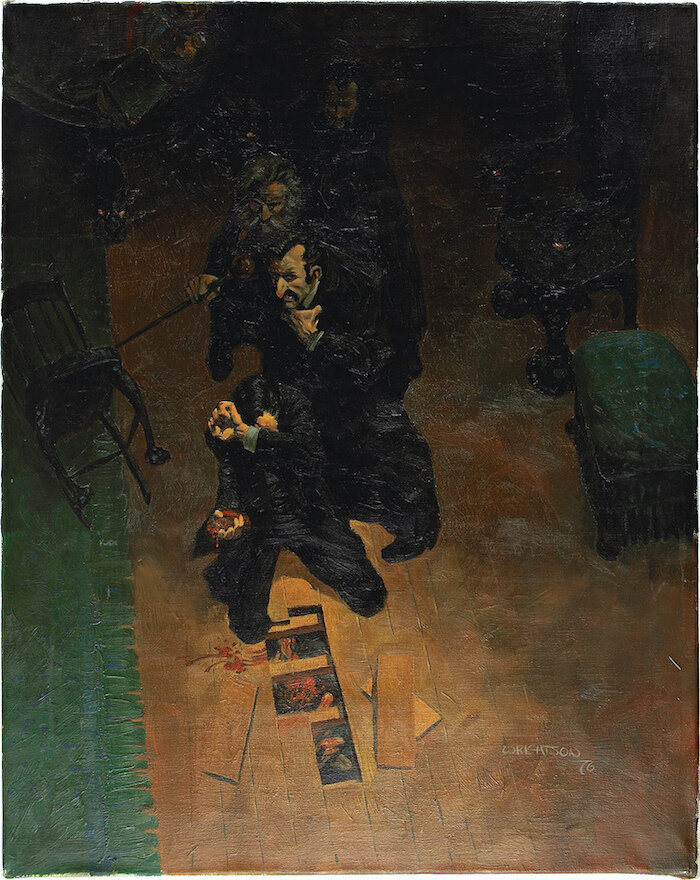
“Now this is the point. You fancy me mad. Madmen know nothing. But you should have seen me. You should have seen how wisely I proceeded — with what caution — with what foresight — with what dissimulation I went to work! I was never kinder to the old man than during the whole week before I killed him.” “The Tell Tale Heart,” 1843
What does it mean to be insane? It depends on when you ask.
We tend to understand madness—true, actual, serious madness—as being a matter of mental health, and therefore a quality of one’s inner world. Just as the mind is experienced internally, mental illness is a deeply personal and interior condition. Although people who struggle with such conditions are encouraged to seek the aid of experts, recovery is understood as being
necessarily collaborative, requiring inner work and personal effort to achieve healing.
Outside of a serious conversation, we might shift our description of insanity over to behavior. Casually, we describe the actions of others as insane when they don’t conform to societal expectation. A chaotic or disruptive person could be described as a madman, and bold or
embarrassing behavior could be seen as crazy. This definition of insanity is more closely aligned with the understanding of the term in Poe’s time.
Poe lived during a period when our understanding of madness was shifting; it was starting to become more like how we conceive of it today. The concept of insanity as a “mental illness” came about during the Age of Enlightenment, which roughly encompassed the 18th century.
Enlightenment Era thinkers started conceptualizing madness as a health condition, and speculated that it could be treated using a rational approach.i
Up until this point, insanity was seen as a failure of character, or even a soul-related issue. Lunacy, idiocy, cretinism, dementia, mania, hysteria, melancholia, and immorality, were all ways to describe insanity. The core idea was that a sane person could remain in control of these errors, but a weak-willed person was unfit to be their own master. Sane people kept their actions in check. Insane people did not have the strength of character to maintain good behavior. Madness was, as a result, a domestic problem. It was a character flaw, and therefore it was to be kept in check by the sufferer’s family and community; it was to be addressed by local religious authorities. If the madness was of a violent or exceptionally disruptive variety, sufferers would be sent away to correction houses, poorhouses, or workhouses.
Around Poe’s time, however, charitable asylums were established to house “chronic lunatics.” The first American facility for the mentally ill appeared in Williamsburg Virginia in the 1770s.ii Early examples of state-mandated mental health facilities emerged in Britain in the early 1800s, and in New York State in the 1840s.iii In 1840s Britain, the status of the mentally ill was shifted to that of a patient (rather than, say, a criminal).iv While many of these institutions operated from a place of compassion and scientific curiosity, they also quickly became profit-motivated. The rise of the state-run mental institution was exponentiated by its capacity to generate wealth.
While this shift was momentous in many ways, the fact remained that, be it a state-run mental asylum or a workhouse, the main purpose of these institutions was to sequester inconvenient, unpalatable people away from the public. Now that such facilities had funding and a more empathetic, science-minded foundation, people would be handed over to them for all kinds of reasons. Transgressions could be as small as disobedience, as broad as poverty, or they might encompass social obstacles like violence. Regardless, the insane were considered burdens upon the general public and represented a threat to social order, propriety, and safety. The formalization of these asylum systems became increasingly focused on clearing out “pauper lunatics” and other undesirables. Poe’s explorations of madness in his short stories illustrate the changing attitude of his time. A
lot of the emerging genre of gothic fiction was focused on this rising emergence of the mental facility, and the nature of the sort of people who benefited from institutionalization. Adding further complexity to Poe’s work was the fact that he wrote during a period when short stories functioned generally as moral lessons, pulling inspiration from and filling a similar role to fairy tales. Consider Rip Van Winkle, written by Washington Irving and published in 1819. It is a short story that reads like folklore. Exploring themes of a rapidly-changing world, it is essentially an allegory that uses fantasy elements in a real-world setting to illustrate a complex
metaphor about something real in the world; in this case, the American Revolution and the sometimes alarming swiftness of time.
“The Tell-Tale Heart,” in contrast, written by Poe and published in 1843, is not an allegory and does not really impart any sort of message to its
audience. A famous example of an unreliable narrator in literature, Poe creates a story in which it is unclear what parts of the narration are reliable, and explores broader questions of morality in such an ambiguous space.
In “The Tell-Tale Heart,” the narrator commits a violent crime, but he feels no guilt for having done so. He explains himself lucidly, asking, “would a madman have been so wise as this?” He describes his actions, which he performed intentionally, and with care. He is sagacious, cautious, wise, sharp, alert, passionless. He is nervous, of course, and has not been insulted or harmed by the man he is about to kill. He recognizes his hyper-fixation, and is aware that he is murdering somebody. His goal is to kill the old man he lives with, thereby ridding himself of the man’s hideous eye, and do so in a way that allows him to evade capture or consequence. He
plans the murder carefully so that he can get away with it. Eventually, he confesses to his crime and is taken into police custody, but not because he was horrified by the magnitude of his crime. Rather, it’s because his lucidity slips. He loses his sense and certainty about the world around him. He hears something that nobody else is reacting to, and it is this distressing feeling of dissonance that causes his collapse. In other words, his
immoral actions are not what exemplify his insanity, but his inner experience. His keen senses detect the sound of a heartbeat, he can hear the beating as the police search his home. “[…] the noise arose over all and continually increased. It grew louder — louder — louder! And still
the men chatted pleasantly, and smiled. Was it possible they heard not?” He becomes unable to reconcile the damning sound with the jovial behavior of the investigators, and cracks. The narrator behaves immorally when his mind is ordered (if a bit manic), but he only acts morally
(by confessing his guilt) when he has lost internal order. He admits his crime only when his rationality starts to fail.
So, what is Poe saying here? Is madness an action or a state of mind? Does certainty absolve a person of madness? Is the narrator lying? If so, is he lying to us, or to himself? Does he need to lie to be unreliable? If he is reporting himself as accurately and honestly as possible, then is he still an unreliable narrator simply because his lived experience gives him
contradictory input? If that’s the case, is it possible for any narrative to be reliable? None of us can guarantee that our perceptions always align with the objective world. Subjective experience is never impartial or empirical.
What Poe did for short stories in his time was make space for uncertainty. He allowed horror to be messy, unresolved, and purposeless. His stories show us examples of madness, hubris, violence, and greed, without necessarily telling us what was right or wrong. By removing any moral framework, many of his works don’t quite serve as metaphors or cautionary tales.
Instead, they were allowed to just be. While it is clear to the readers that such a person as the narrator is likely a good candidate for institutionalization, it is unclear why. Is it because he’s a danger to others? If so, would prison not serve this end just as well? Nowadays, a story like “The Tell-Tale Heart” doesn’t seem very out of place. We’re accustomed to stories that read like snapshots, that simply look into the mind of another person. In Poe’s time, this sort of neutrality was new, and through it, he was able to explore nuance in a way that hadn’t really been done before.
iSee John Locke (1690 An Essay on Human Understanding) and Philippe Pine.
ii Public Hospital for Persons of Insane and Disordered Minds, Williamsburg VA 1773.
iii County Asylums Act of Britain 1808 and NY State Asylum system established 1842.
iv Lunacy Act of 1845 (Britain).