Written by Kelly Keener
In the fall of 2016, I acquired Elizabeth Fries Ellet’s autograph album. Ellet, who was a contemporary of Poe’s, was known publicly for her prolific writing. She is best known today for her work The Women of the American Revolution (1849), as well as for being involved in Poe’s life in notorious ways. Her involvement in the Frances Sargent Osgood and Poe affair of 1845-46 usually places her in a negative light, leaving her to seem like a vindictive, gossiping busybody. It makes one wonder, however, if she truly deserves to be remembered as the woman who allegedly caused Virginia Poe’s death, or if she deserved the treatment Poe paid her in his short story, “Hop-Frog”, where she most likely represents the king character. After all, how could one feel sympathy for Ellet when, according to Poe in a letter written by him to Sarah Helen Whitman dated November 24, 1848, “My poor Virginia was continually tortured…and on her death-bed declared that Mrs. E. had been her murderer” (The Edgar Allan Poe Society of Baltimore). Although it is tempting to only recognize her in the context of Poe, and in negative contexts at that, I believe she deserves to live beyond these small moments for which she is widely remembered. I hope that by sharing some of the letters from her album, I may be able to continue her story beyond the Poe episodes and present her in a sympathetic way.
In this article, I am continuing my series by sharing and exploring a personal letter from her album. I will transcribe and provide scans of the letter and then discuss whatever context may be taken from the letter, focusing on Ellet and her character.
This letter is written by Ellet to an unknown recipient. Please find scans below, as well as my transcriptions.
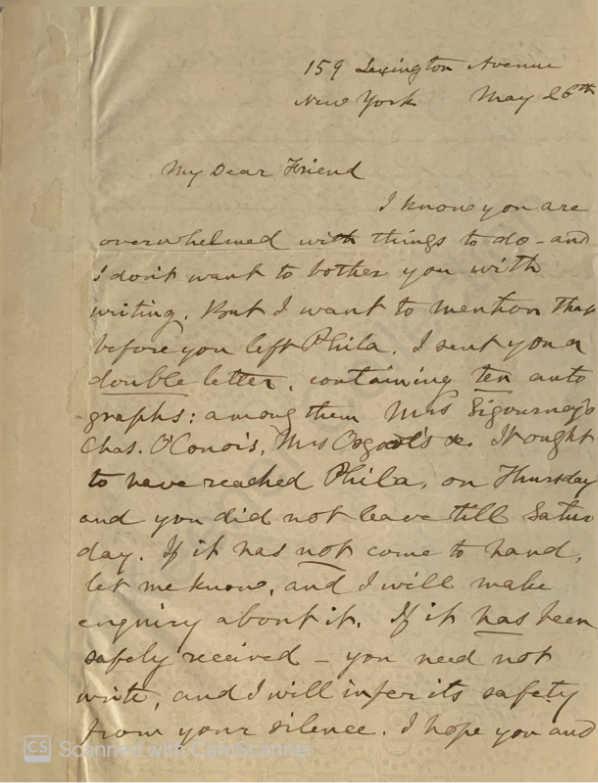
159 Lexington Avenue
New York May 26th
My Dear Friend
I know you are
overwhelmed with things to do – and
I don’t want to bother you with
writing. But I want to mention that
before you left Phila. I sent you a
double[?] letter, containing ten auto
graphs; among them Mrs. Sigourney’s,
Chas. O’Conor’s, Mrs. Osgood’s, etc. I thought
to have reached Phila. On Thursday
and you did not leave till Satur
day. If it has not come to hand,
let me know, and I will make
enquiry about it. If it has been
safely received – you need not
write, and I will infer its safety
from your silence. I hope you and
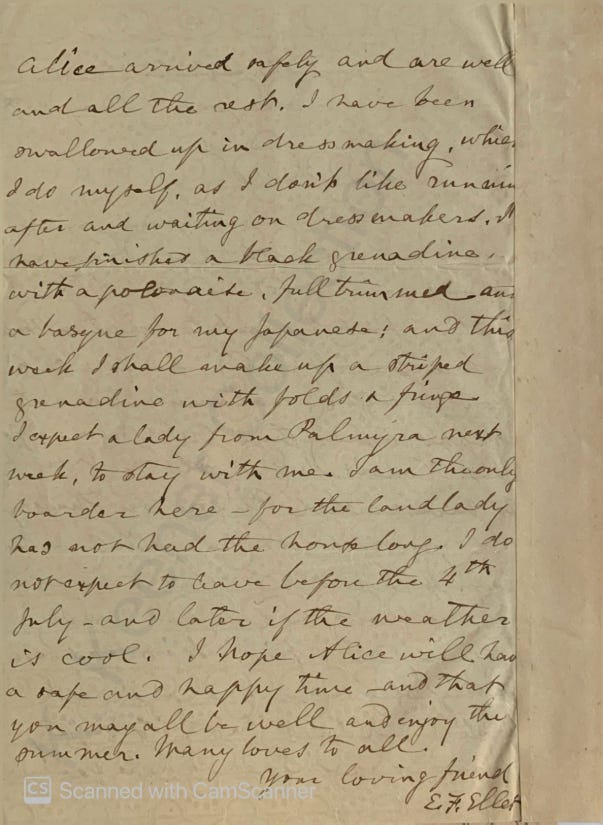
Alice arrived safely and are well
and all the rest. I have been
swallowed up in dressmaking, which
I do myself, as I don’t like [?]
after and waiting on dressmakers. I
have finished a black grenadine,
with a polonaise, full trimmed and
a basque for my Japanese; and this
week I shall make up a striped
grenadine with folds + fringe.
I expect a lady from Palmyra next
week, to stay with me. I am the only
boarder here – for the landlady
has not had the home long. I do
not expect to have before the 4th
July – and later if the weather
is cool. I hope Alice will have
a safe and happy time and that
you may all be well and enjoy the
summer. Many loves to all.
your loving friend
E. F. Ellet
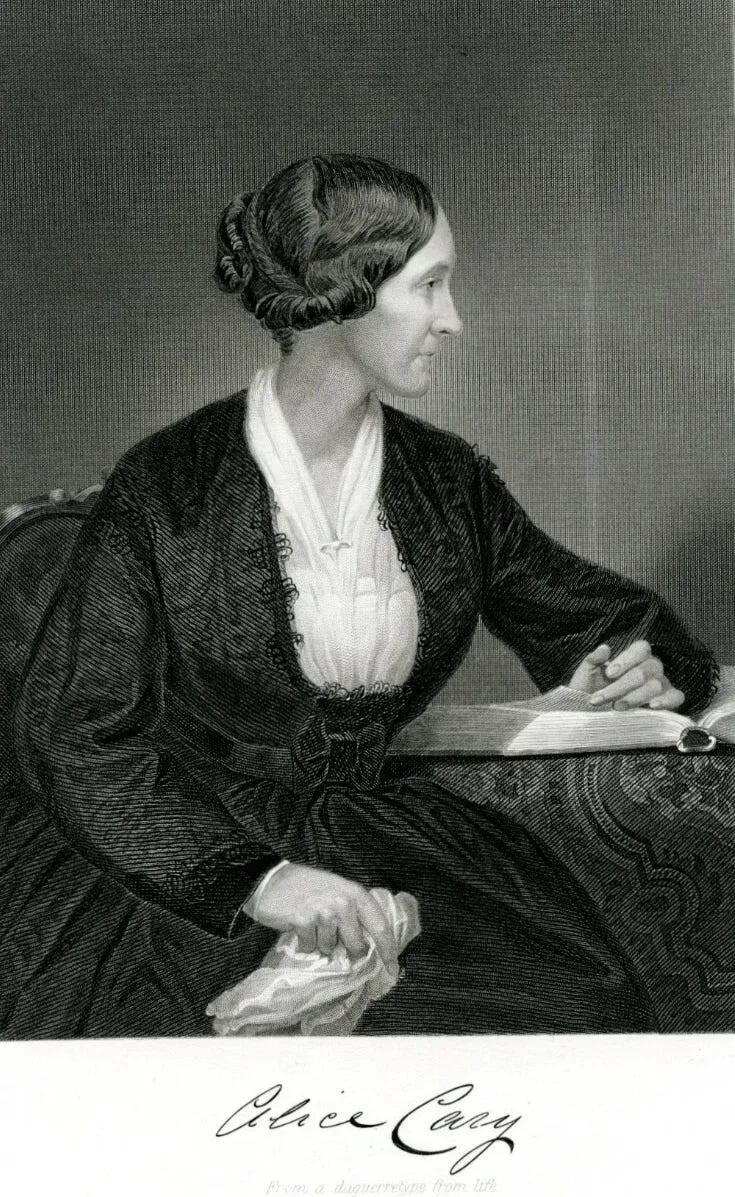
Firstly, who is the Alice to whom she refers? It is impossible to tell who this warm letter was written to, although the mention of Alice brings to mind Alice Cary, an American poet who was often closely associated with her sister, Phoebe Cary, who was also a poet. It should be noted that Ellet and the Cary sisters ran in the same literary circles. According to The Stammering Century by Gilbert Seldes, Amelia Bloomer wrote about one of Horace Greeley’s soirées where Ellet and the Cary sisters were both present: “At the latter place [Horace Greeley’s] we met about a dozen of New York’s literati. Of these I only remember Charles A. Dana, then on the Tribune staff; Mrs. E. F. Ellet, a prominent story-writer at that time; and Alice and Phoebe Cary, the poet sisters” (282). However, at this time I do not have evidence that they had an enduring friendship. For example, in the section “Elizabeth Frieze Ellet” in Thomas Ollive Mabbott’s The Collected Works of Edgar Allan Poe, Mabbott writes, “Later they [Rufus Griswold and Ellet] were not on friendly terms, the lady [Ellet] did not like her treatment in the Female Poets, nor the excessive praise there given the Carey[sic] sisters, Alice and Phoebe. With Mrs. Stephens and Anne Lewis, she planned to write Griswold and Alice Carey[sic] down” (178). Of course, Griswold’s volume was published in 1848, which gave several decadesfor the three to reconcile.
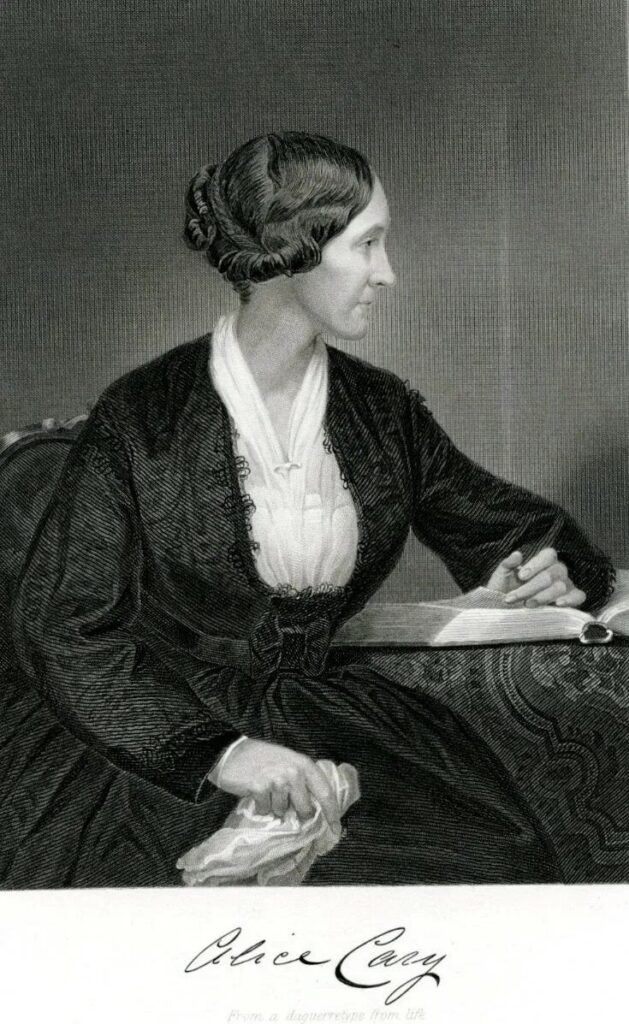
There is another possible clue regarding Ellet and the sisters having a relationship, which relates to my previous article about Margaret Fox, who Ellet was on friendly terms with. As found in Poe’s Helen Remembers, in a letter by Sarah Helen Whitman to John H. Ingram dated July 31, 1874, Whitman writes that the Cary sisters were involved with Spiritualism: “They were, Alice & Phoebe, enthusiastic spiritualists — ‘mediums,’ their friends said — & late in the evening the conversation turned on that subject” (pg. 197). Perhaps Ellet grew closer to the two following her friendship with Margaret, who founded the Spiritualist movement? Regardless, it is impossible to name the recipient or ascertain the nature of Ellet’s relationship with the Cary sisters. Nor do we have a date for this letter, other than the vague “May 26th.” “159 Lexington Avenue” appeared as the address for a boarding house as early as February 26, 1858, in the New York Daily Herald; thus, perhaps we can date this to 1858 or later. We will revisit this date following an analysis of the clothing, which may perhaps give us a more definitive date. For now, regardless of these missing pieces of information, the letter still provides context about Ellet’s personal world—autograph collecting and her interest in dressmaking, for example. These are worth exploring.
In her letter, she begins by explaining she had sent ten autographs to the letter recipient, including Lydia Sigourney’s, Charles O’Conor’s, and Frances Osgood’s. Lydia Sigourney was an American author, poet, and publisher; Charles O’Conor was United States Attorney for the Southern District of New York; and Frances Sargent Osgood was a poet. Interestingly, if this letter was written in 1858 or after, Osgood had been deceased for at least eight years. It causes one to wonder if Ellet was gifting cut signatures of Osgood’s name to close friends or had a source for these signatures. Either way, her generosity in gifting these signatures, whether acquired in-person, after the fact, or through others, is one small gesture that nods to a larger cultural interest at the time—autograph collecting.
Before I discuss this further, consider the Poe Museum’s own Lucy Dorothea Henry Laighton album, which can be seen here. Her album features numerous prominent literary signatures, from poet and educator Charles Dickens to Edgar Allan Poe, to political figures such as Thomas Jefferson and her grandfather, Patrick Henry. But how did she acquire these? In terms of the Poe acquisition, Edgar Allan Poe’s Manuscript for “Frances Sargent Osgood,” there is an interesting backstory. It was given to Lucy by poet, editor, and publisher John R. Thompson, most likely because Lucy was a friend of Edgar’s sister, Rosalie Poe. Thompson had acquired it when Poe sent it to him for inclusion in the Southern Literary Messenger, which Thompson owned at the time.
However, personal connections were not always necessary for acquiring autographs, and it was not uncommon for authors to respond to simple letter requests for signatures. According to the website Raab Collection’s article, “Autograph Collecting in America—a Brief History,” autograph collecting had become widespread by the late 1830s, growing even more popular in the 1840s and 1850s. Even Lincoln, in 1860, “had so many, he set secretaries to writing out responses for his signature. By then, recreational clubs devoted to autograph collecting had appeared,” according to Raab Collection. Many autograph albums, often ornately decorated, can still be found for sale online, in antique stores, and found in museums, and exemplify historical communication, penmanship, and oftentimes friendship.
Referring back to the letter found in Ellet’s own album, not only does it reveal a glimpse into autograph collecting, but it also reveals a possible hobby of hers: dressmaking. In her letter, she talks about how she has “been swallowed up in dressmaking, which I do myself …” She mentions a black grenadine dress with a polonaise, fully trimmed. According to the Greater Bay Area Costumers Guild in their article, “Sheer Delight: Sheer Dresses of the Crinoline Era,” a grenadine dress is “An open silk, or silk/wool, gauze resembling barège but with a more open mesh. Many varieties both plain and figured” (GBACG). According to Kenna Libes in her article, “Polonaise,” “The polonaise dress of the nineteenth century was especially popular in the 1870s, and could refer to a long overbodice cut all in one piece … or a gown featuring bustled swags on its overskirt …” (Fashion History Timeline).You can follow this link to see examples of this style of dress from both the 18th and 19th centuries. Ellet mentioned her dress was also fully trimmed, meaning it most likely was embellished in a way that gave the dress elegance, sophistication, and propriety. For example, she mentioned another dress, a striped grenadine with folds and fringe. The fringe was such an example of trimming. Other examples include ribbon and lace. Finally, she mentioned a basque for her Japanese. The Kyoto Costume Institute shows an example of an 1870s dress that was created as the result of the West’s interest in Japanese culture and fashion, called “Japonism”. According to their website, women deconstructed Japanese kimonos to make new gowns, wore kimonos, and made dresses out of kimono fabric (KCI). You can see an example of an 1870s gown here. Regarding the basque for her “Japanese,” according to Harper Franklin in her article, “1870-1879,” this would have been a “kind of peplum extending past the waistline. Basques combined with the overskirts to create a layered look” (Fashion History Timeline). These were also popularly worn during the 1870s. Based on these fashion clues, therefore, we may surmise the letter is dated to the 1870s, well beyond my initially proposed 1858 date.
Finally, one thing I would like to point out is the way in which she signed her letter. She first signed off with “Many loves to all” and continued with “your loving friend”. These affectionate ways of ending her letter perhaps shed light on a kinder character. She does not sign off with “sincerely,” “truly,” or “yours,” but rather in an intimate way that evokes deep friendship. Although we tend to place her in light of the Poe-Osgood affair that forced Poe out of literary circles, this shows she was beyond vitriol and could be a good friend who showed genuine goodwill. All in all, her letter shows she sometimes lived a mundane life, sewing dresses and most likely tending to normal house chores. She took the time to write letters, such as this one, showing care towards her friends. Hopefully, as I continue this blog series, we will be able to further uncover other aspects of her character and personality and continue to showcase her in a way that moves her beyond the Poe episode.