
Written by Jake Taylor
Today marks the 183rd anniversary of the publication of Poe’s short story “The Black Cat”
The first mention of a cat in Poe’s life dates to when he was only three years old. While he and his foster family were away in 1812, the Allans’ niece, Rosanna Dixon, wrote to them, “Tell Edgar, Tib is very well, also the Bird and Dog.”[i] A footnote provided by Thomas H. Ellis, the son of John Allan’s business partner, identified Tib as “a famous Tabby cat of remarkable size and beauty.”[ii] Tib’s name may have been a reference to Tybalt, the “Prince of Cats,” from Shakespeare’s Romeo and Juliet. This allusion is certainly possible as John Allan admired Shakespeare, once writing, “Gods! what would I not give, if I had his talent for writing! and what use would I not make of the raw material at my command!”[iii]
The exact ownership of Tib is uncertain. Ellis’ footnote continues, recalling a famous Tabby “when Mr. Richard lived on Main Street.”[iv] John Richard was Rosanna Dixon’s uncle and a neighbor to the Allans.[v] It is likely that either the Richard or Dixon families cared for the Allans’ pets while they were away in Staunton or that Poe simply became attached to his neighbor’s cat. It is also worth noting that Ellis, having been born in 1814, would have had little, if any, firsthand recollection of Tib. Another possibility is that the Allans, when leaving for England in 1815, gave Tib to John Richard to care for, explaining Ellis’ association of the two.
Nonetheless, Poe maintained an appreciation for cats throughout his life, as evidenced by their appearances in some of his earliest short stories published between 1832 to 1835. In “Loss of Breath,” the protagonist’s cat purrs on the rug, ignoring its master’s predicament. In “Bon-Bon,” the titular hero’s tabby, whose thoughts are read aloud, believes Bon-Bon is admiring “the length of her tail and the profundity of her mind.” In “The Unparalleled Adventure of One Hans Pfaall,” a mother cat and her litter accompany Hans on his journey to the Moon, but tragically fall from the balloon in Hans’ pursuit of scientific discovery.
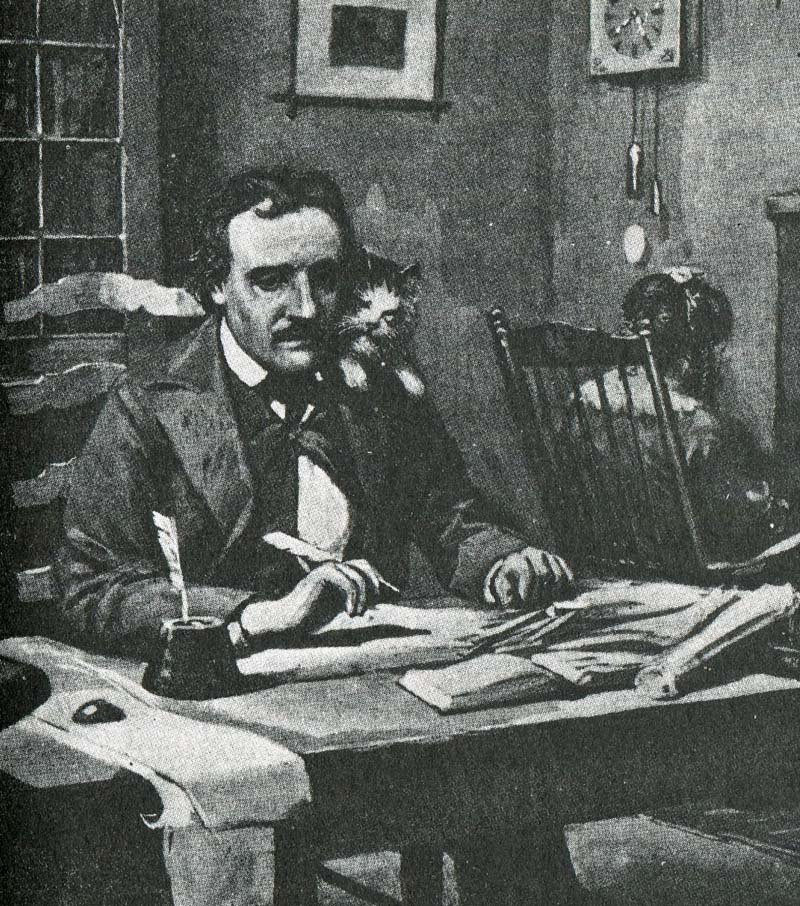
By 1840, Poe owned a black cat with his wife, Virginia, and mother-in-law, Maria Clemm. What little is known about this cat comes from a short article, “Instinct vs Reason, ” where Poe writes: “The writer of this article is the owner of one of the most remarkable black cats in the world — and this is saying much; for it will be remembered that black cats are all of them witches. The one in question has not a white hair about her, and is of a demure and sanctified demeanor.”[vi] He goes on to describe how the cat uses reason to bypass a thumb-latched door to the kitchen; a feat that his family has witnessed “a hundred times at least.”[vii]
Three years later in 1843, Poe featured a black cat as a main character in his aptly named tale, “The Black Cat.” Pluto, named after the ancient Greek god of the underworld, is described as “a remarkably large and beautiful animal, entirely black, and sagacious to an astonishing degree.”[viii] Pluto lived with the story’s narrator for several years, following him wherever he went. This story repeats Poe’s notion that all black cats are witches in disguise. Following Pluto’s murder, another black cat, similar in appearance to him but with a white mark of hair on its chest resembling gallows, comes to haunt the narrator.
The last cat to join Poe’s household was a large tortoiseshell named Catterina. The exact spelling of her name is uncertain as Poe referred to her as both “Catterina” and “Catarina,” along with nicknames “Catter” and “Kate,” in his letters.[ix] Although the name is an obvious pun on her being a cat, it may have also been inspired by Elizabeth Barrett Browning’s poem “Catarina to Camoens,” which Poe reviewed as part of Browning’s 1844 anthology A Drama of Exile and Other Poems.[x]
Catterina lived with the Poe family from at least 1844 while they were in Philadelphia. After moving to New York, Virginia “had a hearty cry” as Catterina was not with her for a brief period.[xi] Marie Louise Shew, a friend of Edgar’s and a voluntary nurse to Virginia, described Catterina’s behavior in the Poe household, “Mr. Poe’s cat always left her cushion to rub my hands and I had always to speak to the cat before it would retire to its place of rest again… She seemed possessed and I was nervous and almost afraid of her, this wonderful cat. Mr. Poe would get up in the night to let her in, or out of the house or room, and the cat would not eat when he was away.”[xii] Another friend, Mary Gove Nichols, recalled the large tortoiseshell cat resting on Virginia to provide warmth as she lay dying. Nichols wrote, “The wonderful cat seemed conscious of her great usefulness.”[xiii] Catterina died shortly after Edgar in October 1849 as Maria Clemm was moving out of their Fordham cottage.[xiv]
To celebrate Poe’s love for cats both in his life and literature, the Poe Museum has been home to several cats over the last fourteen years. On November 7, 2012, the museum’s gardener found three small kittens in the Enchanted Garden: Edgar, Pluto and Catterina. Staff volunteered to care for them, seeing that they receive regular veterinary care, healthy food, and a warm room to call home. Edgar and Pluto became beloved mascots for the museum and often greeted visitors, while Catterina was adopted by a former staff member. Pluto passed away in September 2024. On November 7, 2024, the Poe Museum welcomed Tib, a two-month old tuxedo cat from Blackstone, Virginia. Originally named Bones, Tib was transferred to Richmond SPCA and was soon adopted by the museum to join Edgar as a museum greeter.
Want to learn more about Poe and Cats? Attend our upcoming Poe and Cats focus tour on October 29th and November 7th.
Support the Poe Museum’s cats by following them @poemuseumcats or by donating to the Poe Museum.
[i] Arthur H. Quinn, Edgar Allan Poe: A Critical Biography (1941), 58.
[ii] Thomas H. Ellis, Ellis family papers, Virginia Museum of History & Culture.
[iii] Quinn, Edgar Allan Poe, 57.
[iv] Ellis, Ellis family papers, Virginia Museum of History & Culture.
[v] James A. Harrison, Life and Letters of Edgar Allan Poe (1903), 23; Dwight R. Thomas and David K. Jackson, The Poe Log (1987), xxii.
[vi] Clarence S. Brigham, Edgar Allan Poe’s Contributions to Alexander’s Weekly Messenger (1943), 31.
[vii] Ibid.
[viii] Edgar Allan Poe, “The Black Cat,” United States Saturday Post (August 19, 1843), 1.
[ix] John W. Ostrom, Burton R. Pollin, and Jeffrey A. Savoye, The Collected Letters of Edgar Allan Poe (2008), 437-438; ibid, 678.
[x] Thomas, Poe in Philadelphia (1978), 111; Pollin, The Collected Writings of Edgar Allan Poe, vol. III, (1986) 1-18.
[xi] Ostrom, Pollin, and Savoye, The Collected Letters of Edgar Allan Poe (2008), 438.
[xii] John C. Miller, Building Poe Biography (1977), 130.
[xiii] Mary G. Nichols, “Reminiscences of Edgar Poe,” Sixpenny Magazine (Feb. 1, 1863), 473.