Written by Kelly Keener
Check out Kelly’s previous article on Elizabeth Ellet, Margaret Fox, and spiritualism here!
In my last article, I focused on Elizabeth Ellet’s connection to Margaret Fox. This topic was inspired by a letter found in Elizabeth Ellet’s autograph album. In this second part of the two-part article, I am going to discuss Edgar Allan Poe, the Fox sisters, and Spiritualism. Before discussing Poe’s relationship with Spiritualism, it is important to explain what the Spiritualist movement was and its origins.
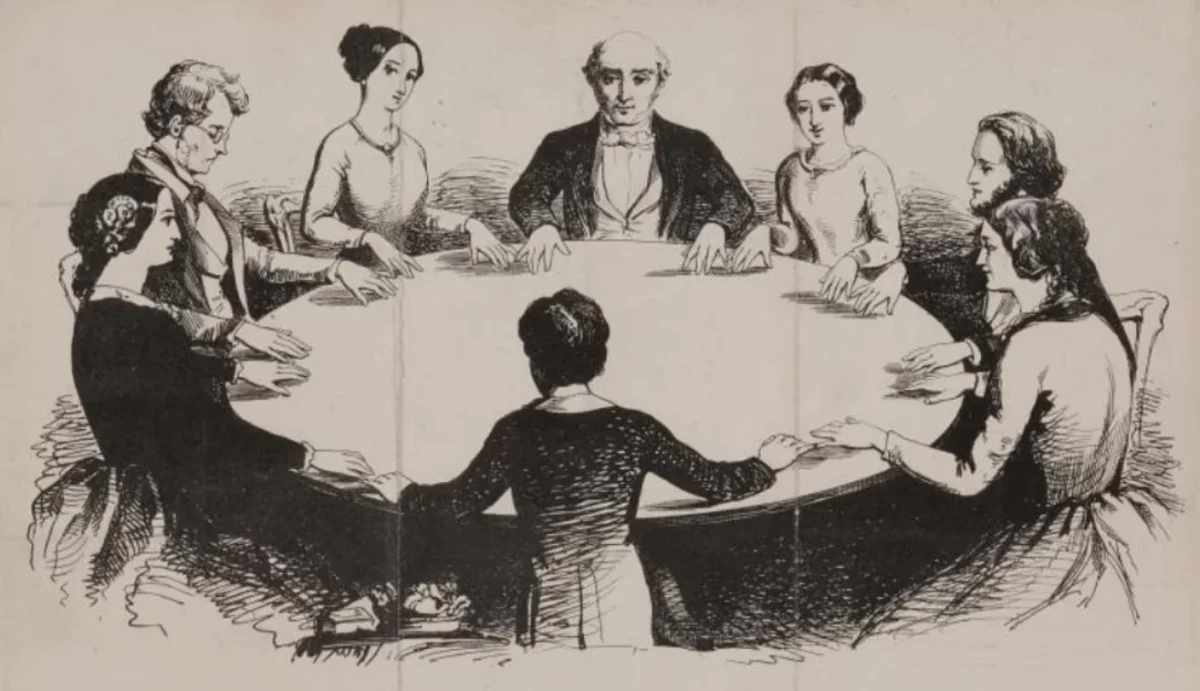
Spirit communication was not new to the 19th century. For example, in the 18th century, Emanuel Swedenborg described “his spiritual senses [as having been] opened and he began to interact directly with the denizens of heaven, hell, and the world of spirits in between” (Swedenborg Foundation). However, it was the Spiritualist movement of the 19th century that reinvented, or certainly reinvigorated, an enthusiasm for spirit communication. This was done through a different, novel approach at that time: modern seances. According to Daniel Bowlin in his thesis, The American Phantasmagoria: The Rise of Spiritualism in Nineteenth-Century America, “In its most simple form, Spiritualism is considered a movement which sought communications with the dead through mediums, seances, or similar means to gain some sort of knowledge of the metaphysical” (1). As mentioned in my first article, Margaret Fox and her sisters took part in a scheme in which they produced rapping sounds with their knuckles and toe joints, creating the false impression that spirits were making the noises. This scheme, which began in 1848, popularized this type of spiritual question and answer system, with victims of the sisters unaware that their loved ones weren’t actually in direct communication with them.
Although this movement took the culture by storm following its conception, Poe did not take part in these spiritual fantasies and fancies. Although drawn to mesmerism, which he touched upon in his story “Mesmeric Revelation,” for example, he did not participate in the Spiritualist movement. This is ironic, as he was engaged briefly to a poet and Spiritualist, Sarah Helen Whitman. According to Chris Semtner in his book, Haunting Poe: His Afterlife in Richmond & Beyond, Whitman “found [Poe’s] mind ‘rarely gifted, and accessible from peculiarities of psychal and physical organization to the subtle vibrations of an ethereal medium conveying but feeble impressions to the senses of ordinary persons.’ To her, he was a medium … Poe had been a seeker of life beyond death … a Spiritualist before Spiritualism” (65).
Despite her remarks, Poe remained unattached to Spiritualism in the traditional sense—we don’t see him partaking in seances, rappings, or other Spiritualist activities. However, according to Semtner, an “acquaintance of Poe’s recounted that, although the poet did not know anything about the new Spiritualist movement, Poe did believe in ‘helper spirits’ … beings who are said to help the living avoid danger or find hidden money” (27). Although these helper spirits did not appear in his works, “unless we include ‘Eleanora,’” according to Semtner, from time to time he incorporated the general divine, or some sort of general incorporeal beings or influences, in his works. For example, in “The Raven”, he questions, “Is there—is there balm in Gilead?” He also presents other divine language in this same poem, such as, “Swung by seraphim whose foot-falls tinkled on the tufted floor”, “’Wretch!’ I cried, ‘thy God hath lent thee—by these angels he hath sent thee’”, and even muses if the raven is a “bird or devil”. Religious language can also be found in “Catholic Hymn,” which evokes a more uplifting spiritual message:
Sancta Maria! turn thine eyes
Upon the sinner’s sacrifice
Of fervent prayer and humble love,
From thy holy throne above.
At morn, at noon, at twilight dim
Maria! thou hast heard my hymn.
In joy and wo, in good and ill
Mother of God! be with me still.
When my hours flew gently by,
And no storms were in the sky,
My soul, lest it should truant be
Thy love did guide to thine and thee.
Now, when clouds of Fate o’ercast
All my Present, and my Past,
Let my Future radiant shine
With sweet hopes of thee and thine.
It is important to note that this poem was written in 1835 for his story, “Morella,” later republished as a standalone in the Broadway Journal in 1845, and underwent slight revision, yet still maintained its overall message and tone. It causes one to wonder if the republication was simply to fill the pages of the Journal, or if he maintained a sincere, albeit ebbing, interest in the Divine. I suggest ebbing due to the uncertainty presented in “The Raven.”
Hearkening back to “The Raven,” which was published within the same year as Poe’s republication of “Catholic Hymn,” in 1845, it is interesting to see the spiritual duality of both suffering, internal turmoil, questioning, and then reassurance, peace, and foundation. Just before the publication of “The Raven,” in a letter sent to James Russell Lowell dated July 2, 1844, Poe wrote conflictedly about his spiritual unrest: “I have no belief in spirituality. I think the word a mere word. No one has really a conception of spirit. We cannot imagine what is not” (EAPoe). He proceeds to “imagine what is not” by clarifying, “… for spirit, we say is unparticled, and therefore is not matter. But it is clear if we proceed sufficiently far in our ideas of rarefaction, we shall arrive at a point where the particles coalesce …. The unparticlet [sic] matter, permeating & impelling, all things, is God. Its activity is the thought of God — which creates. Man, and other thinking beings, are individualizations of the unparticled matter.” He concludes by incorporating mesmerism and the idea of life beyond death by writing, “At death, the worm is a butterfly — still material, but of a matter unrecognized by our organs — recognized, occasionally, perhaps by the sleep-walker … through the mesmeric medium …. Thus, a sleepwalker may see ghosts.” He effectively went from stating he held no spiritual belief to forming his own conception of God and the afterlife, concluding with the possibility of being able to see ghosts. Clearly, Poe was still reconciling with these ideas.
However, the death of his wife, Virginia, in 1847 was a major turning point in Poe’s life. This left him in a state more so like his narrator in “The Raven”—someone suffering, in turmoil, and questioning if there is a balm in Gilead. Coincidentally, this event nearly overlapped the beginnings of the Spiritualist movement, preceding the birth of the movement by a year. It causes one to wonder what Poe’s initial reaction may have been to this event which developed so closely to the date of his wife’s death.
Regardless, one of Poe’s most important, yet confusing works was published the same year as the movement’s conception: Eureka. In Eureka, we perhaps see the struggle presented in both “The Raven” and “Catholic Hymn.” According to Murray Ellison in his thesis, Edgar Allan Poe and Science: Unravelling the Plot of the Universe, in Eureka, “Poe understands and writes about the pain and suffering that he has encountered in his life. To his greater satisfaction, he can attribute his suffering to science, metaphysics, and Spiritualism” (93). This seems to suggest Poe wrestled with a mix of logic, reason, and Spiritualism, especially towards the end of his life, unable to contend with one or the other. If Eureka is to be taken seriously, for its sincerity continues to befuddle Poe scholars, then it serves as a sublime example of Poe’s crisis. The so-called “Prose Poem” theorizes an early conception of the Big Bang Theory, positing that God removed Himself from mankind’s influence after creating life. Poe contends a Divine Being while also arguing that man is responsible for everything thereafter; thus, how much of our world is based on science and how much is divinely influenced? While members of the Spiritualism movement drew on the idea of an afterlife, hoping to make direct contact with it, Poe suggested that God gave man freewill—that He took away any authority upon making creation. Does this infer Poe’s argument to be both scientific and spiritual, meaning spiritual due to the inclusion and discussion of God in his prose poem? This partially betrays the Spiritualist movement because of the rational, scientific component tied to the Big Bang Theory and the removal of God following this event. Comparing this to his poems from just a few years earlier, it is interesting to wonder if Poe ever felt a sense of divinity on earth, or if he had always considered there to be a distinct separation between Heaven and earth. According to Poe, if God removed Himself completely, then why would the spirits of loved ones interact with those on earth? Therefore, was his beloved Virginia able to visit him, or was there complete separation? This must have been agonizing for Poe, and it leaves one to wonder if the Spiritualist movement left him feeling resentment for what he couldn’t experience or believe in.
Regardless of speculation, what is known is that Poe considered Eureka one of his best works, which he articulated in a letter to his mother-in-law Maria Clemm dated July 7, 1849, writing, “It is no use to reason with me now; I must die. I have no desire to live since I have done ‘Eureka.’ I could accomplish nothing more” (EAPoe).
In his 1849 poem, “To My Mother,” he suggests Virginia has a soul in the lines, “And fill my heart of hearts, where Death installed you / In setting my Virginia’s spirit free.” Because this poem succeeded Eureka, it exemplifies his ongoing struggle with the permanency of souls, the presence of an afterlife, and truth in the Divine. Why would he suggest Virginia has a spirit if he didn’t believe in an eternal resting place beyond the corporeal state? In his poem, “Annabel Lee,” also published in 1849, he mentions angels and Heaven: “With a love that the wingèd seraphs of Heaven / Coveted her and me.” Whether this language was religiously motivated, spiritually motivated, or used as an effective literary device is up to interpretation.
Although we cannot speak for Poe conclusively regarding where his mind and heart were on these matters, there may be a clue in Poe’s own very last words, recorded by Dr. John Moran while Poe lay dying in the Washington College Hospital in Baltimore. If the account is to be believed, according to Moran, Poe’s last words were, “Lord, help my poor soul.” Invoking the word “Lord” on his deathbed and crying out for mercy for his “soul” may set the debate to rest.
Overall, based on the last few years of his life, it causes one to think that if Poe had bothered to partake in Spiritualist activities, then he would have been left frustrated, for his scientific ideology would have theoretically prevented him from believing in what the Spiritualists promoted—connection to the dead on earth. In his case, based on Eureka, without God’s direct and ongoing influence, a divine connection of any kind with Heaven is impossible. But his personal spiritual wrestlings, as seen in “Catholic Hymn,” “The Raven,” “Annabel Lee,” and perhaps the last words spoken on his deathbed, show us another side that seemed hopeful, one which would have aligned with the Spiritualist movement. It is evident that although the Fox Sisters were able to influence popular writers of the day, including Sarah Helen Whitman, the ever-skeptical Poe remained unconvinced by their scheme.
Notes:
[1] Follow this link to read a newspaper clipping about a séance held at Rufus Griswold’s home: https://poemuseum.catalogaccess.com/objects/259
[2] Book suggestion: Exploring Other Worlds: Margaret Fox, Elisha Kent Kane, and the Antebellum Culture of Curiosity by David Chapin
[3] Sarah Helen Whitman can be seen in the photo below potentially posing for a séance, or showing how she would pose for such a thing: https://library.brown.edu/dps/curio/edgar-allan-poe-sarah-helen-whitman/whitman_medium-3/]
[4] An excellent article that similarly discusses Poe’s spiritual crisis, as well as the poems mentioned, can be found here: https://churchlifejournal.nd.edu/articles/suffering-and-solace-edgar-allan-poes-catholic-imagination/