“The boundaries which divide life from death are at best shadowy and vague.”
Today we celebrate the 177th anniversary of Edgar Allan Poe’s death.
Death is a part of life; it comes for us all. When we cross that divide, those who love us must deal with what we leave behind, and the history of burial and remembrance is complex, shaped by society, culture, and the station we held in life. Scholars in mortuary archaeology and bioarchaeology study these variations through a burial’s materials, iconography, cost, and circumstances — usually a straightforward analysis, so long as the paperwork and the marker have survived. Most people don’t have a complicated life post-mortem. Edgar Allan Poe is the exception.
When he was laid to rest in 1849, his body found little peace or remembrance — buried without a headstone in the Poe family plot at Westminster Hall and Burial Ground, where no other Poes had headstones either. His journey from that unmarked grave to his current resting place beside his mother-in-law and aunt, Maria Poe Clemm, and his wife, Virginia Clemm Poe, was full of mishaps: a grave site left to chance, a memorial destroyed in a freak accident before it could be placed, and eventually a fund led by schoolteacher Sara Sigourney Rice to purchase the memorial you visit today. Edgar Allan Poe’s post-life was almost as complicated as his living one.
Poe’s First Burial
October 7th, 1849, at Washington College University Hospital (later known as Church Hospital), around 5:00 am, Edgar Allan Poe crossed over to the great mysterious beyond at the age of 40. According to accounts, it was a cloudy, cold Monday, October 8th, when the poet was laid to rest. He was placed in an unmarked family burial plot just behind the Westminster Presbyterian Church. Reverend W.T.D. Clemm, a relative of his late wife, led the service, with fewer than ten in attendance. George W. Spence served as sexton at the brief funeral. Looking at the lack of pomp and circumstance, you would not expect this to be the funeral of the Father of American Horror.
The burial plot held Poe’s grandfather, David Poe, his grandmother, Elizabeth Cairnes Poe, and his older brother, William Henry Leonard Poe. According to sources, Edgar was placed between his grandfather and Reverend Patrick Allison. Although the Poes had no headstones, the plot was marked by Rev. Allison’s headstone and a vault belonging to William Buchanan, but the marker bears the name Joseph Pearson. According to Sexton Spence, the burial was marked with a small block of sandstone with the number 80.
Death Announcement: Rufus Griswold’s Poison Pen
Edgar Allan Poe made many enemies during his lifetime, none with a more enduring impact than Rufus Griswold. Their friendship began in Philadelphia; both writers competed for the same jobs and women. Griswold was known for his anthologies, collections that brought together the work of many different poets and authors in a single volume. However, their relationship soured over time, and Griswold would seek his revenge in print after Edgar Allan Poe’s death.
In October of 1849, Griswold was in New York when word of Edgar Allan Poe’s death reached him. Griswold sat down and, under the name of Ludwig, he wrote one of the most scathing reviews of a man’s life and disguised it as an obituary.
It opened with, “EDGAR ALLAN POE is dead. He died in Baltimore the day before yesterday. This announcement will startle many, but few will be grieved by it. The poet was well known, personally or by reputation, in all this country; he had readers in England, and in several of the states of Continental Europe; but he had few or no friends; and the regrets for his death will be suggested principally by the consideration that in him literary art has lost one of its most brilliant but erratic stars.”
On October 9, 1849, the Tribune ran Griswold’s poison obit.
Horace Greeley, the editor, would come to regret running the obituary because of the aftermath it caused for the Poe family and those who loved him. Even with the use of a Pen Name, other writers and authors figured out it was Griswold, for he had not been quiet about his contempt for Poe. Those who knew Poe and loved him tried to defend the recently deceased poet, claiming that Griswold’s words came from his own dislike of Poe, not from those who loved the man while he was alive. Sarah Helen Whitman tried to do damage control over Poe’s legacy after the obituary was published. Whitman would go on to publish a book, “Edgar Poe and His Critics,” in 1859 as a defense of her beloved, including accounts from other people and authors who had known Poe during his lifetime. Sadly, the book mattered little because, at this point in American history, the looming governmental crisis in the American South, marked by acts of rebellion, mattered more.
It is unclear why, but Maria Poe Clemm, who claimed to be the heir to Poe’s manuscripts, decided after the publication of the obituary to allow Griswold to have publishing rights to Poe’s collection of published and unpublished works. Perhaps she believed this Ludwig character was not Griswold, or maybe she thought someone else was behind the poisonous print. What is clear is that Griswold shaped the narrative surrounding Poe’s death and then profited from it.
Changing Current
Headstone: The First Attempt.
The Poe family plot held no grave markers; whether because of financial restraint or family tradition, Edgar Allan Poe was left without a marker to tell the world who lay there. Interest in Poe had not waned in spite of Griswold’s attempts to ruin Poe’s reputation, and his fans were upset when they found out the author lay in an unmarked grave. Around 1860, rumors spread around Baltimore, eventually reaching Maria Poe Clemm in Alexandria, Virginia, that Poe might be laid to rest in a basement with coal and debris covering his grave. She reached out to Poe’s cousin in Baltimore, Neilson Poe, to find out if these rumors were true. Neilson went to Westminster graveyard and made sure that Edgar Allan Poe was in the Poe family plot, but it was not well maintained or cared for. He promised Mrs. Clemm that he would make sure that the plot was better cared for, and he decided to provide a headstone for his cousin. Neilson ordered a headstone of marble brought to Baltimore to be carved by Hugh Sisson at the local monument yard. The yard sat next to the train station for convenience due to the weight of the stones. Once the stone was complete, a train derailment into the monument yard destroyed Edgar Allan Poe’s newly completed headstone. Unfortunately, Neilson Poe was not extremely wealthy and could not afford a second purchase.
Monument Achieved
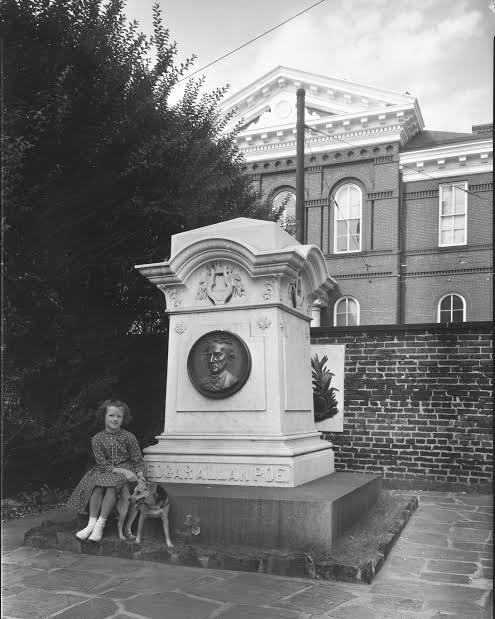
By 1871, Sara Sigourney Rice had been running a campaign to pay for the monument, with school children in Baltimore collecting small sums of money. In 1874, a final $650 donation from Philadelphia philanthropist George W. Childs cleared the bill, and a monument for Edgar Allan Poe was purchased. Poe remained unmarked until twenty-six years after his death; in late October, Poe was exhumed and, on November 6, placed under a granite monument. The monument itself was unveiled and opened to the public on November 17, 1875. It consists of two pieces: the pedestal has an attic base measuring three feet ten inches high. The die, or screen, is cubic and measures three feet two inches tall. The monument’s total height is eight feet. Poe’s mother-in-law, Maria Poe Clemm, had passed away on February 16, 1871, in Baltimore. So, when the exhumed Poe was reburied, they buried him next to Mrs. Clemm so that they would lie side by side under the new monument.
Virginia Clemm Poe’s exhumation took place later, when it was discovered that portions of Fordham Cemetery were being razed in 1883. According to the story given by William F. Gill, he had discovered that the local sexton, Dennis Valentine, had planned to toss what was left of Virginia because he did not know of anyone to claim her. Gill took Virginia Poe’s bones home and placed them under his bed, then brought them out to show visitors the bones of the real “Annabel Lee.” He eventually worked with the sexton to collect a box for her remains, and he contacted Neilson and John Prentiss Poe, his cousin and Neilson’s son in Baltimore, to make arrangements for Virginia to be laid to rest next to her cousin and husband.
The memorial celebrations in 1875 tell a very different story than the meager funeral of 1849. Love and appreciation for Poe grew after his passing. Compared with the sparse attendance at his funeral, the memorial celebrations drew large crowds. The dedication ceremonies began in the study room of the Western Female High School, with a stage full of dignitaries. The Baltimore Philharmonic Society performed, the President of Baltimore City College gave the primary address, and letters were read aloud from famous American and British writers such as Longfellow, Holmes, Bryant, Swinburne, and Tennyson. There was even a graveside dedication with a big reveal of the new monument, and a floral tribute in the shape of a raven from the acting company of Ford’s Grand Opera House. Walt Whitman attended this celebration.
1849 vs 1875
For a man as controversial in life as in death, what can the different memorials to Edgar Allan Poe tell us about the man and those who loved him? First, we must say that part of the reason why Poe’s funeral might have been so poorly attended was due to the suddenness of his death. He was forty years old, and despite popular belief about the past, was not considered to be an age close to death. If someone made it out of the childhood phase, which had the highest mortality, you could potentially expect to live into your sixties or seventies. That is part of the reason why Poe’s death is considered to be so mysterious, because it would not be a natural cause but one that must have been caused by something unforeseen, such as an accident or disease. There was no expectation of his death. Another reason it was likely rushed is that embalming would not become a practice until after the beginning of the American Civil War. Even then, it would have been extremely costly and done only for families who could afford it. There would have been a time crunch to bury Poe before decomposition started in earnest.
Cost would have been another prohibitive factor; at this time, Edgar Allan Poe was struggling financially. He had planned on marrying the Widow Elmira Royster Shelton when he left Richmond, but his own personal bank account had been tight since the failure of his literary magazine, the Broadway Journal, and the death of his wife Virginia in New York. All of these would have been contributing factors to why Poe’s first burial and memorial had been so sparse.
Griswold’s poison pen was meant to detract from Poe’s remembrance, and the poor timing of Whitman’s refutation of the obituary wasn’t helpful. However, the success of “Annabel Lee,” “The Tell-Tale Heart,” and “The Raven” could not be underestimated. He spoke to something in the American psyche that would eventually cross through time and space. Death, longing, pain, and guilt. In fact, “Annabel Lee” had been written months before his death, and after, several magazines reprinted the poem as a memorial to Poe’s sudden death. It was his writing that saved a man so widely damned by another writer’s vengeance.
Starting in 1874, an Englishman named John Henry Ingram took it upon himself to give Poe a more sympathetic biography and a better understanding of the much maligned writer. He had competition from W. F. Gill, R. H. Stoddard, and E. L. Didier, but Ingram’s biography and collection of Poe’s work were the most reprinted of the works. Ingram used Whitman’s daguerreotype, which shows Poe as put together and more handsome than the daguerreotype Griswold used. He did not shy away from the more problematic sides of Poe’s life but tended to paint them in more sympathetic terms. Ingram also directly attacked Griswold’s obit and account, citing the ill feelings between the two men at the time of Poe’s death, calling into question Griswold’s motivation for publishing a negatively framed obit. By 1875, with the celebration and re-interment of Edgar Allan Poe, the narrative around him was already changing, focusing on celebrating a man whose pen had gifted the world with stories and poems that connected deeply with the human experience.
Complexities of Remembrance
Edgar Allan Poe’s struggle to find a place of belonging seemed to follow him well into the afterlife. However, his work was undeniable and spoke to generations about longing, death, guilt, and fear. Those who loved him fought tirelessly to correct the damage Griswold had done to his reputation. A writer and fan named John Ingram finally began to correct the narrative, turning it in the deceased author’s favor. The people of Baltimore, along with Sara Sigourney Rice and George W. Childs, transformed Poe’s grave into a proper memorial and gave the author a more elaborate celebration befitting one of America’s most recognizable writers.
Poe died in 1849, but his story did not end. His legacy, memorial, and final reunion with his family shape how he is remembered today. When you think the time is done and there is nothing left to be said, remember that sometimes our story is still being written, even if we no longer have any impact on it. The dead still tell tales, and depending on who we are and how we lived, no legacy may ever be settled.
Sources:
A Monument to the Memory of Edgar Allan Poe Historical Marker. https://www.hmdb.org/m.asp?m=6627. Accessed 10 Aug. 2026.
“American Gravestone Evolution – Part 2.” Atlas Preservation, https://atlaspreservation.com/pages/american-gravestone-evolution-part-2. Accessed 24 Aug. 2026.
Among Family: Poe’s Original Burial Place. http://www.nextexithistory.us/explore/historical-sites/among-family-poes-original-burial-place/. Accessed 24 Aug. 2026.
Cooke, Alice L. “The Popular Conception of Edgar Allan Poe from 1850 to 1890.” Studies in English, no. [22], 1942, pp. 145–70.
———. “The Popular Conception of Edgar Allan Poe from 1850 to 1890.” Studies in English, no. [22], 1942, pp. 145–70.
Deetz, James. In Small Things Forgotten : [An Archaeology of Early American Life]. With Internet Archive, New York : Anchor Books, 1996. Internet Archive, http://archive.org/details/insmallthingsfor0000deet.
Edgar Allan Poe Society of Baltimore – Articles – Edgar Allan Poe: The Man (M. E. Phillips, 1926) (Section 01). https://www.eapoe.org/papers/misc1921/mep1ch01.htm. Accessed 24 Aug. 2026.
Edgar Allan Poe Society of Baltimore – Baltimore – Poe’s Memorial Grave – Original Burial Place. https://www.eapoe.org/balt/poegravd.htm. Accessed 24 Aug. 2026.
Edgar Allan Poe Society of Baltimore – Bookshelf – Edgar Allan Poe the Man (Phillips, 1926) – Title and Contents. https://www.eapoe.org/papers/misc1921/mep10000.htm. Accessed 24 Aug. 2026.
Edgar Allan Poe Society of Baltimore – Works – Poems – Annabel Lee (Text-05b). https://www.eapoe.org/works/poems/annabelk.htm. Accessed 5 Sept. 2026.
Edgar’s Bitterest Enemy – The Poe Museum. https://poemuseum.org/edgars-bitterest-enemy/. Accessed 1 Sept. 2026.
Here at Last He Is Happy: The Death and Burial of Edgar Allan Poe – Maryland Center for History and Culture. https://www.mdhistory.org/here-at-last-he-is-happy-the-death-and-burial-of-edgar-allan-poe/. Accessed 29 Aug. 2026.
Hopkins, Johns. “Westminster Burying Ground.” Explore Baltimore Heritage, https://explore.baltimoreheritage.org/items/show/25. Accessed 24 Aug. 2026.
Hutcherson, Dudley R. “Poe’s Reputation in England and America, 1850-1909.” American Literature, vol. 14, no. 3, 1942, pp. 211–33. JSTOR, https://doi.org/10.2307/2920972.
In Small Things Forgotten : [An Archaeology of Early American Life] : Deetz, James : Free Download, Borrow, and Streaming : Internet Archive. https://archive.org/details/insmallthingsfor0000deet/page/n9/mode/1up. Accessed 24 Aug. 2026.
Learn about the Fake News behind Edgar Allan Poe’s Reputation | American Masters | PBS. https://www.pbs.org/wnet/americanmasters/learn-fake-news-behind-edgar-allan-poes-story/9486/. Accessed 29 Aug. 2026.
mdhslibrarydept. “Here at Last He Is Happy: The Death and Burial of Edgar Allan Poe.” Maryland Center for History and Culture, 22 Oct. 2015, https://www.mdhistory.org/here-at-last-he-is-happy-the-death-and-burial-of-edgar-allan-poe/.
“Poe History in Baltimore.” Poe Baltimore, https://www.poeinbaltimore.org/experience/poe-history-in-baltimore/. Accessed 29 Aug. 2026.
Poe Museum’s Object of the Month Angered Poe’s Father – The Poe Museum. https://poemuseum.org/poe-museums-object-of-the-month-angered-poes-father/. Accessed 24 Aug. 2026.
The (Still) Mysterious Death of Edgar Allan Poe. https://www.smithsonianmag.com/history/still-mysterious-death-edgar-allan-poe-180952936/. Accessed 24 Aug. 2026.