Categories
The Poe Museum Blog

Poe’s Last Love Remembered

In one of the last letters he would ever write, Edgar Poe told his aunt, Maria Clemm, “I think [Elmira] loves me more devotedly than any one I ever knew & I cannot help loving her in return.” In the same note, he spoke of his desire to marry Elmira, the woman to whom he had been engaged twenty two years earlier and who had inspired a number of his poems written during those two decades.

“Elmira” was Sarah Elmira Royster Shelton, one of the people who had the greatest influence on Poe’s life and work. When their first engagement was broken by her father, the eighteen-year-old Poe wrote about his sense of loss in poems including “Tamerlane,” “Song,” and “To Elmira.” Even Poe’s brother, William Henry Leonard Poe, wrote a short story about the doomed romance. A few critics also believe both Poe’s poem “To One in Paradise” and his 1848 version of “To Helen” describe the garden Poe and Elmira used to hide from her disapproving parents during their courtship. Years later, after a twenty-seven-year-old Poe encountered a married Elmira Shelton at a Richmond party, he wrote “To Zante” about the experience. The poem’s refrain of “No more!” foreshadowed the famous refrain of “Nevermore,” which would be published eight years later.

At the age of forty, when Poe renewed his engagement to the widowed Shelton, he may have told her she was his “Lost Lenore,” but it is unlikely that he had actually written “The Raven” about her. He may even have told her “Annabel Lee” had been written about her for there are echoes of their first courtship in such lines as “She was a child, and I was a child…” But other women may also have claims to inspiring the poem (if it was, in fact, based on any person in particular).

The significance of “Annabel Lee” to their relationship may, however, be reflected in the account of his desire to have it published for the first time with their wedding announcement in the local papers. Since Poe died just ten days before they would have been married, the poem was instead first printed at the end of his obituary written by Rufus Griswold in the New York Daily Tribune (although Poe had actually sold it to his John Sartain’s Union Magazine). As Poe lay dying in a Baltimore hospital, he repeatedly told his physician he had a wife in Richmond to whom he needed to return. Though the marriage had not yet taken place, Poe’s “wife” might have been Elmira Shelton.

Upon hearing word of Poe’s death, Shelton wrote to Poe’s aunt Maria Clemm, that he had been “the dearest object on earth.” Shelton then wrote Poe’s attending physician John J. Moran, “Mr. Poe was more to me than any other living being” and expressing her desire to know everything about Poe’s final days.

In her remaining years, Shelton spoke little of Poe and refused to cooperate with Poe’s biographers when they requested interviews. One of Shelton’s granddaughters, who lived with her, later claimed to know nothing of Poe’s relationship with her grandmother until around 1876, probably when she read about it in one of Poe’s biographies. In an 1875 interview with Richmond sculptor and historian Edward V. Valentine, Shelton, likely embarrassed by her connection with such an infamous figure as Poe (whose first biography had portrayed him as a drunken madman in an attempt to impugn Poe’s character), went so far as to deny she had actually been engaged to Poe in 1849, but this is contradicted by one of Shelton’s own letters written to Maria Clemm on September 22, 1849 in which Shelton clearly implies she is engaged to Poe. The newspapers at the time also reported that “It was universally reported that he was engaged to be married. The lady was a widow, of wealth and beauty, who was an old flame of his, and whom he declared to be the ideal and original of his Lenore.” (John M. Daniel. Richmond Semi-Weekly Examiner. October 12, 1849). When Shelton finally granted John Moran an interview for his book A Defense of Edgar Allan Poe (1885), she verified that she had indeed been engaged to Poe. In the same book, Moran repeatedly refers to Shelton as “[Poe’s] ‘Annabel Lee,’” further spreading the rumor that Poe had written the poem about her. After Shelton’s death in 1888, her obituary in the Richmond Whig bore the headline “Poe’s First and Last Love.”

Since Shelton was so reluctant to speak about Poe, many of the facts of their relationship remain secret, and what has come to light is often a mixture of legend and truth. It is known that Shelton kept as souvenirs of the author a daguerreotype of Poe (known today as the “Traylor Daguerreotype”), a mother-of-pearl purse, a locket containing Poe’s hair, a drawing Poe made of her as a teenager, and an albumen print photograph of Poe. The latter was printed decades after Poe’s death.

When the Poe Museum opened in 1922, Shelton’s great granddaughter, Mrs. Elsie W. Pearson, was one of its founding members and later left Shelton’s daguerreotype, eyeglasses, and photograph of Poe to the museum. Other Shelton descendants, Thomas and William Cobb, also donated Shelton family items to the Poe Museum, continuing the tradition of Shelton family support of the museum. Visitors to the museum can today see some of these items on display as reminders of the role Shelton played in Poe’s life.

Given Shelton’s influence over Poe’s life and work, one might be surprised to know that she is buried in an unmarked grave next to her husband’s severely weathered and barely readable monument. This October, the Poe Museum, which was instrumental in marking the grave of Poe’s mother and in placing a plaque on the grave of Poe’s first love, Jane Stanard, will finally mark the grave of Sarah Elmira Royster Shelton in Richmond’s Shockoe Hill Cemetery. You are invited to attend the historic unveiling on Saturday, October 7, 2012 at 1 PM and to pay long overdue homage to a woman who, as the muse of a great poet, helped shape the course of world literature.

Categories
The Poe Museum Blog

Poe Museum Summer 2012 Newsletter

Here is the latest issue of the Poe Museum’s newsletter featuring updates on the Museum’s fall events. Summer2012newsletter5

Categories
The Poe Museum Blog

A Visit to Poe’s Cottage

A guest at the modest cottage in which Poe lived during his final three years provided this description of meeting the poet in his home: “I well remember the pretty little house, a tiny white cottage, set up above the road, surrounded by tall shrubs, trees, and emerald grass. It was a modest abode, but tasteful, and so scrupulously clean and well ordered that at once on entering it one felt that it was no ordinary home…The door leading into the small “entry” to the house was generally open. Beside the narrow staircase leading to the upper rooms stood a large tube-rose plant, which sent its fragrance all over the house. A door to the right on entering opened into the sitting room, and it was here that Poe received his guests, three or four literary people, on the day I first saw him.”
(Elma Mary Gove Letchworth, “A Young Girl’s Recollections of Edgar Allan Poe” undated manuscript)

Poe lived in the cottage with his wife Virginia Clemm Poe, his mother-in-law Maria Clemm, his cat, and some pet birds. After Poe’s death on October 7, 1849, Maria Clemm moved from the cottage to live with friends who could care for her in her final years. (She would actually live another twenty-two years.)

I recently visited The Bronx and the small cottage Poe rented there (now maintained by the Bronx County Historical Scoiety). Although the house is now in an urban environment, it is still possible to imagine how it must have appeared in Poe’s day when it was surrounded by rolling hills and cherry trees. Once inside the house, a guest can see furniture of the kind that Poe and his small family would have used. In fact, they still have Virginia Poe’s bed and Edgar Poe’s rocking chair. After reading the accounts of Poe’s final days in that cottage, walking those halls and seeing the artifacts about which I’d read really brought history to life. The pictures below show some of what the cottage has to offer.

Above is a photo of Poe’s rocking chair.

Here is the bed in which Poe’s wife died. There are descriptions of her lying here, covered with her husband’s West Point great coat with her cat sleeping on her check to keep her warm.

The mirror in Virginia Poe’s bedroom is a replica of her mirror, which is now on display at the Poe Museum in Richmond. The elbow in the reflection belongs to my guide, museum educator Angel Hernandez.

A source recounts that “beside the narrow staircase leading to the upper rooms stood a large tube-rose plant, which sent its fragrance all over the house.” (Letchworth)

A description of this room by one of Poe’s guests: “The sitting-room floor was laid with check matting; four chairs, a light stand, and a hanging bookshelf completed its furniture. There were pretty presentation copies of books on the little shelves, and the Brownings had posts of honour on the stand. With quiet exultation Poe drew from his side pocket a letter that he had recently received from Elizabeth Barrett Browning. He read it to us. It was very flattering. She told Poe that his ‘poem of the Raven had awakened a fit of horror in England.’ This was what he loved to do. To make the flesh creep, to make one shudder and freeze with horror, was more to his relish (I cannot say more to his mind or heart) than to touch the tenderest chords of sympathy or sadness…”
(Mrs. Mary Gove Nichols, “Reminiscences of Edgar Poe,” Sixpenny Magazine, February 1, 1863)

Poe’s bedroom is now the orientation room in which visitors can watch a video about Poe’s time in the cottage. This description provides a young girl’s perspective on seeing the poet’s bedroom: “On one of our visits to Fordham I was allowed to accept Mrs Clemm’s invitation to spend the night. I felt very proud as my hostess took me over the little house and showed me the exquisitely neat bed-rooms. There was ‘Eddy’s room,’ and I wondered at the snowy pillows piled high for the poet’s head. ‘Eddy cannot sleep if his head lies low,’ said Mrs Clemm, and I thought how uncomfortable high his head must be, like sitting up in bed.
(Elma Mary Gove Letchworth, “A Young Girl’s Recollections of Edgar Allan Poe” undated manuscript)

This is the kitchen in which Poe’s mother-in-law Maria Clemm prepared the family’s meals. Mary Gove Nichols recounted of this room, “The floor of the kitchen was white as wheaten flour. A table, a chair, and a little stove that it contained, seemed to furnish it perfectly.” Click here to see the soup ladle Mrs. Clemm used at the cottage.

This bronze bust of Poe by Edmund T. Quinn was unveiled on January 19, 1909, the centennial of Poe’s birth. Though it was once displayed outdoors, the bust is now exhibited inside the cottage. In 1930, the Bronx Society of Arts and Sciences gave a plaster copy of this bust to the Poe Museum in Richmond. (You can even purchase a copy from our gift shop.)

Although Poe experienced the tragic death of his wife while living in this cottage, he also composed some of his greatest works, including “The Bells,” “Annabel Lee,” and “Eureka.” Over 163 years after Poe left the cottage, it still evokes the feeling expressed by one of Poe’s guest Mrs. Nichols: “The cottage had an air of taste and gentility that must have been lent to it by the presence of its inmates. So neat, so poor, so unfurnished, and yet so charming a dwelling I never saw.”

Learn more about the Poe cottage by visiting this website.

To see some of the pieces the family owned while living there, you can also visit the Poe Museum in Richmond, where you can see Virginia Poe’s mirror, Virginia’s trinket box, the family’s soup ladle, Maria Clemm’s clothing, and Edgar Poe’s clothing, boot hooks, trunk, and walking stick.

Categories
The Poe Museum Blog

August Unhappy Hour Celebrates “Hop-Frog”

On August 23 from 6-9 P.M., the Poe Museum will host an Unhappy Hour featuring Poe’s classic revenge tale “Hop-Frog.” Join us for live music by accoustic duo Haze and Dacey, a cash bar, and a special installation of the story by Haunts of Richmond. Admission is free, but a $5 suggested donation is welcomed.

Categories
The Poe Museum Blog

Weird Richmond #5 – Egypt Mania

Ancient Egypt has long been of great fascination to the world, capturing the imaginations of everyone from the Greeks who conquered Egypt in 332 BC, all the way to people of our own time. Much of the ancient civilization’s culture is preserved in the monumental temples and pyramids, the cryptic hieroglyphics, and of course in the elaborate burials and mummifications that became the hallmark of Egypt. While the interest in Ancient Egypt continues on, it was perhaps at its most fervent in the Victorian era. Discoveries such as the Rosetta Stone by the French in 1799 made it possible for scholars to finally translate the hieroglyphics that had stumped them for centuries, and created an intense interest in this formerly mysterious culture.

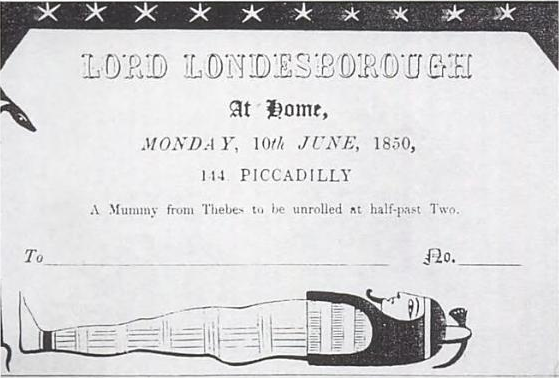
It was with Napoleon’s invasion of Egypt and the discovery of the Rosetta Stone that the discipline of Egyptology was born. The publication of the essay Description de l’Égypte (1809-1829) officially made the study an academic discipline. Soon, historians, archaeologists, and anthropologists alike flocked to Egypt to excavate the tombs and study what was inscribed on the walls of its temples and other landmarks. Many of these excavations yielded crypts of pharaohs richly adorned with gold, jewels, and mummies, many of which were taken back to Europe to be put on display in museums. The people of the Victorian age came in droves to see these mummies, which both delighted and terrified them. There were even mummy unwrapping parties, which guests could attend and watch as the linen wrappings were peeled back to reveal the embalmed body inside. When Poe was fourteen, there was even a mummy on public display in the Senate Chamber of the Capitol in Richmond.

http://1.bp.blogspot.com/-4B7i3PyHDxI/TlZyTm6_pGI/AAAAAAAAAdk/lb7IvkYPLeE/s1600/Screenshot+2011-08-18+12.11.52.png
An Invitation to a Mummy Unwrapping Party

Poe wrote a satirical critique of this fascination with mummies entitled “Some Words With a Mummy” (published in 1845). The story is a commentary on the treatment of the artifacts of Ancient Egypt, particularly the mummies. Once back in Europe, many mummies were damaged or destroyed in the name of science by dissections and examinations, and others were stolen from their tombs by grave robbers to be ground into a powder which was thought to have medicinal properties. Poe’s mummy, Allamistakeo, admonishes his examiners on their treatment of him, showing the author’s view on the Egypt Mania and the disrespect of the tombs that had overtaken the Victorian era.

At the same time as the publication of “Some Words With a Mummy”, the Egyptian Building was being constructed to house the Medical College of Virginia here in Richmond. Designed by architect Thomas W. Stewart, the building is in the Egyptian Revival style and brings to mind the colossal temples that dot the Nile Valley. The choice to make the building very Egyptian in appearance may coincide with the Egypt Mania of the time, or perhaps ally the medical campus with Imhotep, the Egyptian priest who is thought to have been the first physician. The building became a national landmark in 1969, and is a treasured part of the MCV campus today. It has been in continual use since 1845, and houses an auditorium and classrooms.

The MCV Egyptian Building
Categories
The Poe Museum Blog

The Wheelbarrow Man in the Old Stone House

This photograph of the Poe Museum’s Old Stone House dates to around 1881. The bearded man standing by the front door is R. L. Potter, the Wheelbarrow Man. Long before anyone ever thought to have a Poe Museum in the Old Stone House, Potter used the building to display his own collection of 1,600 curiosities, which included rattlesnakes, two wolves, rocks and minerals collected on his travels, and—according to one source—a live bear. Admission was probably about fifteen cents, which is the price he charged when his collection was on display on Marshall Street, according to an advertisement in the November 29, 1881 Daily Dispatch.

Potter was born in Marietta, Ohio but moved to Albany, New York, where he had a wife and three children. When Grant won the Presidency, Potter refused to shave his beard until a Democrat was in office. He earned the name Wheelbarrow Man by pushing a wheelbarrow carrying 100 pounds from Albany to San Francisco in 1878. He walked the 4,100 miles in just 160 days, becoming famous in the process. During the trip, he adopted and tamed two wolf cubs, which followed him for the rest of his life. He also filled his wheelbarrow with rocks, minerals, live specimens, and other “curiosities” he found along the way. Upon Potter’s arrival in San Francisco, the poet Samuel Booth wrote “The Song of the Wheelbarrow Man,” a stanza of which reads, “He started from Albany five months ago,/ And trundled his wheelbarrow steady and slow,/ In storm and in sunshine, through dust, wind, and rain,/ Four thousand odd miles trudged the Wheelbarrow Man.”

When asked why he took the trip, Potter told reporters he wanted to make his name doing something no one else had ever done. That distinction was short-lived. In a publicity stunt to sell papers, newspaper owner George Hearst offered a prize to whoever could win a wheelbarrow race from San Francisco to New York. Potter’s competition was L. P. Federmeyer of Paris, France. Federmeyer won the race, but Potter continued to tour the country, never returning to his home in Albany because, according to a May 19, 1881 interview in the National Republican, “I have three children there. The reason I don’t go home is that if I get there with my children I can’t get away.”

In the same interview, Potter mentions that he has exhibited his collection of curiosities in a number of cities and will take it to Virginia. By July 27, 1881, he was showing his “museum of natural curiosities” in Woodstock, Virginia, according to the Shenandoah Herald of that date. By November 27, 1881, when an advertisement for his museum appeared in the Daily Dispatch, he was in Richmond.

The exact dates of his time in the Old Stone House are unknown. An 1894 guide to the Old Stone House (which was then in service as the Washington’s Headquarters Antiquarium and Relic Museum) states that Potter rented the house for eight months beginning in 1879. Poe Museum trustee Rosemarie Mitchell, who is researching a history of the Old Stone House, theorizes Potter might have rented the house in late 1882 or early 1883. By 1883, he returned to New York to accept the challenge of pushing his wheelbarrow from New York City to New Orleans.

Potter died shortly afterwards. The April 30, 1883 issue of the New York Times reported that he was killed while crossing the railroad bridge over the Yadkin River in North Carolina. His last surviving pet wolf remained at his master’s side and was retrieved by Potter’s widow.

As the Poe Museum celebrates its 90th anniversary this year, it is easy to forget that the Old Stone House was already a Richmond landmark—and even a museum—decades before the Poe Foundation took over the property. Although the bear, wolves, and rattlesnakes are long gone, we still like to think we have an interesting, if slightly less dangerous, collection of Poeana.

Categories
The Poe Museum Blog

Find a Lost Treasure at the Poe Museum

Did you enjoy Treasure Island, The Da Vinci Code, or National Treasure? These and similar tales had their origins in Edgar Allan Poe’s 1843 tale of hidden treasure, invisible messages, cryptograms, riddles, and mysterious clues “The Gold-Bug.” It was Poe’s most popular story during his lifetime and has spawned countless imitations. Find out how it all began with an evening at the Poe Museum’s “Gold-Bug” Unhappy Hour.

On Thursday, July 26 from 6-9 P.M., the Poe Museum will host an Unhappy Hour and Carnival inspired by Poe’s classic treasure-hunt mystery “The Gold-Bug.” Guests can look forward to live music, Poe-themed carnival games, a performance of “The Gold-Bug,” a cash bar, and more. You can join the fun for a suggested donation of only five dollars. This is the perfect opportunity to rediscover “The Gold-Bug,” a forgotten treasure of world literature.

Click here to see photos and video from last summer’s carnival at the Poe Museum. This month’s event promises to be bigger and better.

Below are photos of the original illustrations for the first printing of the story as it appeared in the Philadelphia Dollar Newspaper in June 1843. Poe won a prize of $100 for the tale, and it was so popular it was reprinted in magazines around the world and even adapted into a play during the author’s lifetime.

Categories
The Poe Museum Blog

Students Encounter Poe at Young Writers’ Conference

From June 17 until June 23, the 2012 Edgar Allan Poe Young Writers’ Conference brought students from across the country to the Poe Museum for a week focused on the craft of writing. When not taking seminars from professional writers—including award-winning poet J. Ron Smith, editor Mary Flinn, and novelist David Lawrence—the group, which included only one Virginian, toured area Poe sites around the Commonwealth.

In the above photo, the students are visiting Fort Monroe, at which Poe was stationed from December 1828 until April 1829. It was there that Poe attained the rank of Regimental Sergeant Major.

Here the students are visiting the University of Virginia, where they will see Poe’s dorm room and some of the Poe artifacts housed in the school’s library.

In this photo, the conferees are standing atop the mountain featured in Poe’s short story “A Tale of the Ragged Mountains.”

The conference director was Edgar Award-winning author and Poe Foundation President Dr. Harry Lee Poe, who is pictured here in the Ragged Mountains.

In the foreground is the grave of Elmira Royster Shelton, Poe’s first and last fiancée. It is just one of the important graves to be found in Shockoe HIll Cemetery. Following in Poe’s footsteps, the students also visited Elmira Shelton’s house, Poe’s mother’s grave, the birthplace of Jane Stanard (inspiration for “To Helen”) and more Richmond places familiar to Poe.

The students also visited a number of other Poe sites in Richmond as well as the Library of Virginia, where they saw some rare documents with the Director of Special Collections Tom Camden.

At the end of the week, each student read the works he or she wrote during the conference. Afterwards, they enjoyed refreshments at a reception held in their honor.

We would like to thank all those who made this year’s conference a success.

If you are interested in attending the 2013 conference, please let us know by emailing us at info@poemuseum.org or by calling us at 888-21-EAPOE. Information about next year’s conference will be posted on this website in the fall.

Categories
The Poe Museum Blog

Spring 2012 Newsletter

Here is the latest issue of the Poe Museum’s newsletter Evermore. Inside you will find updates about the Poe Museum’s 90th anniversary, some upcoming members-only events, and a newly discovered Poe manuscript.
Spring2012newsletter

Categories
The Poe Museum Blog

Young Writers Read Their Latest Works at the Poe Museum

Hear tomorrow’s great writers read their latest work. The Poe Museum will host a public reading by the participants in this year’s Edgar Allan Poe Young Writers’ Conference on Friday, June 22 from 7 to 8:30 P.M. This year, the conference accepted nine high school students from seven different states into a week-long intensive writing program for promising young writers. During the conference, the students are challenged to produce a work that can be read at the week-end public reading. Each day of the conference, attendees will have an opportunity to learn more about American writers Edgar Allan Poe by visiting the places he lived and worked or by taking special tours of prominent collections of Poe artifacts.

Directed by Edgar™ Award-winning author and Edgar Allan Poe cousin Dr. Harry Lee Poe, this exclusive conference is now entering its fifth year and has so far attracted students from across the country to spend a week learning the craft of writing from a variety of profession writers and editors. This year’s applicants hail from Arizona, Florida, Massachusetts, Michigan, New York, Wisconsin, and Virginia.

Admission to the reading and reception is free. Join us in supporting tomorrow’s great writers today.

Categories
The Poe Museum Blog

Weird Richmond #4 – Victorian Dentistry

A 19th century sign advertising tooth extraction

Let’s face it: no one likes a trip to the dentist. The mere thought of a root canal is enough to make us cringe and that high-pitched whir of the dentist’s drill is more than enough to send a shiver up our spines. While the modern day dentist’s office may be a far cry from a walk in the park, dentistry in the Victorian era was even more cringe-worthy. While dental practices were experiencing a renaissance from the 18th century, they were still a far cry from modern dentistry. Without electricity or numbing agents like Novocain, going to the dentist was the definition of pain. The mere thought of tooth extraction was so horrifying that Poe utilized it in his lesser-known tale “Berenice.”

A Victorian foot-powered dentist's drill

The Victorian era dentist did not have an office separate from his home –his home was his office. Dentists were also extremely expensive, meaning only the affluent families could afford to pay a visit. The dentist would reuse his instruments instead of replacing them after every visit, and at the most give them a perfunctory wipe-down between appointments (this was an era before sterilization). The most infamous dentist tool, the drill, was powered manually by a foot pedal that the dentist had to pump furiously in order to generate enough power to use it. Because of this, what we know as preventative dentistry today did not exist; the one-stop cure for all dental maladies was tooth extraction.

Towards the latter half of the 19th century, dentists began using ether and chloroform to anesthetize their patients. These gases would render the patient unconscious, but only for a brief period of time. A dentist thus had to work very quickly to extract the tooth (or teeth) before the gas would wear off and the patient would wake up.

Tooth Keys: Corkscrews for tooth extraction

Because of the high number of tooth extractions happening in dentistry, dentures became a way of remedying the lack of teeth in one’s mouth. These dentures were not custom-made and often were one-size fits all, meaning that they were extremely uncomfortable to wear. While George Washington’s dentures are by far the most famous dentures in American history, they were not made of wood. Fake teeth at the time were made from ivory taken from hippopotamus teeth or elephant tusks. Or, if you had a doctor who dealt in the black market, your teeth had a much more sinister place of origin; grave robbers could be paid off to dig up corpses and remove their teeth to be used in dentures.

Categories
The Poe Museum Blog

Weird Richmond #3 – The Church Hill Tunnel Collapse

Three years after the Edgar Allan Poe Museum opened its doors in 1922, tragedy befell the city of Richmond in the Church Hill area when the train tunnel beneath what is now Jefferson Park collapsed, killing four people and burying a train engine beneath the hill. Although the bodies of one worker and the conductor were recovered, the locomotive and the remains of two workers are still trapped under the earth.

Completed in 1875 to connect the C&O Railroad to the Shockoe area, the Church Hill train tunnel had a history of structural problems. Because the soil contained a high clay content, the ground which the tunnel was built through retained a large amount of groundwater after rain, making the tunnel structurally unsound. During its initial construction, ten workers were reportedly killed due to collapses. Because of this instability, the tunnel fell into disuse after the construction of the river viaduct, and would be unused for twenty years.

In 1925, efforts were made to restore the tunnel to a useable condition to increase railroad capacity in the city. It was during these repairs that the western end of the tunnel would collapse on October 2nd, trapping six people, Train Engine #231, and ten flat cars beneath the hill. Two workers managed to crawl out to the eastern end beneath the flat cars; by the time rescue teams managed to dig to the engine, they discovered the bodies of the conductor and one other worker. Due to the tunnel’s instability, however, the bodies of the two remaining workers were never recovered. The Virginia State Corporation Commission ordered the tunnel sealed to prevent others from being trapped in subsequent cave-ins. The train locomotive and the cars are still there today.

Even after the tunnel was sealed, it continued to be a problem for the Church Hill area, collapsing in various other locations and creating sinkholes. In 2006, the Virginia Historical Society drilled a hole through the tunnel seal and used a camera to look inside and see if there was any way to recover the lost train engine. The tunnel was discovered to be full of water and silt, and any attempts to open the tunnel would inevitably result in further sinkholes developing in Church Hill.

The sealed western end of the tunnel lies mere blocks away from the Poe Museum at 18th and Marshall Streets, and can be visited by the public.