To me his [Poe’s] prose is unreadable — like Jane Austen’s. No, there is a difference. I could read his prose on salary, but not Jane’s. Jane is entirely impossible. It seems a great pity that they allowed her to die a natural death.
-Mark Twain1
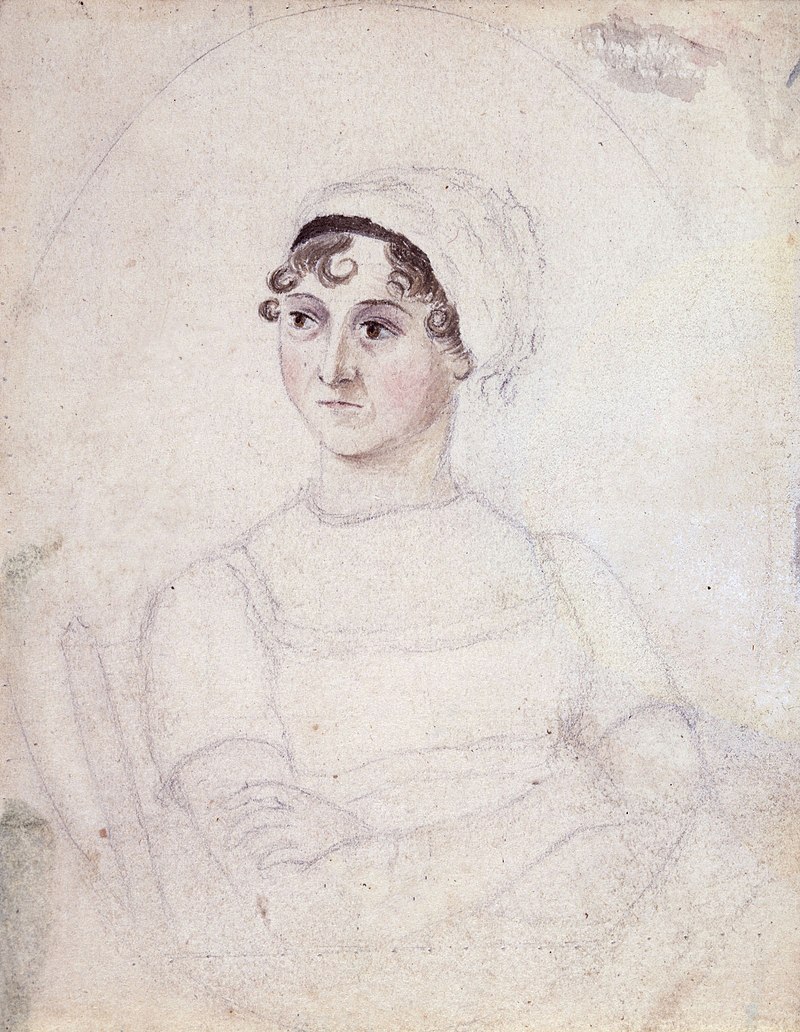
While Twain would certainly disagree, we at the Poe Museum quite appreciate the literary works of both Poe and Austen. They are regarded as two of the most influential authors of the nineteenth century; though at first, they appear to be many worlds apart. Poe grew up in Richmond, Virginia and spent most of his life writing across several cities on the east coast of the young United States. Austen, while spending some time in Bath, England, preferred the countryside of Steventon and Chawton. Throughout her life Austen published six novels, whereas Poe only published one, The Narrative of Arthur Gordon Pym of Nantucket, along with over 100 short stories and poems such as “The Tell-Tale Heart” and “The Raven.” So, what do these two authors have in common across their distinct literary styles that would connect them in the mind of Mark Twain?
Throughout their lives, both authors faced financial difficulties and relied on their writing as a means of support. Both published their early works anonymously, Poe publishing his first collection of poems, Tamerlane, “By a Bostonian.” Likewise, all of Austen’s novels published during her lifetime were published anonymously, only after her death with the publication of Persuasion and Northanger Abbey was her identity revealed. Within their literature, both Poe and Austen explored themes of their own worlds through a distinctly satirical and witty style. Coincidentally, while Poe is credited for the invention of the word “epigrammatism,” a letter written by Austen predates Poe usage.
While Poe and Austen wrote about vastly different subjects, inspired by their different upbringings, they both drew inspiration from similar literary influences: William Shakespeare, Alexander Pope and John Milton. However, one author proved especially influential in shaping the literary works of both writers: Ann Radcliffe. Radcliffe, best known for The Mysteries of Udolpho (1794) was the chief source material in Austen’s gothic parody, Northanger Abbey. The protagonist, Catherine Morland, becomes enthralled with Radcliffe’s novel. However, her fascination with the story leads Catherine to misinterpret her own reality.
I think you must like Udolpho, if you were to read it; it is so very interesting.
Not I, faith! No, if I read any, it shall be Mrs. Radcliffe’s; her novels are amusing enough; they are worth reading; some fun and nature in them.
“Udolpho was written by Mrs. Radcliffe,” said Catherine, with some hesitation, from the fear of mortifying him.
-Chapter 7, Northanger Abbey
While Udolpho is the dominate gothic story referenced in Northanger, Austen is credited with bringing to light many ‘horrid novels’ that had been forgotten such as Castle of Wolfenbach, Clermont, Mysterious Warnings, Necromancer of the Black Forest, Midnight Bell, Orphan of the Rhine, and Horrid Mysteries. Poe too, was inspired by the works of Radcliffe, even mentioning her by name in his gothic story “The Oval Portrait.”
THE chateau into which my valet had ventured to make forcible entrance, rather than permit me, in my desperately wounded condition, to pass a night in the open air, was one of those piles of commingled gloom and grandeur which have so long frowned among the Appennines, not less in fact than in the fancy of Mrs. Radcliffe.
-“The Oval Portrait” (1842)
The literary careers of Poe and Austen were cut short when both died young, ages 40 and 41 respectively. The causes of both of their deaths remain unknown today. Both authors had some of their most well-known works published posthumously, for Poe it was “Annabel Lee” and Austen, Persuasion. After their deaths, both of their lives were mispresented by their first biographers. Poe’s rival, literary executor and eventual biographer, Rufus Griswold, falsely portrayed Poe as a drunk madman in hopes of ruining his reputation. Both of Austen’s early biographers, her brother Henry Thomas Austen with “Biographical Notice” and nephew James Edward Austen-Leigh with “A Memoir of Jane Austen” stripped Austen of her independence and struggles as a writer swapping them for narrative of a quiet, subdued English woman. These early misrepresentations contributed to the creation of both authors’ legacies, eventually rising to pop-culture icons (even if those misrepresentations continue today). Today, Poe’s and Austen’s works have been adapted across stage and screen, influencing modern media and culture of the past 200 years.
1 Mark Twain [Samuel L. Clemens], letter to W. D. Howells, January 18, 1909. Reprinted in Henry Nash Smith and William M. Gibson, eds., Mark Twain-Howells Letters, Cambridge: Belknap Press of Harvard University Press, 1960, II, p. 841.