Written by Victoria Meader
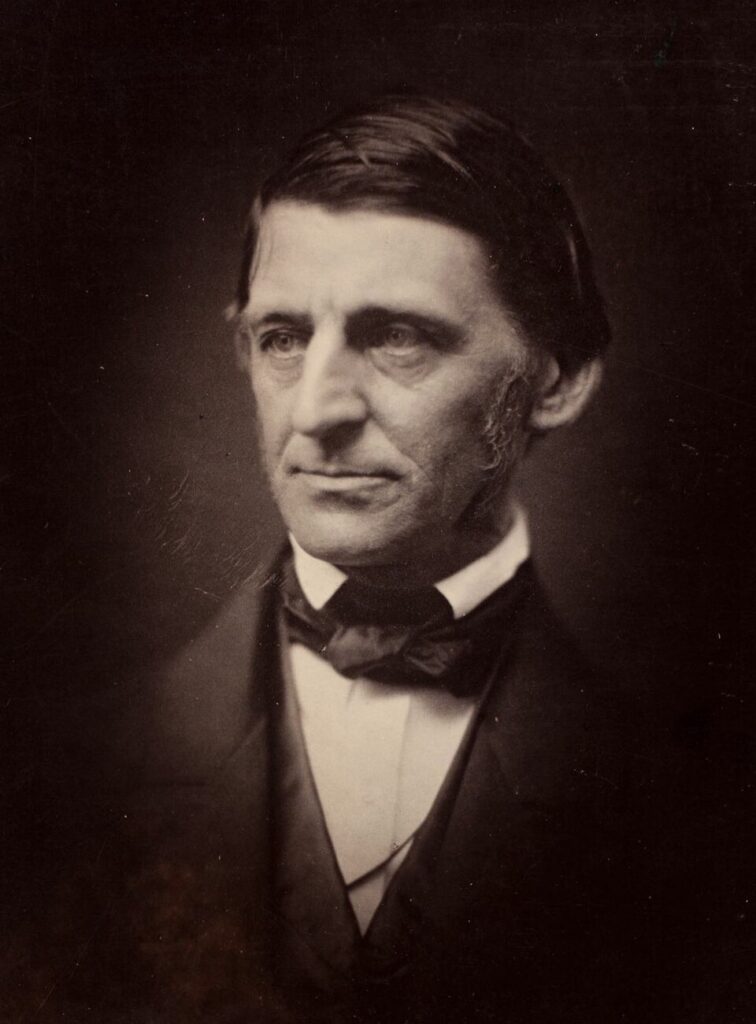
American Transcendentalism was a literary and philosophical movement that emerged from the New England region of the United States in the 1830s. It was established by Ralph Waldo Emerson, a writer from Massachusetts, and inspired by eastern spiritualism, European romanticism, and German idealism, it was a response to the rigid utilitarian and rationalist mentalities of its era. The movement advocated transcendence beyond the rational world of ideas, knowledge, and arbitrary man-made rules, into the natural, experiential world of instinct, goodness, and beauty, which exists independently of human structure and value-judgements.
Philosophically, Transcendentalism emphasized concepts like rugged individualism, freedom, self-reliance, and simple living. Practically speaking, it was a movement that was only accessible to a certain class of person: one with enough social-standing, wealth, and autonomy to be able to retreat to idyllic wilderness retreats, eschew work (and tax-paying), and object to (or opt out of) the legal and social systems in which they and their countrymen were mired. Ultimately, it was sufficiently theoretical and drawn from so many oversimplifications and misreadings of other philosophies that it fell apart quite quickly under scrutiny. Edgar Allan Poe, among many of his contemporaries, did not care for it.
Most of the criticisms at the time revolved around the literary style favored by transcendentalist authors. It leaned romantic and metaphorical to the point of being, in Poe’s opinion, nonsensical and empty. He mocked their tendency toward floweriness and sophism in works like “How to Write a Blackwood Article” (1838), and “Never Bet the Devil Your Head” (1841). In his essay “The Philosophy of Composition” (1846) he warns against excessively relying on implication and suggestion to develop your prose, insisting that it’s eventually empty writing if you refuse to impart any meaning yourself. Essentially, transcendentalist authors preferred a sort of grandiose and elevated but ultimately empty style of prose. They were repetitive and self-referential, suggesting broad and fundamental points without ever actually making them.
Criticisms were also leveraged at the Transcendentalists’ core philosophy. Transcendentalists considered nature to be inherently good, and as human beings are ultimately part of nature, we are also intrinsically good. Communing with nature helps us connect with this kind of existential beauty, and feel more whole and complete with this encompassing Goodness. Anybody who has read Poe will immediately see that he does not hold this same opinion, often writing about the intrinsic darkness of human nature.
Further, “nature never wears a mean appearance” says Emerson in his essay Nature (1836). In this essay, Emerson argues that the natural world only causes grief to man when they superimpose their own desires upon it. Suffering is caused not by nature, but by man.
“The misery of man appears like childish petulance, when we explore the steady and prodigal provision that has been made for his support and delight on this green ball which floats him through the heavens. What angels invented these splendid ornaments, these rich conveniences, this ocean of air above, this ocean of water beneath, this firmament of earth between? this zodiac of lights, this tent of dropping clouds, this striped coat of climates, this fourfold year?”
There is a lot of bootstrap-sentiment intrinsic to Transcendentalist thinking: misery and melancholy are things we experience only when we fail to appreciate the world around us. If we are sad in the face of such a beautiful world, it is because we are not sufficiently endeavoring to be happy.
Poe very clearly drew a line here. It’s no mystery that one of his favorite all-time literary themes was the death of a beautiful woman. Why? Because it’s melancholic! Beauty makes us care, and melancholy lets us explore our sensitivities and experience catharsis. This loss, the cruel destruction of something beautiful, makes us sad. Where is the Good in such a loss? How can it be said that suffering is our own doing and not caused by nature? If man is part of the natural
world, and nature does not cause misery, where does it come from? If we are plagued with disease, struggling with infirmity, starving, or freezing, is it really fair to say that suffering has been inflicted upon us by our own misguided expectations? Can we expect to end our own misery simply by trying harder to recognize that nature has also given us good things? Just because nature can be good and beautiful, does it mean that seeing any bad in it is some kind of human failing?
“Yet it is certain that the power to produce this delight does not reside in nature, but in man, or in a harmony of both.” says Emerson. “It is necessary to use these pleasures with great temperance. For nature is not always tricked in holiday attire, but the same scene which yesterday breathed perfume and glittered as for the frolic of the nymphs is overspread with melancholy to-day. Nature always wears the colors of the spirit. To a man laboring under calamity, the heat of his own fire hath sadness in it.” In other words, delight and melancholy come from us, not nature. We project them onto nature, not vice versa. It is a Transcendentalist sentiment that is difficult to digest when disease is decimating your loved ones.
“The Raven,” by Edgar Allan Poe, was published in 1845. It was Poe’s biggest critical success. Two years later, in 1847, Poe’s wife Virginia would finally die after slowly being eaten away by tuberculosis. The progression of the disease was slow and terrible, and would drag on for five years. During this time, Virginia, who was only 19 when she began coughing up blood, wasted away. It would be inaccurate to say that all her family could do was watch as she suffered, because there would also be periods when she seemed to recover a bit, and hope would bloom, just to be dashed several months later. Anybody who has watched a loved one battle with a deteriorating health condition, especially one where it is uncertain how (or when) things will end, knows the torment it entails. “The Raven” was such a success because it resonated with others so strongly. In a time when tuberculosis was the cause of a full quarter of all deaths, everybody was experiencing this kind of powerlessness and loss.
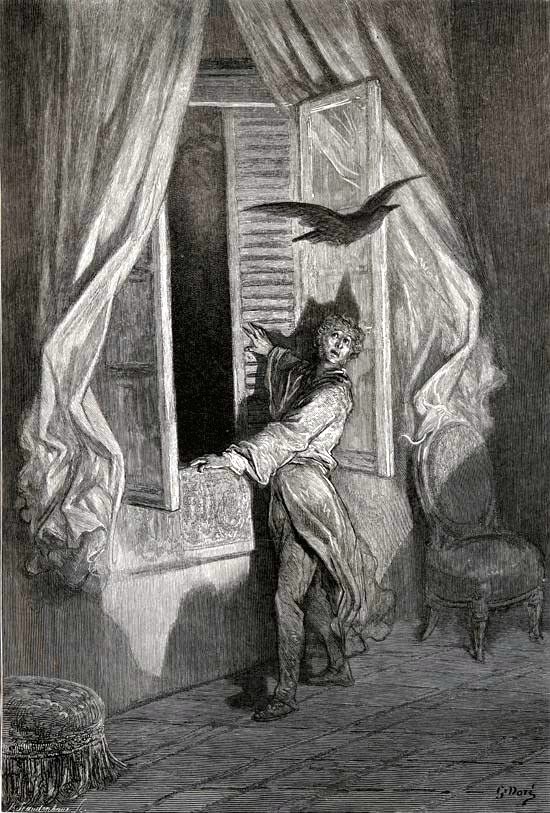
“The Raven” is considered by many to be a distinctly anti-Transcendental work. We can see in “The Raven” that Poe disagrees with the basic Transcendentalist assertion that Nature is itself a comforting or categorically Good thing. In “The Raven,” he explores its indifference and rigidity. In the face of tremendous human suffering, Nature offers no comfort. It is merely an immovable truth. As the poem begins, the narrator is attempting to distract himself from his deep sorrow at the loss of his love.
Eagerly I wished the morrow;—vainly I had sought to borrow
From my books surcease of sorrow—sorrow for the lost Lenore—
For the rare and radiant maiden whom the angels name Lenore—
Nameless here for evermore.
He investigates a sound: the entrance of the titular Raven, a symbolic representation of nature. He calls out to it, but it gives nothing back.
Deep into that darkness peering, long I stood there wondering, fearing,
Doubting, dreaming dreams no mortal ever dared to dream before;
But the silence was unbroken, and the stillness gave no token,
And the only word there spoken was the whispered word, “Lenore?”
This I whispered, and an echo murmured back the word, “Lenore!”—
Merely this and nothing more.
Eventually, the raven enters his chamber and perches on a statue of Pallas, the goddess of wisdom and a representation of the rational self. The raven, it becomes clear, will only speak the word nevermore: it gives this as its own name, it gives it in response to the narrator muttering to himself (saying that it too, like others who have abandoned him, will leave him shortly). Despite seeming to understand that this is the only answer the raven will ever give, we see the narrator struggle. He knows he should not ascribe meaning to the answer, it’s not even clear that the raven understands what he’s saying at all, but he can’t really help himself. He asks questions, entreating the spectre to answer, though he knows already what its answer will be. He still hopes it might be different, and is disappointed when it is not. He is begging Nature for comfort, for some sign that he will be able to forget this terrible sadness he is experiencing, some indication that this cruel spectre will leave him, but he is always answered, immovably, in the same way.
“Be that word our sign of parting, bird or fiend!” I shrieked, upstarting
— “Get thee back into the tempest and the Night’s Plutonian shore!
Leave no black plume as a token of that lie thy soul hath spoken!
Leave my loneliness unbroken!—quit the bust above my door!
Take thy beak from out my heart, and take thy form from off my door!”
Quoth the Raven “Nevermore.”
And the Raven, never flitting, still is sitting, still is sitting
On the pallid bust of Pallas just above my chamber door;
Nature does not leave, it feels no remorse, it offers no empathy. It cannot take pity, it doesn’t change its mind. We know it is rigid, but we still beg for exceptions. We reason with it, we try to understand its purpose, but there is none. This isn’t even a conversation. The Raven illustrates the cold neutrality of nature and shows how humanity suffers within such a context. Maybe there is beauty in it, maybe it is not morally bad, but it also isn’t some transcendent Goodness. We can’t simply end our misery by embracing Nature, we can’t comfort ourselves merely by understanding it. It is cruel to expect ourselves to contextualize our sadness as a failure, or to see our healing as something to be achieved by a correctly appreciative mindset. Sometimes, the circumstances of our lives are harsh and unfair. Sometimes, we will suffer and it isn’t our fault.
Poe and Emerson lived in a time where the leading causes of death were disease, infection, and poor sanitation. Infant mortality rates were high, famine was widespread, and most people lived in extreme poverty. Reality for the everyday person in the 1840s U.S. was fraught with injustice and hardship. It is no wonder that the Transcendentalist movement, a movement comprised of white property-owning men, was brief. It relied on a short-sighted kind of idealism born from reductive misinterpretations of other philosophies, and failed to take into account the diverse experiences of anybody other than the men who established the movement. In “The Raven,” Poe captures the broader sentiment of his time, extending empathy to his contemporaries while dismissing the lofty and disconnected ideals touted by the Transcendentalists.
Further Reading:
Casale, Ottavio Mark. “Edgar Allan Poe and Transcendentalism: Conflict and Affinity.” PhD diss., University of Michigan, 1965.
Silcox, Heidi. “Transcendentalism.” In Edgar Allan Poe in Context, edited by Kevin J. Hayes, 259–69. Cambridge: Cambridge University Press, 2013.
One reply on “Poe’s Rejection of Transcendentalism in “The Raven””
https://addlinks.pro/hX9gf