
Written by Victoria Meader
“To me his prose is unreadable—like Jane Austen’s. No, there is a difference. I could read his prose on salary, but not Jane’s. Jane is entirely impossible.”
—Mark Twain about Edgar Allan Poe, in a letter written to friend and author W.D. Howells in January 1909.
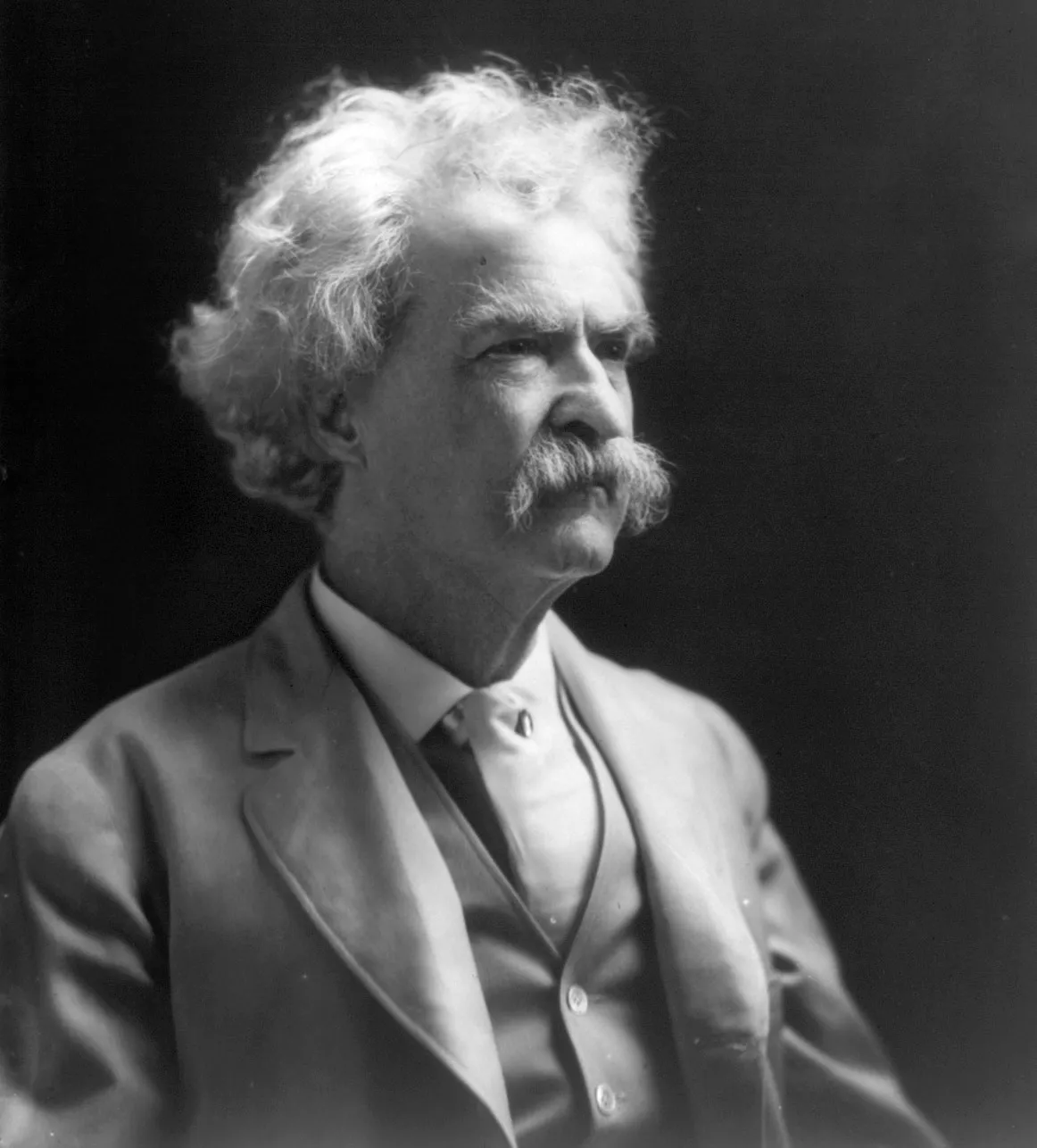
It’s relatively well-known that Mark Twain had a pretty low opinion of Edgar Allan Poe (and an even lower opinion of Jane Austen), but why? Let’s examine some key differences between these authors.
Twain was 13 when Poe died, and Poe was 13 when Austen died. Poe and Twain were both American authors, while Austen was British. Poe and Twain both took literature very seriously, and endeavored throughout their lifetimes to help cultivate the body of American literature. Both of them wanted to see the establishment of a distinctly American literary identity on the world stage, worthy of respect and discourse.
However, while Twain wrote during the American Civil War and Reconstruction periods of U.S. history, Poe wrote in a much more nebulous period of American history: a vague, expansionist period after the colonial and revolutionary periods but before the Civil War. There was no clearly-established American identity at this point. Instead, the culture was broadly informed by European trends and attitudes. As such, European interests, especially those of Britain, were the overwhelming context by which American art and culture was judged. Even today, many visitors to the Poe Museum in Richmond, Virginia, are surprised to learn that Poe was American at all. His contemporaries, like Longfellow, Irving, and Emerson, are also not always clearly connected to their American roots.
What does it mean, then, to establish a distinctly American literary canon, to each of these men? How would that have been understood? Well, differently, it turns out.
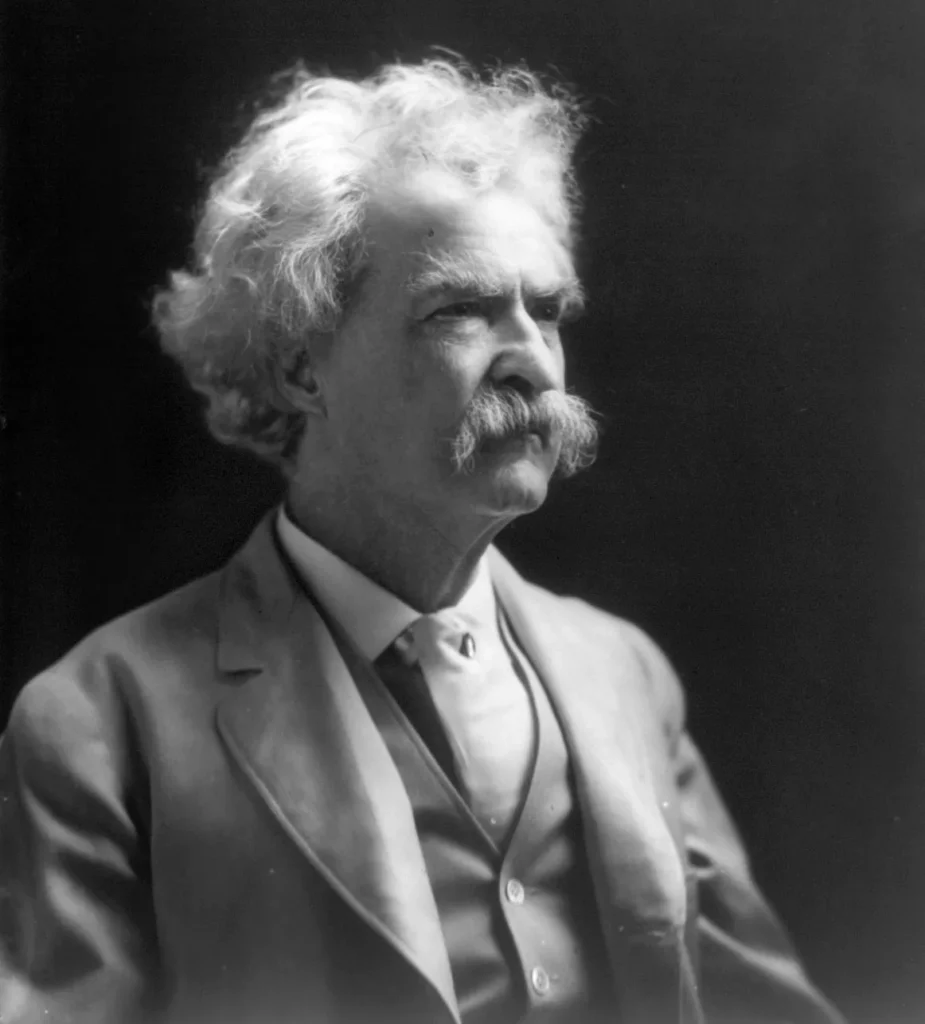

Twain was an author associated with the Realism movement, whose values centered on the faithful and accurate depiction of the everyday lives of ordinary people. To Twain, good American literature was predicated on realistically portraying the lives of average Americans. To this end, Twain is famously associated with a colloquial rhetorical style, in which he uses simple language, dialectical speech, and straightforward grammar to help his (potentially well-educated, potentially wealthy, potentially foreign) readers empathize with his characters, and be immersed in their worlds.
“Well, three or four months run along, and it was well into the winter now. I had been to school most all the time and could spell and read and write just a little, and could say the multiplication table up to six times seven is thirty-five, and I don’t reckon I could ever get any further than that if I was to live forever. I don’t take no stock in mathematics, anyway.”
—The Adventures of Huckleberry Finn (1884).
This is an example of a rhetorical device called parataxis: it’s been three or four months, it’s well into winter, I’d been going to school, I can read and write. None of this information is indicated to be any more or less important than the other information surrounding it, it feels more like a series of off-the-cuff observations. Twain pairs this with polysyndeton (an abundance of conjunctions) to connect clauses. This kind of paratactic writing is accessible, and helps put you in the mind of a person without formal education, supporting a sense of empathy with the main character, who may be quite unlike the average reader. This is Twain’s strength: representing the American experience through realism and humanity.
Poe’s approach was different. First of all, to Poe, since there was no clearly distinct American identity yet, he sought validation through competition. If American literature has no clear way to feel separate, it can set itself apart with its quality. Therefore, Poe pushed boundaries and explored various genres, like the relatively new Science Fiction, and the so-new-that-he-had-to-invent-it-himself Detective Fiction. He also endeavored to work within the bounds of what was already popular: like Gothic Fiction and Horror. This is partially what earned him the derision of Realist authors like Howells, he wrote very atmospherically and included a lot of very dark and horrible imagery. He also, in contrast to Twain’s parataxis, used a lot of hypotaxis, a rhetorical device wherein clauses and subclauses and subordinate clauses fit into each other like nesting dolls. It is not a written style that reflects the way people really speak or think, but it does communicate information effectively, and it helps us parse what information is more important than others.
“It was upon a gloomy and tempestuous night of an early autumn, about the close of my fifth year at the school, and immediately after the altercation just mentioned, that, finding every one wrapped in sleep, I arose from bed, and, lamp in hand, stole through a wilderness of narrow passages from my own bedroom to that of my rival.”
—”William Wilson” (1839).
In this passage from Poe’s “William Wilson” (1839), we understand that it was a stormy autumn night on which the narrator rose from his bed and snuck to the bedroom of his rival. That’s the important bit. We also know what year of school this happened in, where it occurred relative to an altercation, that everybody else was asleep, and that the dormitory was maze-like. We don’t focus so much on the possible reality of this information as much as the atmosphere, which was the more important component in Gothic literature.
This style is much more technically impressive. It generally does not reflect realism or give an accurate impression of even the fanciest of interactions, since people can’t really speak like this (you have to know how your sentence ends before you start it). It can be a bit lofty and exclusionary because of its complexity. However, this hypotactic style was very popular earlier in the century, back when the only people who typically read novels were the upper-class, well-educated, leisure-having elites. Such people as them enjoyed a skillfully arranged sentence, and authors could earn respect with their ability to craft such cleverly structured passages. One author who particularly nailed this technique was Jane Austen.
Austen was not worried about aiding in the establishment of a literary identity, as hers was an already ancient foundation. Novels, in her time, despite being mainly accessible to the elites of society, were also considered low-brow. Reading novels was not seen as a constructive use of time, and was generally condemned as being a sort of idle amusement favored by bored ladies. With this as her medium, Austen was much more interested in exploring the intricate and complex world of social expectation and restraints, especially as they applied to women like her, who were forced to navigate such a lavish yet confining world. She used hypotaxis to humorous effect, artfully relying on tact and subtlety to land indirect blows.
“About thirty years ago Miss Maria Ward, of Huntingdon, with only seven thousand pounds, had the good luck to captivate Sir Thomas Bertram, of Mansfield Park, in the county of Northampton, and to be thereby raised to the rank of a baronet’s lady, with all the comforts and consequences of an handsome house and large income.”
—Mansfield Park (1814)
The opening line of Austen’s 1814 book Mansfield Park good-naturedly lets us know that a woman’s position in society was elevated through marriage. We understand from just this one sentence that she started out with relatively little, and ended up in a better position with a nice home and high rank. We see that this is generally a good thing, but are reminded by the use of the word “consequences” that there are hardships involved in this change too, and the overall tone of the sentence reminds us of the powerlessness of women in situations like this, as Miss Ward is a subject to whom these changes are happening rather than an agent bringing about any changes herself. By presenting the information using hypotaxis, though we have to pay more attention to catch all the subtle implications, more information is communicated to us, and it’s done in a fun way that lets us all feel very clever.
It’s easy to see how writing styles changed across the century, and to understand why Twain, a realist who used empathy and accessibility to highlight the down-to-earth American experience, might have felt annoyed with Austen’s writing style. She wrote to an upper-class audience about social constraints they mostly all shared. She wrote in hilarious, complex circles, while Twain wrote in a series of short, straight lines. Their audiences, values, and goals were different. Poe, caught somewhere in the middle, did the best he could in the context of his circumstances. As such, despite feeling that his prose was “unreadable,” Twain did respect Poe.
Twain ends the same letter to Howell by saying, “you grant that God and circumstances sinned against Poe, but you also grant that he sinned against himself—a thing which he couldn’t do and didn’t do.” It seems from this letter that Twain was much more protective of Poe’s legacy than he was of Austen’s, with whom he shared very little in common. He pushed back against his friend for being too dismissive of Poe. Twain, while not being a fan of Poe’s actual work, believed that he was a product of his time and seems to have respected that they both shared and worked hard for the same vision.