
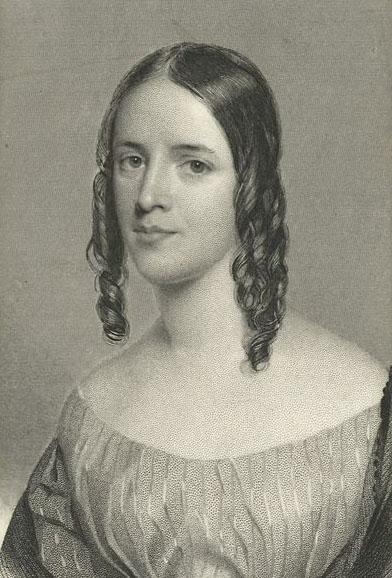
Written by Kelly Keener
In the fall of 2016, I acquired Elizabeth Fries Ellet’s autograph album. Ellet, a contemporary of Poe’s, was known to the public during her time for her prolific writing, and is best known today for her work The Women of the American Revolution (1849), as well as for being involved in Poe’s life in notorious ways. Her involvement in the Frances Sargent Osgood and Poe affair of 1845-46 usually places her in a negative light, leaving her to seem like a vindictive, gossiping busy-body. It makes one wonder, however, if she truly deserves to be remembered as the woman who allegedly caused Virginia Poe’s death, or if she deserved the treatment Poe paid her in his short story, “Hop-Frog”, where she most likely represents the king character. After all, how could one feel sympathy for Ellet when, according to Poe in a letter written by him to Sarah Helen Whitman dated November 24, 1848, “My poor Virginia was continually tortured…and on her death-bed declared that Mrs. E. had been her murderer” (The Edgar Allan Poe Society of Baltimore). Although it is tempting to only recognize her in the context of Poe, and in negative contexts at that, I believe she deserves to live beyond these small moments for which she is widely remembered. I hope that by sharing some of the letters from her album, I may be able to continue her story beyond the Poe episodes and present her in a sympathetic way.
In this blog post series, I will share and explore a few letters from her album. I will transcribe and provide a scan of the letter, and then discuss the relationship between Ellet and her correspondent, as well as provide historical background context when necessary.
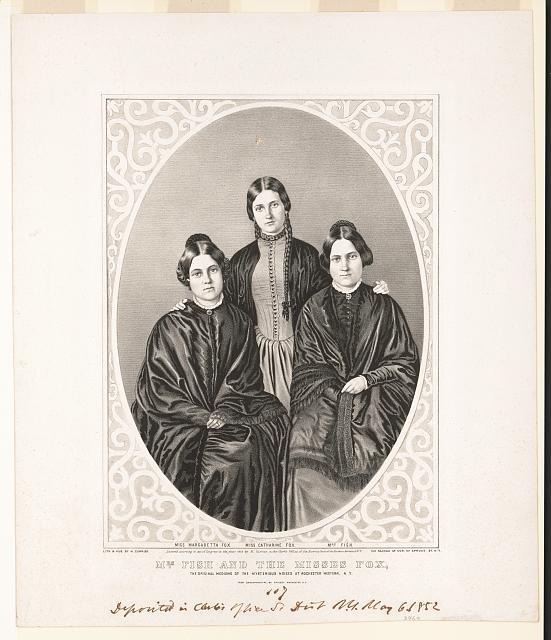
The first letter in this series comes from Margaret F. Kane, who is best known as having been one of the Fox Sisters. These sisters, comprising of Kate, Leah, and Margaret (Maggie) Fox, claimed to have psychic abilities and “proved” their abilities by performing seances. They were ultimately debunked when Margaret, with a heavy conscience, went before the public and announced how she and her sister pulled off the stunts—by producing noises with their knuckles and joints, especially using their toes. She later recanted her statement, but the truth was already out, and she never recovered from the publicity she had brought upon herself. Amidst these circumstances, she especially faced hardship concerning her courtship with a man named Elisha K. Kane, whom she romantically pursued despite his family’s wishes until his death.
I first want to share the letter that Margaret wrote. It is written to Frederick Carroll Brewster (1825–1898), a Philadelphia lawyer, judge, and the state Attorney General of Philadelphia. The letter, dated December 27, 1861, reads as follows:
Mr. F. Carroll Brewster
My dear Sir
I called on the
Rev Father Quinn yesterday
+ his his last words to me
were, “Margaret the marriage
is valid, perfectly valid,
in the Catholic church or out
of it”— how different was
Mr Robert P. Kane’s language,
when he talked of me, to
my friends, Father Quinn,
+ Mrs Watter[?].
With great respect
Very truly yours
Margaret F. Kane
————————————
{ Will Mr. Brewster have
{ the kindness to give this[?]
{ enclosed note to Mrs Ellet
{ I received her letter after
{ I had written yours.
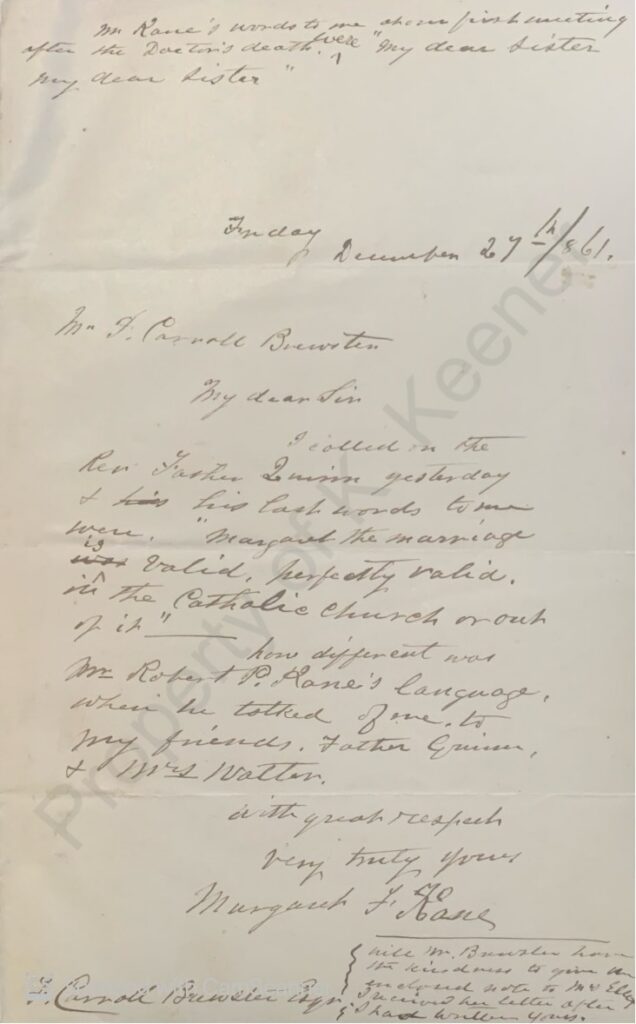
The letter’s contents are of great interest in numerous ways. The first detail I want to point out is the bulk of the letter itself. Out of context, one would be unsure of what she’s talking about. However, it is with thanks to a wonderful and thorough article written about Fox and Kane’s relationship that we are able to shed light on Margaret’s message.
According to Kathy Warnes in her article, “Margaret Fox Kane and Her Victorian Love Story,” Kane, an Arctic explorer and medical officer, and Fox’s paths crossed in 1852 at a rapping demonstration performed in Philadelphia by Fox and her mother. Elisha “immediately fell in love with Margaret, but according to his letters, not so deeply in love that he thought she was perfect” (Warnes). He sought to refine her, to get her to leave her spirit rapping business, “believing that the three Fox sisters, Leah, Margaret and Kate were committing fraud with their rappings and séances” (Warnes). According to some sources, the two formally married at some point within the four years following their first meeting, while other sources believe Elisha couldn’t bring himself to formally marry her, as this would require him to “defy the objections of his wealthy and prominent Philadelphia family” (Warnes). In her book The Love Life of Dr. Kane, Margaret recalled that Dr. Kane had announced their legal marriage in her third-story apartment, but that their marriage would be kept secret until his return from a book trip in England, when he would then publicly marry her (Warnes). Unfortunately, they never formally married as he died February 16, 1857, in Havana, thus before he could return to the United States.
Now that the background context has been provided, we can understand the letter more clearly. In it, Margaret is insisting the legality of her “marriage” to Kane, citing “Rev. Father Quinn” as the granter or supporter of their union. She is appealing her cause to Brewster, who, at the time, was not yet a judge but most likely a lawyer. Was she friends with Brewster, a client, or imploring her case, hoping by chance that he would further it on her behalf? It is difficult to tell.
Now that the main letter content has been explained, I want to point out the reference to Ellet in the message found in the right-hand corner of the document. Following Elisha’s death, according to Warnes, “In the summer of 1858, Margaret gave her letters to publisher Elizabeth Fries Ellet and Joseph La Fume of the Brooklyn Eagle and they helped her write a narrative to connect the letters.” Warnes continues to explain that Margaret had withdrawn from the project and used the letters as a financial and manipulative bartering tool against Elisha Kane’s family, as she had not been included in his will. After years of back-and-forth bartering in court, Margaret eventually ran dry of funds and was unable to continue pursuing the family, despite having initially won some restitution, and thus the letters were finally published, perhaps out of spite and/or desperation, in The Love Life of Dr. Kane in 1866.
Although it cannot be proven that Ellet was directly involved with the final published version, given the gap in time between its conception in 1858 and publication in 1866, and as it was published without attribution to an author or editor, it may be assumed. According to David Alexander Chapin, author of “Exploring other worlds: Margaret Fox, Elisha Kane, and the antebellum culture of curiosity,” “correspondence in the Elisha Kent Kane papers and Robert Patterson Kane papers clearly indicate that Ellet prepared it [Fox’s book] and was the driving force behind its publication” (159).
One other interesting thing to note is that Ellet may have been more closely connected to Fox, and in a way that was beyond Fox’s book, as Ellet was listed as a witness of Margaret’s baptism into the Roman Catholic Church, which occurred in 1858, the same year that the book idea was conceived. The Daily National Democrat, dated September 19, 1858, states, “Miss Margaret Fox, of Rochester-knocking notoriety, was, on Sunday, August 15th, admitted, by the rite of baptism, into the Roman Catholic Church at Saint Peter’s in Barclay street, New York. Horace Greeley and Mrs. Ellet were present as witnesses to the ceremony.”
All of that said, we now have an idea of why Ellet was mentioned in the right-hand corner of Kane’s letter. Margaret wanted to prove the legitimacy of her marriage, and Ellet, who she knew from at least the summer of 1858, was eager to help produce her book. It isn’t surprising that Ellet would step up to the challenge, whether to help a friend, acquaintance, or be involved in some kind of literary pursuit. Not to mention this wasn’t the first time Ellet had stepped up to advocate for a woman she felt had been strongly wronged.*
I leave readers with this last question before closing the first part of this two-parter article: Does this show a sympathetic, philanthropic, and/or friendly side to Ellet, in that she was willing to go to bat for her friend by using her literary talent to produce the book? Let us know!
Stay tuned: In the next part of this two-parter article, I will explore more about the Fox Sisters, spiritualism in the 1840s, and Edgar Allan Poe’s connection to spiritualism.
* For example, see Statement of the Relations of Rufus W. Griswold with Charlotte Meyers (Called Charlotte Griswold), Elizabeth F. Ellet, Ann S. Stephens, Samuel J. Waring, Hamilton R. Searles, and Charles D. Lewis… (1856), which recounts a court case mainly involving Rufus Griswold, his second wife Charlotte Meyers Griswold, and Ellet and Stephens’ support of Charlotte and defamation of Rufus.In this case, according to Joy Bayless in Rufus Wilmot Griswold, “The only person who gained anything by this trial was probably Mrs. Ellet, who had the satisfaction of a belated revenge [against Griswold]…Charlotte certainly gained nothing from the trial. Harriet [Griswold’s third wife], humiliated by the notoriety which the proceedings brought upon her, accepted an invitation of her brother to live in Bangor, leaving Griswold to drag out his one remaining year of life alone (251). It may be argued that Ellet, along with Ann S. Stephens, had precipitated the court case by “working as a self-appointed committee to disturb [Griswold’s] newly acquired domestic peace. Both of them wrote letters to his former wife, Charlotte, telling her that she had been wronged [concerning the legitimacy of her divorce from Rufus] and urging her to have redress” (226).